
Affiliate Disclosure
Some links on this page are affiliate links. As an Amazon Associate, we earn from qualifying purchases — at no extra cost to you. We do not buy, test, or physically handle the products we cover; our rankings come from aggregated owner reviews, ratings and expert consensus. Commissions never change our verdicts. How we rank & full disclosure.
Some links below are affiliate links. As an Amazon Associate we earn a commission from qualifying purchases at no extra cost to you — it never changes which products we recommend or how we rank them.
Indoor allergy symptoms are usually an indoor climate problem: pollen, dust and pet dander stay suspended in the air you breathe all day. A True-HEPA air purifier is the single most effective appliance for pulling those allergens out of a room — but only one sized correctly for your space actually helps. If your worst symptoms are confined to one bedroom, a compact HEPA unit is plenty; if they follow you across an open-plan home, you need a high-coverage model. Skip ozone "ionizers" and filterless gadgets — for allergies, sealed HEPA plus activated carbon is what the evidence supports. Below we've picked units across a range of room sizes and budgets, from a compact bedroom unit to a large open-plan purifier, so you can match coverage to where your allergy symptoms actually flare up rather than buying on brand name alone.
What actually matters in an air purifier for allergies?
True HEPA filtration and enough clean-air delivery for your room size — in that order. HEPA captures the pollen, dust-mite debris and pet dander that trigger most indoor allergies, and a unit rated below your room simply cycles the air too slowly to keep up.
Look for the words "True HEPA" or "H13" rather than "HEPA-type," which is a weaker marketing label. Match the purifier's rated coverage to your actual room — most brands quote the largest space they can clean once per hour, so sizing up gives you faster turnover and lets you run a lower, quieter speed. An activated-carbon layer is worth having if odors or smoke ride along with your allergies, but it does nothing for the particles themselves.
How big an air purifier do I need for allergies?
Match the unit's rated coverage — its square footage rating — to your room, then size up. A purifier rated for 1,000 square feet placed in a 300 sq ft bedroom cleans the air several times an hour on a low, quiet setting — which is what real relief actually takes.
The number that matters for allergies is air changes per hour: aim for roughly four to five, meaning the purifier filters the room's entire volume four or five times every hour. That is why sizing up matters more than any single feature. A unit run flat-out to keep up in a too-large room is loud, wears its filter faster and still lags; the same air cleaned by an over-sized unit on medium is quieter and more consistent.
What is CADR and why does it matter for allergy relief?
CADR — Clean Air Delivery Rate — measures how many cubic feet of air a purifier actually cleans per minute, tested separately for pollen, dust, and smoke. A higher CADR number for pollen and dust is the most reliable single spec for allergy performance, more useful than square footage alone.
Two purifiers rated for the same room size can still perform very differently if their CADR numbers differ, because CADR reflects real measured airflow through the filter rather than a marketing estimate. AHAM, the industry association, certifies CADR testing, so a listing that quotes an AHAM-verified CADR number is more trustworthy than one that only advertises square footage. For allergies specifically, look at the pollen and dust CADR figures — a unit can have a high smoke CADR and a mediocre dust CADR, which matters if pollen and dust mites are your main trigger rather than smoke or odor. As a rule of thumb, a purifier's dust CADR should be at least two-thirds of your room's square footage for it to clear the air at a reasonably fast pace, and higher still if you want to run it on a quiet, low setting rather than flat out.
Do air purifiers actually help with allergies and asthma, or is it hype?
For airborne allergens, yes — within limits. A true HEPA purifier measurably lowers suspended pollen, dust mites, PM2.5 particles, and dander in a closed room, and that reduction is also why doctors often recommend one for asthma triggers. What it cannot do is pull allergens already settled into carpet, bedding and upholstery.
The purifier does its job while allergens are still airborne, so it works best running continuously with doors and windows kept closed, ideally on auto mode so it ramps up automatically when its sensor detects a spike in PM2.5 or pollen. Pair it with the basics — washing bedding in hot water, vacuuming with a sealed HEPA vacuum to control dust mites — and the combination does far more than either alone. A washable pre-filter also matters here: catching pet hair and large debris before it reaches the HEPA stage extends the life of the expensive filter and keeps CADR performance from dropping off between changes.
What do owners complain about most?
Filter replacement cost and noise at high speed are the two recurring complaints across nearly every brand. The practical fix for both is the same: buy a purifier rated well above your room size so it clears the air on a lower, quieter, longer-lasting setting.
Filter replacement schedules vary by brand and usage, but budgeting for a new HEPA filter every six to eight months is realistic for a unit run continuously through allergy season. A washable pre-filter stretches that interval by intercepting the bulk of visible debris before it ever reaches the HEPA media, which is why several picks above lean on that feature specifically for pet owners and heavy pollen seasons.
Should you avoid ionizer or ozone-generating purifiers for allergies?
Yes, for allergy relief specifically. The EPA has flagged ozone as a lung irritant that can worsen respiratory symptoms rather than help them, so a purifier that relies on ionization or deliberately generates ozone works against the goal of calming allergy and asthma symptoms.
Every unit on this list uses sealed mechanical HEPA filtration instead — physically trapping particles rather than charging them or reacting them with ozone. That is the approach supported by the evidence for allergy sufferers, and it's the same reason true HEPA units carry no ozone warning on the box. If a purifier's marketing leans heavily on "ionic" or "plasma" technology without a true HEPA filter behind it, treat that as a sign to look elsewhere, especially for a bedroom where you'll be breathing its output for eight hours a night.

Best for Bedrooms and small living rooms where allergy relief matters most
- H13 True HEPA captures pollen, dust and dander down to 0.3 microns
- Activated-carbon layer helps with everyday allergens and odors
- Quiet sleep mode suited to overnight bedroom use
- Compact footprint for nightstands and desks
Why buy it: A long-standing allergy-season staple. Owners consistently report noticeably fewer sneezing fits and less visible dust within the first week, and the compact size makes it easy to keep running right beside the bed where symptoms hit hardest.

Best for Dorms, offices and smaller bedrooms on a tight budget
- True HEPA and activated carbon in a small, low-cost body
- Sized for personal spaces up to a mid-size bedroom
- Low running noise on the quietest setting
- Inexpensive, widely available replacement filters
Why buy it: The go-to entry point for allergy sufferers who want genuine HEPA filtration without a big outlay. Owners consistently report it clears a single room well; the main trade-off is coverage, so it suits one room rather than an open floor.

Best for Larger living rooms and smart-home users who want automation
- Rated for large rooms up to roughly 1,875 sq ft
- App and voice control with an auto mode driven by an air-quality sensor
- Washable pre-filter catches hair and large particles first
- Higher clean-air delivery for faster whole-room turnover
Why buy it: The step up for people who want set-and-forget allergy control. Reviewers frequently mention the auto mode ramping up on high-pollen days without being touched, though a common complaint is that the initial app setup can be fiddly.

Best for Open-plan homes that need one unit to cover a lot of ground
- Rated for very large areas up to about 2,200 sq ft
- Real-time PM2.5 readout and air-quality sensor
- Washable filter component to lower ongoing costs
- Higher fan speeds for rapid air changes in big rooms
Why buy it: A high-coverage option when the allergy trouble spot is a large, connected space rather than one bedroom. Owners consistently report the PM2.5 readout is what convinces them it is actually working; the trade-off is more noise at the top speeds.
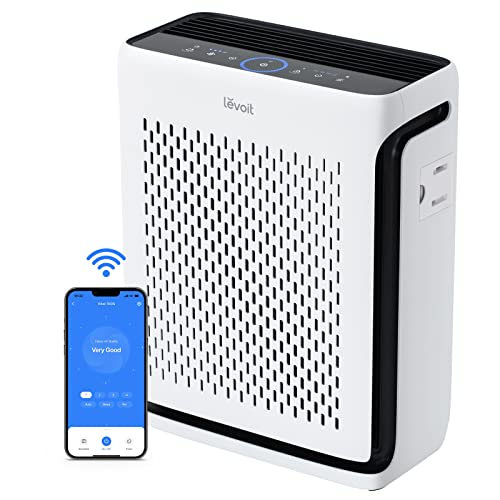
Best for Allergy sufferers who also live with shedding pets
- Washable pre-filter traps pet hair before it reaches the HEPA
- True HEPA and carbon stack for dander and odor together
- Sized for bedrooms and mid-size living rooms
- Reusable pre-filter lowers filter-replacement frequency
Why buy it: A practical pick when pet dander is part of the allergy picture. The washable pre-filter is the feature owners single out most, since catching hair up front keeps the main filter working longer between replacements.

Best for Medium-to-large rooms that need steady background filtration
- High-efficiency filtration rated for rooms up to about 1,076 sq ft
- Multi-stage filter targeting pollen, dust and smoke
- Quiet enough to run all day in the background
- Simple controls with no app to configure
Why buy it: A straightforward, no-app option for larger single rooms. Owners consistently report it runs quietly enough to leave on all day, which is exactly what sustained pollen-season relief needs.
How we picked
We do not buy, unbox or run these units ourselves. Energy Efficient HVAC System ranks air purifiers by reading aggregated owner reviews, manufacturer filtration specifications and the recurring complaint patterns that only surface across hundreds of buyers. Across the allergy category the consensus favors sealed true HEPA units correctly sized to the room, with an activated-carbon stage where odor is also a concern. LEVOIT dominates this particular list, but Coway, Winix, and Honeywell are the other names that come up constantly in allergy-focused comparisons and are worth cross-checking if none of these fit your room. See how we rank for the full method.
New to this? Start with our air purifiers for allergies hub for the buying guide and cost breakdown, step back to the air purification pillar to see how filtration fits your whole home, or read how to improve indoor air quality for the habits that make any purifier work better.