


Affiliate Disclosure
Some links on this page are affiliate links. As an Amazon Associate, we earn from qualifying purchases — at no extra cost to you. We do not buy, test, or physically handle the products we cover; our rankings come from aggregated owner reviews, ratings and expert consensus. Commissions never change our verdicts. How we rank & full disclosure.
Evaporative coolers, still widely called swamp coolers, are the most climate-dependent appliance in this entire pillar. They work by pulling warm dry air through a water-soaked pad; the water evaporates, the energy required for that evaporation comes out of the air as heat, and the air leaving the unit is genuinely cooler. In dry desert air that process is remarkably effective for a fraction of an air conditioner's electricity. In humid air it does almost nothing useful — and this single fact explains most of the disappointed owner reviews in the category.
Will an evaporative cooler actually work where you live?
It depends almost entirely on humidity. Below roughly 40 percent relative humidity these units cool effectively, and in genuinely arid conditions under 20 percent the temperature drop is dramatic. Above about 60 percent humidity, the cooling effect is small enough that most owners describe it as a fan that makes the room damp.
The physics is straightforward: the amount of cooling available is set by the difference between the air's current temperature and its wet-bulb temperature — effectively, how much more water the air can still absorb. Dry air has a large gap and therefore a large potential temperature drop. Humid air is already close to saturated, so there is very little evaporation left to drive, and what little happens raises the moisture level in a room that is already uncomfortable.
The practical geography is that the arid interior West and Southwest of the United States are the natural home of this category, and coastal and southeastern regions are not. It is also seasonal and even hourly: a dry-climate afternoon is ideal, while the same location during a monsoon period may not be. If your region is humid, the honest recommendation is to look at portable air conditioners instead, which remove moisture rather than adding it.
How much CFM do you need for the space you're cooling?
Evaporative coolers are rated in airflow, not BTU, because they work by continuously replacing air rather than recirculating it. A common approach is to take the room's volume in cubic feet and divide by two, giving roughly 30 air changes per hour.
Applying that to a real space: a 400 square foot room with eight-foot ceilings holds 3,200 cubic feet, which points to something in the region of 1,600 CFM. Small personal and single-room units typically fall between a few hundred and 1,500 CFM; large residential and garage units run from around 2,000 CFM into the 5,000 CFM range and above. Manufacturer square-footage claims tend to assume open, well-ventilated space and outdoor-adjacent use, so treating them as optimistic is reasonable.
The other half of sizing is water capacity. Tank sizes on portable units commonly run from a few gallons to well over ten, and consumption depends on how dry the air is and how hard the unit works. In genuinely arid conditions a unit will get through several gallons in a day, which is why continuous water-supply connections exist on larger models and why owners of small-tank units frequently complain about refilling more than the marketing suggested.
Pad type is the third sizing variable and the one buyers most often overlook. Traditional aspen fibre pads are inexpensive, absorb water readily and cool well when new, but they compact and clog with mineral deposits and need replacing regularly. Rigid media pads — a thick honeycomb of corrugated cellulose — cost considerably more, last several seasons, and present far more wetted surface area to the airflow, which is why units built around them typically achieve a larger temperature drop at the same airflow. If a unit will run all summer rather than for occasional hot spells, the rigid media version is usually the better long-term purchase despite the higher price.
Why do evaporative coolers need an open window?
Because they cool by moving air through the space rather than recirculating it. A swamp cooler pushes a continuous stream of humidified air into a room, and that air has to leave somewhere. In a sealed room the humidity simply climbs until cooling stops working.
This is the single most common operating mistake, and it is the exact opposite of how an air conditioner is used. With a conventional AC you close everything up; with an evaporative cooler you deliberately open a window or door on the far side of the space so air flows through in one direction. Owners who follow the air-conditioner habit of sealing the room report the appliance "stopped cooling after twenty minutes" — which is precisely what the physics predicts.
It also means the category is a poor fit for anyone who needs a closed, controlled space: a bedroom with pollen concerns, a room being kept clean of outdoor smoke, or any situation where the outdoor air is the problem. Adding humidity to an already balanced room has its own consequences too — our page on the ideal indoor humidity level covers the range worth staying inside, and evaporative cooling can push a room past it even in a dry climate.
What does an evaporative cooler cost to run?
Far less than air conditioning, because there is no compressor. A residential evaporative cooler is essentially a fan and a small water pump, typically drawing somewhere between about 100 and 300 watts even on larger units, against roughly a kilowatt or more for a comparable portable AC.
That running-cost advantage is the genuine appeal of the category, and it is not marketing exaggeration — the difference is structural, not incremental. In a dry climate where the appliance actually performs, the electricity saving over a long cooling season is substantial, and the equipment itself is generally cheaper to buy as well.
The costs that offset it are water and maintenance. Water use is real and, in drought-affected regions, is a consideration beyond the bill. Cooling pads are consumables that need replacing on a regular cycle, mineral scale from hard water shortens their life, and the pump is a wear item. None of these are expensive individually; they are simply ongoing in a way that a sealed refrigerant system is not.
What maintenance keeps a swamp cooler from smelling?
Drain and dry the reservoir when the unit is not in use, replace the pads on schedule, and keep hard-water scale off the pad media. Standing water plus organic dust is what produces the musty smell owners report, and it is almost always a maintenance issue rather than a design flaw.
The routine that owners with good long-term experiences describe is consistent. Empty the tank rather than leaving water in it between uses. Run the fan alone for a while at the end of a session so the pads dry out, and rinse or replace the pads when they start to stiffen with mineral deposits. Aspen fibre pads are cheap and need replacing more often; rigid media pads last longer and cost more.
Winter storage deserves the same attention. A unit put away with a wet reservoir is the standard origin of a bad first startup the following season. For a single desk or workspace rather than a whole room, personal air coolers apply the same principle at much smaller scale — with the same climate limits and the same maintenance requirements, in a tank you can refill from a kitchen tap.
What types of evaporative coolers are there?
Format decides footprint, portability and how much airflow a unit can push.
Portable evaporative coolers
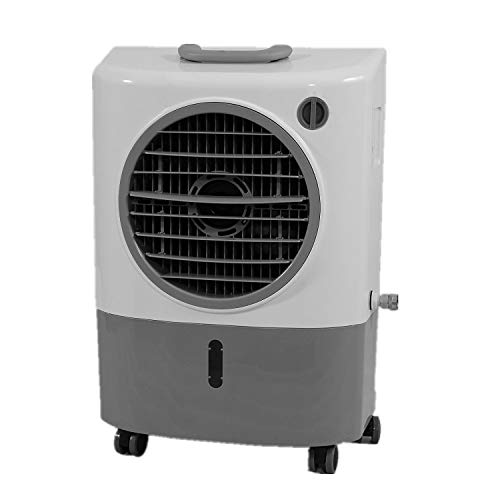
Portable evaporative coolers roll on casters and plug into any outlet, no install required. Hessaire and NewAir both build widely reviewed portable units. Refill the water tank, point it at a window, and it's running within minutes.
Tower evaporative coolers
A tower design stands narrow and tall, trading some airflow for a small footprint. It suits a bedroom or home office better than a bulky box unit. Honeywell sells several tower-format evaporative coolers alongside its box models.
Indoor vs outdoor swamp coolers
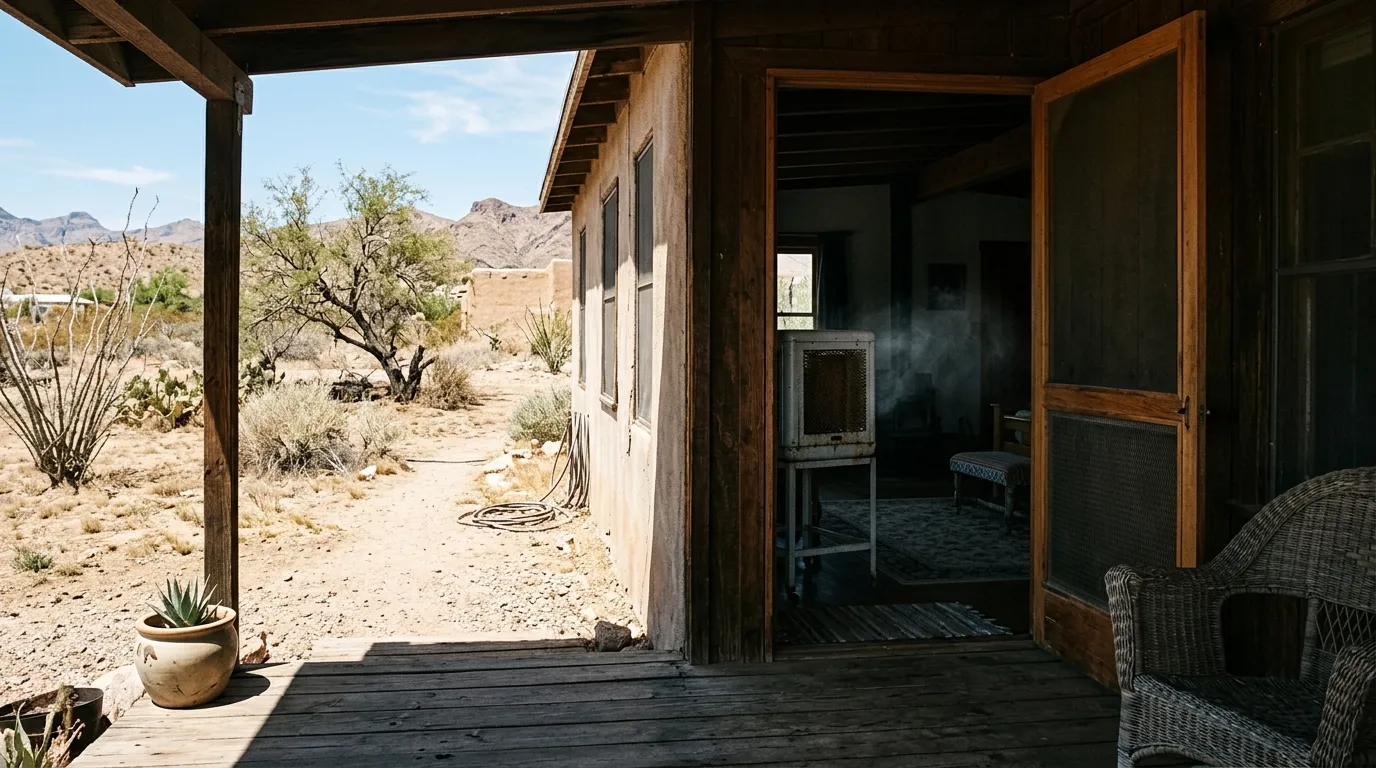
Indoor units are built for a sealed room with a window cracked for exhaust. Outdoor and semi-outdoor swamp coolers — patios, garages, workshops — can run bigger cooling pads and higher CFM since ventilation isn't a constraint. Portacool specializes almost entirely in the outdoor and industrial end of that range.
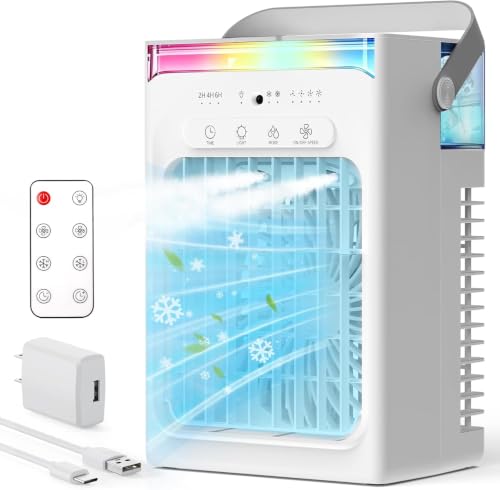
Personal coolers with an ice pack tray
Small personal units add an ice pack tray to chill the water before it reaches the pad, boosting the temperature drop for an hour or two. It's a genuine but temporary effect — once the ice melts, performance drops back to the water tank's baseline.
What specs actually matter when buying one?
Past format, a short list of specs decides how much cooling you actually get.
Water tank capacity and cooling pad type
Water tank size ranges from a couple of gallons on a personal unit to well over ten on a large room model, and consumption tracks how dry the air is. Cooling pad type matters just as much: aspen fiber pads are cheap and cool well when new, while rigid media pads cost more and last several seasons.
Airflow, CFM and oscillation
Airflow is rated in CFM because these units work by continuously replacing air, not recirculating it. Oscillation spreads that airflow across a wider area instead of a single fixed column, which matters more in a room with more than one seating spot.
Dry climate, low humidity and square footage sizing
A dry climate with humidity under 40% is where this category genuinely works. Above roughly 60% humidity, the cooling effect all but disappears. Size by CFM against the room's square footage — roughly cubic footage divided by two, for about 30 air changes an hour.
Energy efficient running cost
An evaporative cooler is dramatically more energy efficient than refrigerant air conditioning because there's no compressor — just a fan and a small pump, often under 300 watts. Running cost in kWh reflects that: a fraction of what a comparable portable AC draws over the same hours.
Every product recommendation below is ranked from aggregated real owner reviews and manufacturer specifications, never from us buying and running a unit ourselves — see How We Rank for the full methodology.