


Affiliate Disclosure
Some links on this page are affiliate links. As an Amazon Associate, we earn from qualifying purchases — at no extra cost to you. We do not buy, test, or physically handle the products we cover; our rankings come from aggregated owner reviews, ratings and expert consensus. Commissions never change our verdicts. How we rank & full disclosure.
A window air conditioner delivers the most cooling capacity per dollar you can put into a single room. The compressor and condenser sit outside the glass, so the heat and most of the noise never enter the room. The catch is that the unit has to physically fit and safely mount in a window you're allowed to modify.
What Size Window Air Conditioner Do You Need?
Roughly 20 BTU per square foot is the long-standing starting point — about 5,000 BTU for a 150 sq ft bedroom, 8,000 BTU for around 350 sq ft, and 12,000 BTU for a 500 to 550 sq ft space. Adjust up for sun, height and occupancy.
Add roughly 10 percent for a room with heavy afternoon sun, and subtract about 10 percent for one that's shaded all day. Add capacity for ceilings above the usual eight feet, since you're cooling volume, not floor area.
BTU, square footage and cooling capacity
Buying larger than the calculation suggests is the most common sizing mistake, and it backfires. An oversized fixed-speed unit satisfies the thermostat fast, shuts down, and restarts. Because dehumidification happens while the compressor runs, short cycles remove far less moisture — the room is cold but feels damp, and the air never seems fresh. Match cooling capacity to your actual square footage, not the biggest number on the shelf.
Will It Fit Your Window? Installation and the Window Kit
Standard window units are designed for double-hung or sliding windows with enough width, and a sash that closes down onto the top of the chassis. Casement and awning windows that crank outward can't take a conventional unit at all — those rooms need a different approach entirely.
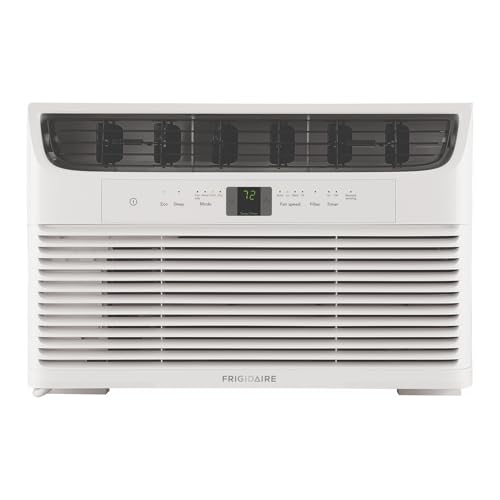
Measure the width and height of the opening, and the depth available outside for the rear of the chassis. Then check the exterior: a unit that overhangs a walkway or a neighbor's window may be prohibited by building rules even when it physically fits. Midea, LG, Frigidaire and GE all ship a window kit with side panels that expand to fill the remaining width — check the kit's coverage range against your actual opening before you buy.
110 volt vs 230 volt window air conditioners
Most window air conditioners under about 15,000 BTU run on a standard 110 volt household outlet. Larger units step up to 230 volt and need a dedicated circuit, which is worth confirming before delivery rather than after — a 230-volt unit sitting unplugged in a box is a common and avoidable disappointment.
Is an Inverter Window Air Conditioner Worth the Extra Cost?
If it's going in a bedroom, usually yes. An inverter unit varies compressor speed instead of switching between full power and off, so it holds temperature more steadily, dehumidifies more consistently, and avoids the loud start-stop cycle that wakes light sleepers.
Fixed-speed units are simple, cheap and reliable, and in a living room the cycling is easy to ignore. The difference is obvious at night: a fixed-speed compressor kicking in is a step change in noise, while an inverter compressor ramps up gradually.
EER, CEER and ENERGY STAR ratings
EER and the newer CEER figure both measure cooling output per watt of electricity — higher is more efficient. ENERGY STAR certification is a useful shortcut, since it confirms a unit has cleared an independent efficiency bar rather than just claiming one on the box.
How Noisy Are Window Units, and What's the Real Noise Level?
Indoor noise level from a window unit is mostly the evaporator fan, typically in the 45 to 55 decibel range on low. Compressor noise is largely outside. What people describe as a loud unit is usually either high fan speed or a fixed-speed compressor cycling.
Installation quality accounts for more perceived noise than most buyers expect. A chassis that isn't level, or that rests on a sill without proper support, transmits vibration into the window frame, turning a mechanical hum into a rattle.
Compressor, remote control and sleeper mode
Most current models include a remote control, and many add a "sleeper" or sleep mode that gradually raises the set temperature overnight and quiets the compressor and fan. It's a genuinely useful feature for a bedroom unit, since it trims noise exactly when it matters most.
What Maintenance and Running Cost Should You Expect?
Clean or rinse the front filter every few weeks during the cooling season, keep the outdoor coil clear of debris, and make sure the drain path at the rear isn't blocked. That short list prevents most performance and running cost complaints.
A clogged filter is the most common cause of a unit that "stopped cooling well." Restricting airflow across the evaporator drops capacity, raises running cost, and in bad cases lets the coil ice over.
Dehumidifier function and energy efficient upkeep
A window air conditioner works as a dehumidifier while it cools, pulling moisture out of the air across the evaporator coil. Running the fan for a few minutes after the compressor stops dries that coil and prevents the musty smell that shows up on startup — an easy, energy efficient habit that costs nothing.
Is a Window Air Conditioner Actually Efficient to Run?
Yes, generally — a window air conditioner cools only the room it's in, unlike central air, which conditions the whole house whether you're using every room or not. That focus is the biggest efficiency advantage the category has over whole-home systems.
Running cost still comes down to the same two numbers: BTU output and the efficiency rating on the yellow ENERGY STAR label. A higher EER or CEER unit costs a little more up front and less every month it runs. Over a full cooling season in a hot climate, that difference adds up enough to matter, particularly on a unit that runs most of the day.
When Should You Skip a Window Unit Entirely?
Skip it when the window can't take one, when building rules prohibit it, or when you need to cool multiple rooms year-round. A ductless system covers those cases at a much higher install cost.
For a single room you cool for a few months a year, a window unit is almost always the value answer. For a permanent solution, mini-split systems handle the job more efficiently. If your window won't take any window unit, portable air conditioners are the fallback, at a real cost in efficiency. And if a window unit isn't a filtration device, see our guide to improving indoor air quality for what actually addresses that separately.
Every product recommendation below is ranked from aggregated real owner reviews and manufacturer specifications, never from us buying and running a unit ourselves — see How We Rank for the full methodology.