


Affiliate Disclosure
Some links on this page are affiliate links. As an Amazon Associate, we earn from qualifying purchases — at no extra cost to you. We do not buy, test, or physically handle the products we cover; our rankings come from aggregated owner reviews, ratings and expert consensus. Commissions never change our verdicts. How we rank & full disclosure.
Heating an outdoor space is a different engineering problem from heating a room, because there is no room. Nothing holds the warm air in place, so convection is largely wasted and everything useful happens by radiation — heat travelling directly from the burner or emitter to your skin. That one fact drives every sensible decision in this category: output, placement, and how far you can sit from the thing before it stops mattering.
How many BTUs do you actually need to heat a patio?
Full-size standing propane heaters are typically rated around 40,000 to 48,000 BTU per hour, tabletop models around 10,000 to 11,000, and a 1,500-watt electric infrared unit produces about 5,100. Outdoors those numbers translate to comfort radius, not to a heated area.
The tempting move is to apply an indoor sizing formula to a deck and divide BTUs by square footage. It does not work, because the calculation assumes an enclosure that holds heat, and a patio holds none. A more useful way to think about it is seats: one full-size standing heater realistically keeps a small circle of people comfortable, and covering a six-person dining table plus a separate seating area usually means two units rather than one larger one.
Wind changes the arithmetic more than any specification does. A moderate breeze strips warm air away from a propane mushroom heater almost as fast as it is produced, which is why exposed decks disappoint owners who bought on BTU numbers alone. Screens, walls or a partial roof do more for outdoor comfort than an extra 10,000 BTU, and any purchase decision made without accounting for the prevailing wind on your property is a guess.
Electric or propane — which one actually fits your setup?
Propane goes anywhere and produces far more heat per unit; electric infrared needs an outlet but has no tank to refill, no flame, and no combustion byproducts. Covered porches and balconies with weight or fire restrictions usually point to electric, open decks to propane.
Standing propane heaters are the classic restaurant-patio design and remain the best answer for a wide, open, unpowered space. They are self-contained, they put out several times the heat of a plug-in electric unit, and the tank sits in the base. The costs are ongoing propane, a heavy unit to move, and the fact that a flame outdoors in wind is exactly as reliable as that sounds.
Electric radiant heaters — wall-mounted, ceiling-mounted or on a stand — trade output for convenience. They light instantly, put out no fumes, need no storage or refills, and can be mounted overhead where nothing can be knocked into them. Because they work by line of sight, placement matters enormously; the same principles that govern indoor infrared heaters apply outdoors, only with less margin for error. Many apartment balconies and covered patios prohibit open flame outright, which settles the question before it is asked.
How far does the heat from a patio heater actually reach?
A full-size standing propane heater warms a circle roughly 15 to 20 feet across, with the useful warmth concentrated well inside that. Tabletop units cover a table, not a patio. Electric radiant units warm what they point at and essentially nothing outside that cone.
The drop-off with distance is steeper than most people expect, because radiant intensity falls off sharply as you move away from the source. Someone sitting five feet from a standing heater and someone sitting twelve feet away are having completely different experiences. That gap is the single most common source of the complaint that a patio heater "does not really work." Furniture arranged around the heater, rather than a heater parked at the edge of existing furniture, fixes most of it.
Height is the other lever. Standing heaters emit downward and outward from a reflector at the top, so the coverage circle depends on how high that reflector sits — which is fixed on most models but adjustable on a few. Overhead-mounted electric units should generally be positioned so the cone lands on the seating area rather than on the paving in front of it, and mounting one too high to save space is a reliable way to waste its output.
What clearance and safety rules apply to a patio heater?
Never operate a propane patio heater indoors, in a garage, or under an enclosed roof — combustion produces carbon monoxide. Outdoors, keep the manufacturer's overhead and side clearances, weight the base, and shut off the tank valve when the heater is not in use.
Enclosure is the risk that actually kills people. A propane heater moved into a garage during a cold snap, or run under a fully enclosed gazebo, is a carbon monoxide source in a space with nowhere for the exhaust to go. Covered but genuinely open-sided patios are usually acceptable if the manufacturer says so and the overhead clearance is respected; anything you could describe as a room is not, and the rules for propane heaters generally are worth reading before you improvise.
Stability is the second issue. A standing heater is a tall column with a tank in the base, and wind gusts tip them over — which is why quality models include an anti-tilt shut-off and a base ring you can fill with sand or water for ballast. Fill it. Owners who skip that step are the ones describing a heater on its side across the deck after an evening storm. Store the tank outdoors and never inside the house, and check the hose and regulator connection with soapy water at the start of each season.
What do patio heater owners complain about most?
Rust. Outdoor heaters live outdoors, and the base, burner assembly and screws corrode within a couple of seasons unless the unit is covered or stored. After that, the recurring themes are ignition failures, flames that will not stay lit in wind, and fiddly assembly.
The rust complaint is largely preventable and largely ignored. A fitted cover and a dry storage spot over winter extend the life of a standing heater dramatically, and stainless components hold up better than powder-coated steel in coastal or high-rainfall areas. Owners in humid climates consistently report a shorter service life than the same models get elsewhere, which is worth factoring into what you are willing to spend.
Ignition problems are the other steady theme, and most trace back to the safety hardware doing its job. The thermocouple that shuts off gas when it does not sense a flame is also the part that refuses to light a heater with a dirty burner or a partly closed tank valve. Before assuming a failure, check that the tank is open, the burner ports are clear of spider webs and debris, and the pilot is being held long enough. For where outdoor heating fits alongside everything else in the range, start at the heating pillar.
How much does a patio heater cost to run?
For propane, work from the tank: a 20-pound cylinder holds around 430,000 BTU, so a 40,000 BTU heater empties one in roughly ten hours of use. For electric, a 1,500-watt unit uses 1.5 kilowatt-hours per hour, priced at your local rate.
Those two figures are the honest way to compare, because the answer moves with your propane price and your electricity rate rather than with the model on the box. Doing the arithmetic once with your own numbers is worth more than any general claim about which fuel is cheaper — and it is worth doing before you commit to a fuel type, since a propane stand and a hardwired electric radiant unit are not interchangeable afterwards.
In practice the pattern most owners settle into is seasonal rather than continuous. An outdoor heater burning through a tank every few evenings is genuinely expensive; the same heater used for a couple of hours on the handful of nights when it turns an unusable deck into a usable one is cheap entertainment. Being realistic about how many evenings that actually is in your climate does more for the value calculation than any amount of specification comparison.
What types of patio and outdoor heaters are there?
Shape and fuel decide where a heater can go and how far it throws warmth.
Freestanding propane heaters
Freestanding propane heaters are the classic restaurant-patio design — a tall column with a tank in the base. Hiland and AZ Patio Heaters both build widely reviewed standing models. They go anywhere with no outlet needed, at the cost of a heavy unit to move and refill.
Tabletop patio heaters
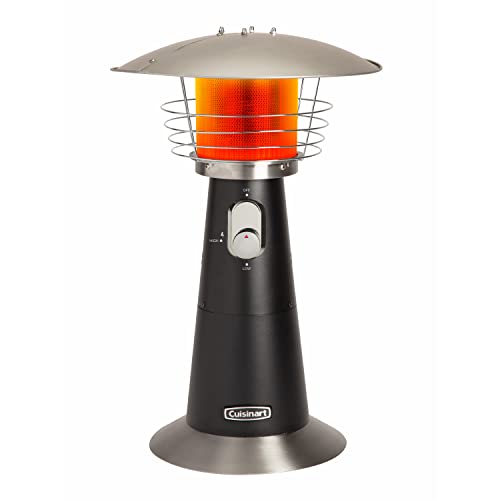
Tabletop patio heaters scale the same propane design down to a small canister and a lower output. Fire Sense makes some of the better-reviewed tabletop units. They heat one table, not a patio, so plan on several rather than one large heater for a bigger space.
Wall-mounted patio heaters
Wall-mounted patio heaters free up floor space on a narrow balcony or covered porch. Bromic's mounted infrared models are a common commercial-grade pick for exactly this job. They need a fixed power or gas connection, so plan the install before you buy.
Infrared and radiant heat electric heaters
Infrared electric heaters deliver radiant heat with no flame, no tank and no fumes. They light instantly and suit covered balconies where an open flame isn't allowed. Output is lower than propane, so plan on more units for the same coverage.
What specs and materials actually matter?
Past shape and fuel, a short list of specs decides how long a heater lasts and what it costs to run.
Propane tank size and BTU output
A standard 20-pound propane tank holds around 430,000 BTU. A full-size standing heater rated near 40,000 BTU per hour empties one tank in roughly ten hours of continuous use — worth knowing before a long evening.
Stainless steel and weatherproof construction
Stainless steel construction resists the rust that kills cheaper powder-coated steel heaters within a couple of seasons outdoors. A genuinely weatherproof unit, or a fitted cover and dry winter storage, is the difference between a heater that lasts and one that doesn't.
Tip-over safety and gas connections
CSA-certified tip-over safety shutoff cuts gas the instant a standing heater tips in the wind. Check the hose and gas connections with soapy water at the start of each season — a slow leak at the regulator is the most common failure owners report.
Running cost, zone heating and deck placement
Running cost for propane comes down to tank price divided by hours of use; for electric, it's kWh at your local rate. Either way, patio heaters are zone heating — warming people, not the deck — so placement around actual seating beats a heater parked at the edge.
Every guide below is ranked from aggregated real owner reviews and manufacturer documentation, never from us buying and running a heater ourselves — see How We Rank for the full methodology.