


Affiliate Disclosure
Some links on this page are affiliate links. As an Amazon Associate, we earn from qualifying purchases — at no extra cost to you. We do not buy, test, or physically handle the products we cover; our rankings come from aggregated owner reviews, ratings and expert consensus. Commissions never change our verdicts. How we rank & full disclosure.
An air quality monitor is a diagnostic instrument, not an appliance — it changes nothing about your air, it only tells you what is in it. That makes it genuinely valuable, because almost everything it measures is invisible, and almost worthless if you buy one without first deciding which question you want answered. The single most important thing to understand before spending money is that the sensors inside these devices are not equally trustworthy, and manufacturers rarely make that distinction obvious.
What does an air quality monitor actually measure?
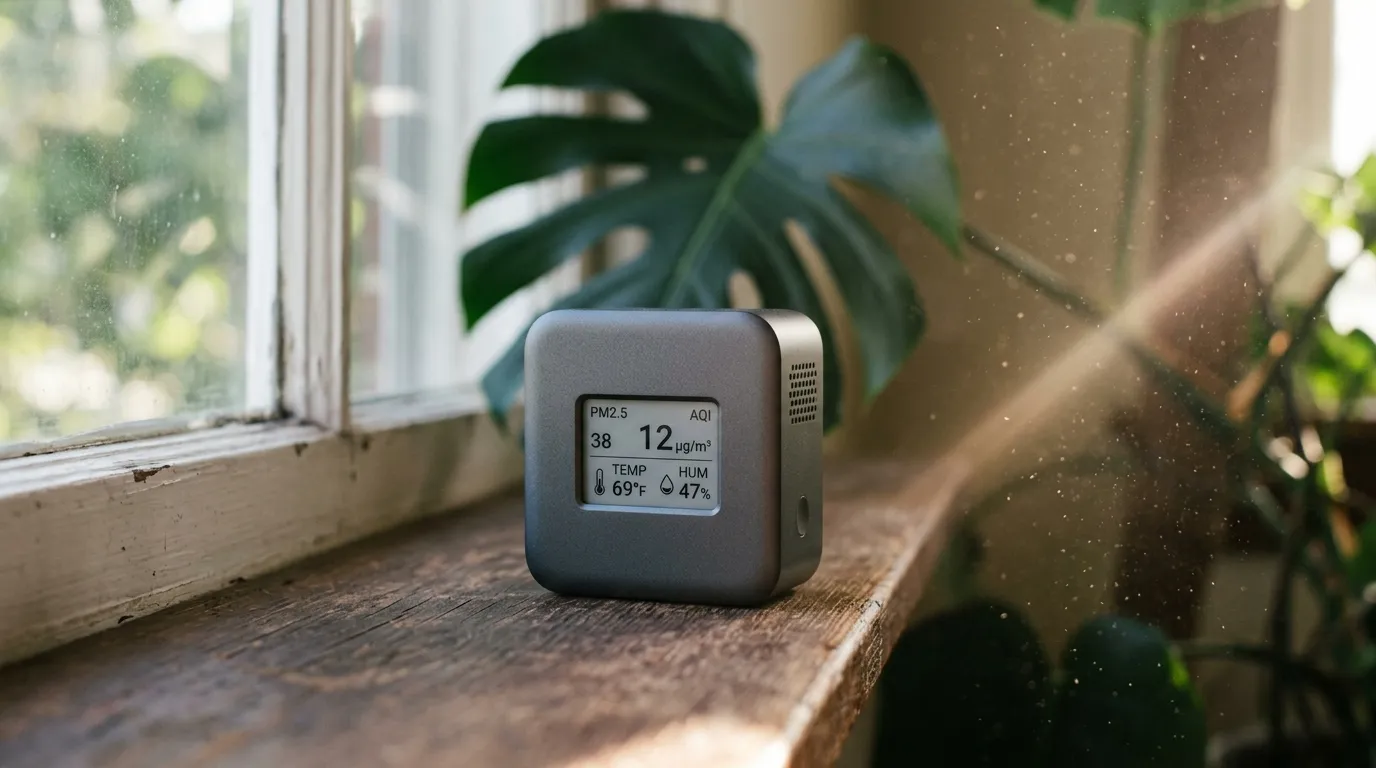
Typically particulate matter (PM2.5 and sometimes PM10), volatile organic compounds, temperature and humidity. Better units add true CO2. A few add radon or formaldehyde. What you get is a per-sensor picture, not one universal number that captures air quality.
PM2.5 and particulate matter sensors
Particulate matter is the measurement with the strongest health evidence behind it, and the most reliable consumer sensor technology. PM2.5 refers to particles under 2.5 micrometres. That's small enough to travel deep into the lungs. It is what spikes when you sear food, light a candle, vacuum a rug, or when wildfire smoke reaches your neighbourhood. Most consumer monitors use a laser scattering sensor with a small fan. It counts particles optically and estimates mass concentration from that count. Budget particulate sensors from brands like Temtop use the same laser-scattering principle as pricier competitors. It is not laboratory-grade, but it is very good at showing you the shape of an event: when levels rose, how high, and how long they took to clear.
VOC sensors: trend, not truth
Volatile organic compounds are a much looser category, covering everything from paint solvents and new-furniture off-gassing to cleaning products and cooking. Consumer VOC sensors are usually metal-oxide types that report a single combined figure. They cannot identify which compound they are detecting. They drift over time, and their absolute numbers should not be taken literally. Read them as a trend line — "something changed in this room" — rather than as a measurement. Combination monitors from Awair and Airthings bundle several sensors, including VOC, into one unit, trading some precision for convenience.
Temperature, humidity, formaldehyde and data logging
Temperature and humidity come along for free on almost every unit, because both are cheap to sense and both are needed to correct the other readings anyway. They are more useful than they look. Humidity is the single best predictor of mould risk and dust mite activity, and it costs nothing extra here. Formaldehyde and radon appear on a small number of premium units. Formaldehyde is worth having if you have recently installed engineered flooring or new cabinetry. Radon is a fundamentally different measurement that needs weeks of averaging to mean anything, so a combination device rarely does it justice. Premium units also add data logging, storing months of history so you can review a trend instead of a single snapshot reading.
Is the CO2 reading on a cheap monitor real?
Often not. Many low-cost monitors report "eCO2", an estimate derived from the VOC sensor rather than a direct measurement. Only an NDIR (non-dispersive infrared) sensor measures carbon dioxide directly. If the specification does not say NDIR, assume the CO2 number is inferred.
This is the most common way an air quality monitor disappoints an owner who cared about ventilation. An estimated CO2 figure will move when you spray cleaner near the device or open a bottle of solvent. That happens because it is really watching VOCs and translating them through an assumption about how humans and their activities co-vary. In an occupied bedroom overnight it may track roughly in the right direction. In a kitchen it can be wildly misleading.
Sensor accuracy and calibration
Sensor accuracy drifts over time, especially for the electrochemical and metal-oxide types used for VOC and CO2. Manufacturers such as Airthings and IQAir recommend periodic calibration, sometimes an automatic baseline reset, to keep CO2 and VOC readings honest. A monitor that has never been calibrated may simply read confidently wrong. If accuracy matters to your use case, check whether the model self-calibrates or needs a manual reset, and how often.
If ventilation is your actual concern, buy for the CO2 sensor specifically rather than for the number of sensors on the box — our CO2 monitors hub covers what to look for and why a dedicated instrument often makes more sense than a combination unit. If your concern is dust, smoke or allergens, a combination monitor with a solid particulate sensor is the better buy, and the CO2 channel becomes a bonus you should not rely on.
What counts as a good indoor air quality score, and what is AQI?
For particulates, the World Health Organization's 2021 guideline sets 5 µg/m³ as an annual PM2.5 target and 15 µg/m³ over 24 hours. There is no equivalent standard for the branded "air quality score" a monitor displays — each manufacturer invents its own formula. In the US, the EPA's AQI (Air Quality Index) is the outdoor standard most people recognize, but it is not the same scale as a monitor's indoor score.
That last point matters more than it sounds. Two monitors sitting side by side on the same shelf can show different scores from near-identical raw readings, because one brand weights VOCs heavily while another leans on particulates. A score is a user-interface convenience, not a measurement. Whenever you are comparing readings, comparing devices, or deciding whether to act, use the underlying numbers in their proper units and ignore the score and the colour of the ring.
The most useful way to read a monitor is relative to itself. Note what the room looks like on a quiet day with the windows shut and nothing happening — that is your baseline. Everything after that is a departure from baseline, and departures are what you can act on. A monitor that shows a large PM2.5 spike every time you cook has told you something specific and fixable: use the range hood, and vent it outside rather than recirculating.
Where should you put a monitor, and how many do you need?
One monitor, placed at breathing height on an interior surface, away from vents, windows, doorways and the stove. Two or three feet from a wall, not tucked into a corner. Start with one in the room you spend the most hours in, then add a second only if you have a specific question about another room.
Placement errors produce most of the confusing data owners report. A monitor next to a cooktop will read like a disaster area three times a day. One directly under a supply register reads the filtered air coming out of the ductwork rather than the air in the room. One on a windowsill tracks the street. None of those are wrong, exactly — they are just answering a question you did not ask.
Real-time alerts and app control
Most monitors pair with an app over WiFi or Bluetooth, showing real-time graphs rather than a single number on the device. Set alerts for PM2.5 or VOC spikes so the app notifies you the moment something changes, not hours later when you happen to glance at the display. Real-time data is what turns a monitor from a passive number into something you can actually act on while the event is still happening.
Bear in mind that these are fan-drawn optical instruments, so they accumulate dust internally over years and gradually read differently. Most manufacturers specify a sensor service life measured in years rather than decades, and a monitor that has been running continuously in a dusty environment will drift sooner. Treat a long-term downward or upward creep in baseline with suspicion, especially if nothing about the room changed.
Sampling interval matters more than most buyers expect. A monitor that updates every few seconds catches the sharp, short spike from searing a steak. One that averages over several minutes smooths that same event into a gentle bump you might not notice. Neither is wrong, but if you are trying to identify a specific source, faster sampling and access to the historical log are what make the difference. Check whether the device stores its own history or depends entirely on a cloud account, because a monitor whose data disappears when a service changes is much less useful for the before-and-after comparisons that justify owning one.
Will a monitor actually improve your health and indoor air quality?
Only indirectly. A monitor makes invisible problems visible and tells you whether a fix worked — but the fixes themselves are ventilation, source control and filtration. Buying a monitor and changing nothing produces data and no benefit to your health.
Where a monitor earns its money is in verification. It shows you whether the extractor fan is doing anything, whether the air purifier you already own is sized for the room, whether the filter you just replaced actually changed the outcome, and how long a room takes to recover after cooking or after a smoky day outside. Those are all questions people otherwise answer by guessing. Our guide on how to improve indoor air quality covers the interventions worth making, and what a true HEPA filter is explains the filtration term most often misused on packaging.
The honest expectation to set is that most homes discover one or two dominant sources — cooking, a fireplace, a pet, an attached garage, poor ventilation in one bedroom — and that fixing those sources produces almost all of the improvement. The point is your health, not the number on a screen. The monitor is how you find the source and how you confirm you were right.
See How We Rank for our full methodology: every recommendation here comes from aggregated real owner reviews, manufacturer specifications and published health guidelines, never from us buying and running a device ourselves.