


Affiliate Disclosure
Some links on this page are affiliate links. As an Amazon Associate, we earn from qualifying purchases — at no extra cost to you. We do not buy, test, or physically handle the products we cover; our rankings come from aggregated owner reviews, ratings and expert consensus. Commissions never change our verdicts. How we rank & full disclosure.
Ceramic heaters are the default portable heater in most American homes, and for good reason: they are compact, they warm a small room within a minute or two, and their self-limiting element makes them one of the safer electric options to leave on a desk. The trade-offs are equally consistent — a fan you will hear, a coverage area smaller than the box suggests, and a room that cools quickly once the unit is off.
What does the ceramic part of a ceramic heater actually do?
The element is a ceramic plate rather than an exposed wire coil. It is self-regulating: as it heats, its electrical resistance rises and it draws less current, which caps its own peak temperature. A fan pushes room air across it and out the front.
PTC element vs wire coil
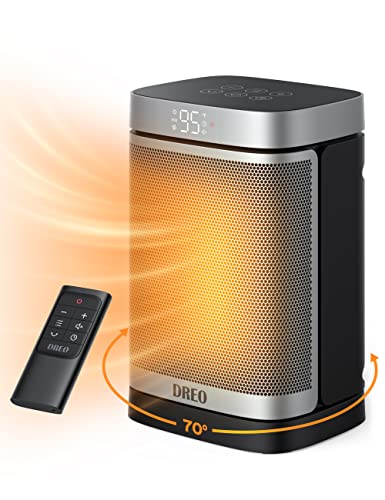
That self-limiting behaviour is the practical safety benefit of the category. A wire-coil heater can glow red and will happily keep climbing if airflow is blocked. A ceramic PTC element naturally tails off as it approaches its design temperature. It is not a substitute for tip-over and overheat cutoffs, which you should still confirm are present. But it is why so many ceramic heaters, including popular electric models from DREO, Lasko, Honeywell and Vornado, can be sold with a housing that stays merely warm to the touch.
It also explains the quick response owners like. The ceramic plate has very little thermal mass, so it reaches working temperature fast and cools fast. You feel heat almost immediately after switching on, and it stops almost immediately after switching off. That is the opposite of oil-filled radiator heaters, which take fifteen minutes or more to get going but keep radiating long after the thermostat cuts out.
How big a room can a ceramic heater realistically handle?
Roughly 150 to 200 square feet on the standard 1500 watts setting, in a room with a door and average insulation. Compact desk heater models rated 750 to 1,000 watts are personal heaters, not room heaters. They cover a chair rather than a floor plan.
1,500 watts, BTU and portable heater sizing
Sizing follows the same ten-watts-per-square-foot starting point as every other portable heater, because the wattage limit of a household outlet applies regardless of element type. A 1,500-watt ceramic heater produces about 5,100 BTU per hour. That's a real amount of supplemental heat for a bedroom or an office, but not enough for an open-plan living area, a basement or anything with a cathedral ceiling.
Tower heater vs desk heater for room size
Where ceramic heaters lose ground is in rooms that are tall, drafty or open to a hallway. The fan gives them good short-range reach and poor long-range reach, so heat pools near the unit and dissipates before it gets anywhere useful. In those rooms an oscillating tower heater distributes the same wattage more evenly. A small desk heater, by contrast, is built for exactly the opposite job: warming one person, not one room. In a genuinely large or leaky space the honest answer is that no plug-in electric heater will do the job.
Are ceramic heaters quiet enough for a bedroom or a home office?
Some are, most are borderline. Every ceramic heater needs a fan to work, so silence is not on the menu. Owners generally describe a low, constant whoosh that reads as white noise by day and becomes noticeable at night once the room is quiet.
Fan-forced noise vs oscillation controls
Noise complaints cluster around two specific behaviours rather than raw volume. The first is thermostat cycling: when the unit reaches temperature and shuts the fan-forced element down, some models also change or stop the fan, and that change in sound is what wakes people. Models that keep the fan running steadily are often less disruptive than quieter ones that cycle audibly. The second is the click of a mechanical thermostat relay, which is a small sound in an empty bedroom and a very loud one at 3am. Oscillation adds a third, mechanical noise source of its own — a motor and gearing that some owners disable entirely to cut noise further.
If a call-heavy home office is the use case, look for a low-power setting you can actually live on. Running a 1,500-watt heater at 750 watts halves both the output and the fan speed on most designs. Place the unit off to the side rather than directly under a microphone. If total silence is the requirement, no ceramic heater will deliver it and the category to look at is oil-filled radiators.
How much does a ceramic heater cost to run?
A 1,500-watt model uses 1.5 kWh for every hour it runs at full output, so your hourly worst case is 1.5 times your electricity rate. Real cost is usually lower, because a thermostat cycles the element off once the room is at temperature.
kWh math and running cost
Ceramic heaters are electric resistance heaters, which means essentially all the electricity they draw becomes heat in the room. The EPA and most energy-efficiency guides agree there is no efficiency advantage between resistance element types, so any listing implying otherwise is selling a claim physics does not support. What varies between models is control quality. A heater with an accurate digital thermostat and a usable low setting spends far less time at full draw than one with a vague dial marked low to high, which lowers running cost without changing the wattage on the box.
Portable heater vs space heater running costs
The bigger lever is behavioural. Running a ceramic heater as a portable, single-room heater while lowering the central thermostat is where the savings come from. Running any space heater in addition to unchanged central heat is simply an extra appliance on your bill, energy efficient element or not. Working out which applies to your home's indoor climate is worth ten minutes before you assume a space heater is the cheaper path.
What goes wrong with ceramic heaters over time?
Dust is the main culprit. Intake grilles clog, airflow drops, output falls and a hot-dust smell appears. Beyond that, owners report failed thermostats, weak fan bearings after a couple of seasons, and remote controls that stop pairing long before the heater itself dies.
Tip-over and overheat safety
Cleaning is the single maintenance task that matters and the one almost nobody does. A ceramic heater pulls a lot of room air through a small grille, and in a carpeted bedroom that grille loads up with lint fast. Owners who describe a heater that "stopped working" after a winter frequently describe an airflow problem rather than a failed element. A vacuum brush over both intake and outlet at the start of each season prevents most of it. Tip-over and overheat switches are the two safety features worth confirming before buying, since a clogged grille is exactly the condition that trips an overheat cutoff.
The other honest observation from the review record is that this is a short-life category by design. Ceramic heaters are inexpensive, mass-produced and built to a price. Expecting a decade from one that runs eight hours a day is unrealistic. Buy one with the tip-over and overheat cutoffs you want, keep the receipt and the warranty paperwork, and treat a heater that lasts several full winters as a good outcome rather than a minimum.
What should you actually look for on the control panel?
A digital thermostat with a numeric setpoint, at least two power levels, oscillation, and a timer. Everything else — remotes, app control, mode names like eco and turbo — is convenience rather than capability, and rarely worth a large price difference on its own.
Thermostat and oscillation controls
The thermostat setpoint is what separates a heater you set once from a heater you fiddle with all evening. A dial marked low to high gives you no way to ask for a specific temperature, so you end up switching the unit on and off manually. That's exactly the behaviour that makes a room feel alternately stifling and chilly. A displayed target temperature, with the heater cycling itself around it, is a meaningfully better experience for a small premium. Oscillation spreads that same heat sideways instead of pointing it at one spot, which matters in a room where you move around.
Fast heat and electric power levels
The second power level matters more than it appears to. Running a 1,500-watt electric heater on its 750-watt setting halves both the electrical draw and, on most designs, the fan speed. That's often the difference between a heater usable during a video call and one that isn't. Fast heat response is the category's genuine strength here — you feel the difference within a minute of switching levels, unlike a slower oil-filled radiator. Timers earn their keep in bedrooms, where an hour of heat at bedtime is all you want, and in home offices, where forgetting to switch a heater off on a Friday afternoon is a genuine risk.
Every guide below is ranked from aggregated real owner reviews and manufacturer documentation, never from us buying and running a heater ourselves — see How We Rank for the full methodology.