


Affiliate Disclosure
Some links on this page are affiliate links. As an Amazon Associate, we earn from qualifying purchases — at no extra cost to you. We do not buy, test, or physically handle the products we cover; our rankings come from aggregated owner reviews, ratings and expert consensus. Commissions never change our verdicts. How we rank & full disclosure.
Radon is the one hazard covered anywhere on this site that gives you no warning at all. It has no colour, no smell and no taste, it produces no immediate symptoms, and there is no household clue that suggests you should check. It is also, according to the EPA and the US Surgeon General, the second leading cause of lung cancer in the United States after smoking, and the leading cause among people who have never smoked. That combination — serious risk, zero sensory signal — is the entire argument for owning a detector, and it is why the advice here is unusually blunt.
What radon level requires action?
The EPA action level is 4.0 pCi/L, and the agency recommends fixing any home at or above it. It also suggests considering mitigation between 2 and 4 pCi/L. The World Health Organization uses a lower reference level of 100 Bq/m³, roughly 2.7 pCi/L.
EPA action level, picocuries and pCi/L units
The important nuance is that these are policy thresholds, not a boundary between safe and unsafe. Radon risk is understood to be cumulative and probabilistic. The more you are exposed to and the longer for, the higher the chance of harm, with no level identified as risk-free. The 4 pCi/L figure — 4 picocuries of radioactivity per litre of air — represents a judgement about where the cost and practicality of fixing a house crosses over into being clearly worthwhile, not a point at which a hazard suddenly begins.
Units cause endless confusion. The United States uses picocuries per litre (pCi/L); most of the rest of the world uses becquerels per cubic metre (Bq/m³). One pCi/L is about 37 Bq/m³. If you are comparing your reading against an international guideline or a monitor set to the wrong unit, check which scale you are looking at before you panic or relax. For the underlying explanation of the gas itself — where it comes from and how it gets into a house — start with what radon is.
Do you need to test if you don't have a basement?
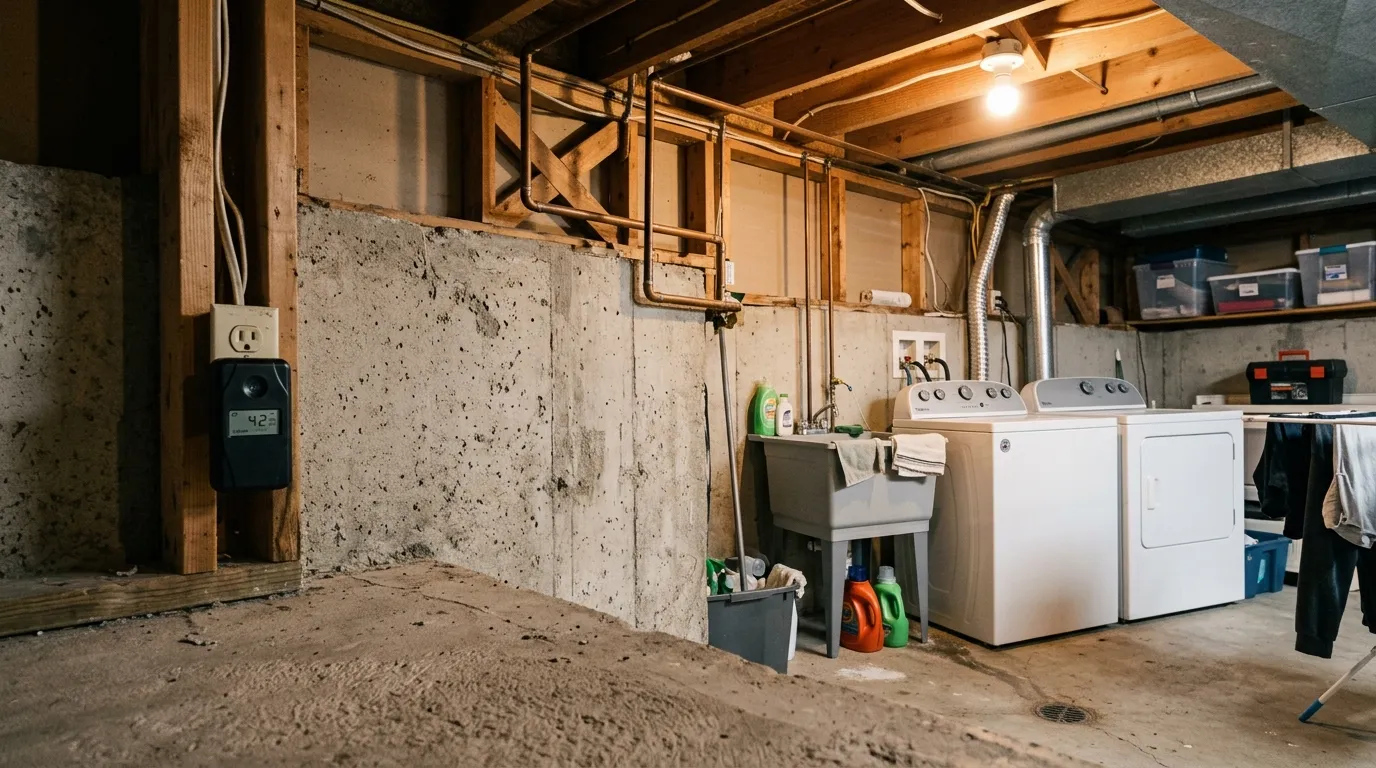
Yes. Radon gas enters through any contact between the home and the ground — slab cracks, control joints, sump pits, crawlspace floors, plumbing penetrations. Slab-on-grade and crawlspace homes routinely test high. The EPA recommends testing every home regardless of style, age or region.
Radon gas, alpha particle decay and soil entry
The basement myth persists because basements often read highest within a given house, which is true and unhelpful. It says nothing about whether a house without one is safe. What actually drives indoor radon is the concentration of uranium in the soil and rock beneath the property, how permeable that ground is, and how strongly the building pulls air out of the ground beneath it. Each radon atom that decays releases an alpha particle, which is the actual source of the lung-tissue damage the EPA is concerned about. That pull — the stack effect created by heating a house in cold weather, plus the suction of exhaust fans and unbalanced ducts — is present in every occupied home.
Neighbourhood-level and county-level radon maps are a planning tool, not a substitute for testing your own address. Two houses on the same street can differ substantially because of foundation construction, soil variation and how airtight the building is. The EPA estimates roughly one in fifteen US homes has a radon level at or above the action level, and those homes are not confined to the areas the maps shade red.
Is a home radon detector as accurate as a professional test?
For your own information, a good consumer radon detector is accurate enough to act on — provided you give it time to average. For a real estate transaction, it usually is not accepted; those measurements generally have to be made by a certified measurement professional using an approved device under documented conditions.
Long-term vs short-term test accuracy
There are two broad approaches. Passive kits — activated charcoal for short-term testing, alpha track film for long-term testing — are exposed for a set period, then mailed to a laboratory that reads them and returns a number. They are inexpensive, well validated, and give you one figure for one window of time.
Continuous monitor, real-time readings and calibration
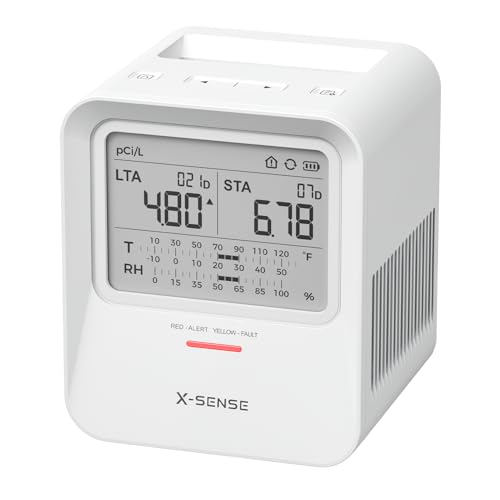
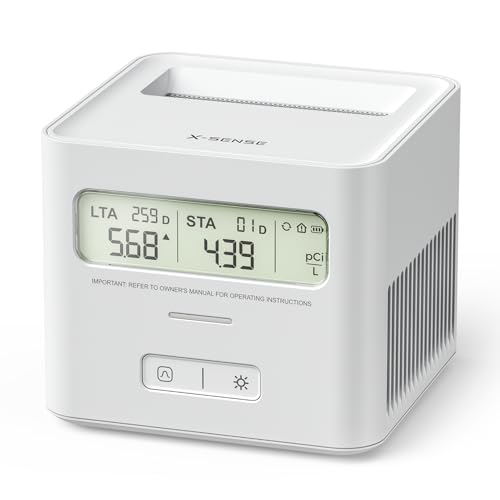
A continuous monitor from a brand like Airthings, Ecosense, EcoQube or FTLAB samples the air constantly and displays rolling, near real-time averages, which is a completely different kind of information. You can see how levels respond to weather, to closing a window, to running the dryer, or to a mitigation fan being switched on. Regular calibration against a lab-verified reference is what keeps these devices trustworthy over years of use, and it is worth checking whether a model supports it before buying.
The accuracy caveat that trips people up is that no radon measurement means much over a short window. Consumer continuous monitors typically need a full day before showing a first meaningful figure, and weeks before their long-term average settles. A reading taken on the second day and treated as gospel is the most common misuse of these devices, and it produces both false alarms and false reassurance depending on the weather that week.
When and where should you test?
Test the lowest level of the home that is lived in — or could reasonably be converted to living space. Place the detector two to six feet off the floor, away from exterior walls, drafts, vents and windows. Winter, under closed-house conditions, gives the most conservative picture.
Short-term testing has a protocol worth following properly, because ignoring it is what produces meaningless numbers. Closed-house conditions mean windows and exterior doors stay shut except for normal entry and exit, for twelve hours before the test starts and throughout. Whole-house fans and window air conditioners are off. Normal heating and central air conditioning continue as usual. Skip these steps and the test measures your ventilation habits rather than the house.
Levels move on two cycles: daily, driven by pressure and temperature differences between indoors and out, and seasonally, with winter typically highest because heating amplifies the stack effect pulling soil gas upward. A long-term test spanning at least ninety days is the better estimate of what you are actually exposed to across a year. Retest every couple of years, and again after any significant renovation, foundation work, HVAC change or air-sealing project — all of these can change how the house interacts with the ground beneath it.
What happens if a reading comes back high?
Confirm it with a second, longer test before spending money, unless the first result is dramatically elevated. If it holds, the standard fix is sub-slab depressurisation: a pipe and a continuously running fan that vent radon gas above the roofline before it can enter the house.
Mitigation is a mature, well-understood engineering solution with a strong track record, and it is not experimental or exotic. A properly installed system typically brings levels down substantially, and it works by changing the pressure relationship between the house and the soil rather than by filtering anything. This is worth understanding because it explains why an air purifier is not a radon solution. The gas is continuously replenished from below, so removing decay products from room air does not address the source. Filtration belongs to particulates; radon belongs to ventilation and pressure.
Ventilation, alarm systems and long-term health
Always test again after mitigation, and keep testing periodically afterwards. Fans fail silently, and most systems include a simple manometer or an alarm precisely so you can confirm at a glance that the ventilation system is still pulling. Since the health case for fixing radon rests on cumulative, long-term exposure rather than a single reading, ongoing monitoring matters more here than for almost any other device on this site. If you are already tracking other indoor conditions, note that a radon problem and a ventilation problem often share a root cause in how tightly a house is sealed; our CO2 monitors and air quality monitors hubs cover the instruments for that side of the picture.
See How We Rank for our full methodology: every recommendation here comes from aggregated real owner reviews, manufacturer specifications and published EPA and WHO guidance, never from us buying and running a device ourselves.