


Affiliate Disclosure
Some links on this page are affiliate links. As an Amazon Associate, we earn from qualifying purchases — at no extra cost to you. We do not buy, test, or physically handle the products we cover; our rankings come from aggregated owner reviews, ratings and expert consensus. Commissions never change our verdicts. How we rank & full disclosure.
A basement is the hardest room in a house to keep dry, and it is not close. It is colder than everything above it. It has the worst air exchange. And it sits surrounded on all sides by ground that holds moisture. Concrete is porous. Water vapor moves through slab and walls all the time. A basement dehumidifier is not managing a one-off event — it stands against a constant supply. That changes how you size it, how you drain it, and what "working properly" looks like.
What capacity does a damp basement actually need?
More than the square footage alone suggests. Standard sizing tables ladder capacity by both floor area and dampness level. Most basements sit at the "very damp" or "wet" end, not the "slightly damp" end that upstairs rooms occupy. Size up rather than down.
Square footage and coverage rating
Manufacturers rate a dehumidifier's coverage in pints per day, then map that number to square footage and dampness level. A 50-pint unit rated for 2,000 square feet assumes very damp conditions, not moderately damp ones. Brands such as Frigidaire, hOmeLabs and Midea all publish coverage charts like this — match the chart to your actual square footage and dampness, not the more flattering number on the box.
Relative humidity and humidistat settings
Most owners get good results holding relative humidity between 45% and 55% on the unit's own humidistat. Below 30% the coil barely condenses any water and the room can feel harsh. Above 60%, musty odor and mold return within days. Set the target in that middle band and let the humidistat cycle the compressor to hold it there.
The honest diagnostic beyond the numbers is smell and surfaces. A basement with a musty odor every time you open the door, clammy walls, or dark staining at the base of the block work is not slightly damp — it is already growing mold somewhere you cannot see. Rate it accordingly, and add capacity again if the space is open to a crawl space, has an unsealed dirt floor section, or connects to a garage.
Undersizing produces one very common complaint. The unit runs continuously, the display never reaches the setpoint, and the owner concludes it is faulty. It usually is not — it is simply losing the race. A correctly sized unit reaches target and then cycles. That costs less to run than a small unit at 100% duty, and it lasts longer because the compressor is not on permanently. It also gets relative humidity down into the band described in our guide to the ideal indoor humidity level.
Why does a basement dehumidifier need auto-defrost?
Because basements run cold. A compressor dehumidifier chills a coil to condense moisture. Once room air drops toward the low sixties, that coil starts icing over. Iced coils block airflow and stop water removal entirely. Auto-defrost pauses the compressor and clears the ice automatically.
Low temperature and compressor performance
This is the specification most likely to be skipped, and most likely to be regretted. A unit without auto-defrost placed in a 58°F basement will appear to run normally while removing almost nothing. The failure is invisible unless you open the grille and see frost. Manufacturers publish a minimum operating temperature for a reason — read it, and treat it as a real limit, not a formality.
If the basement runs genuinely cold year-round — an unheated, uninsulated space near 50°F — a compressor unit is at the edge of its range even with auto-defrost. A desiccant dehumidifier becomes the better tool at that low temperature. Desiccant designs absorb moisture onto a rotor instead of condensing it, so cold does not defeat them, and they discharge slightly warmed air as a bonus. The trade-offs between the two technologies are covered on our dehumidifiers hub.
Auto restart after a power outage
Basements lose power more often than upstairs rooms, often during the same storms that push humidity up. Auto restart returns the unit to its last setting the moment power comes back, with nobody home to press a button. Skip this feature, and a brief outage can leave a dehumidifier sitting idle for days, undoing weeks of dry air.
Water tank, drain hose or continuous drainage?
In a basement, never rely on the water tank alone. A unit removing 30 or more pints a day will fill a typical one-to-two-gallon reservoir several times over. A full tank means the machine shuts off and stays off. Plan continuous drainage before purchase, not after.
Gravity drainage is the simplest and most reliable option when the geometry allows it. Run a drain hose from the outlet port to a floor drain or sump pit, sloping downhill the whole way with no dips to trap water. Basements suit this well, because floor drains and sump pits are common and the unit can often sit on a block or shelf to gain the necessary height.
Where the only drain sits above the outlet — a laundry sink, a standpipe, a window well — you need a condensate pump, either built into the unit or fitted inline. Pumps work well and give you routing freedom, but they add a failure point and a small periodic noise. Whichever route you take, check the drain hose run a few times a season. Kinks, crushed sections behind stored boxes, and algae growth inside the line are what owners report finding only after the water tank started filling again.
Why is the basement still damp with a dehumidifier running?
Usually one of five things: bulk water getting in from outside, an unsealed crawl space feeding unlimited vapor, open windows in humid summer weather, an undersized unit, or airflow blocked by stored boxes. A dehumidifier manages air moisture. It cannot out-run a leak.
Start outside the house. Blocked gutters, downspouts discharging against the foundation, and ground graded toward the wall put liquid water into the soil right where you least want it. No appliance wins that argument. The same is true of an unencapsulated crawl space with an exposed dirt floor. That is an effectively infinite moisture source, and a vapor barrier over the soil does more for the reading than any amount of extra pint capacity.
Musty odor and mold risk
A musty odor is usually the first sign that relative humidity has been too high for too long. Mold needs moisture more than it needs anything else, and a basement sitting above 60% humidity for weeks gives it exactly that. Running a dehumidifier consistently, not just when the smell shows up, is what keeps mold from establishing in the first place.
The summer window habit is the counter-intuitive one. Opening basement windows on a warm humid day feels like ventilation, but it draws moisture-laden outdoor air onto cold basement walls, where it condenses. Keeping the space closed and letting the dehumidifier work is the correct move in humid weather. And because sealing, drainage work and mechanical ventilation all interact with soil gases in below-grade spaces, this is a sensible point to understand what radon is and whether the basement should be tested for it.
Where should a basement dehumidifier actually sit?
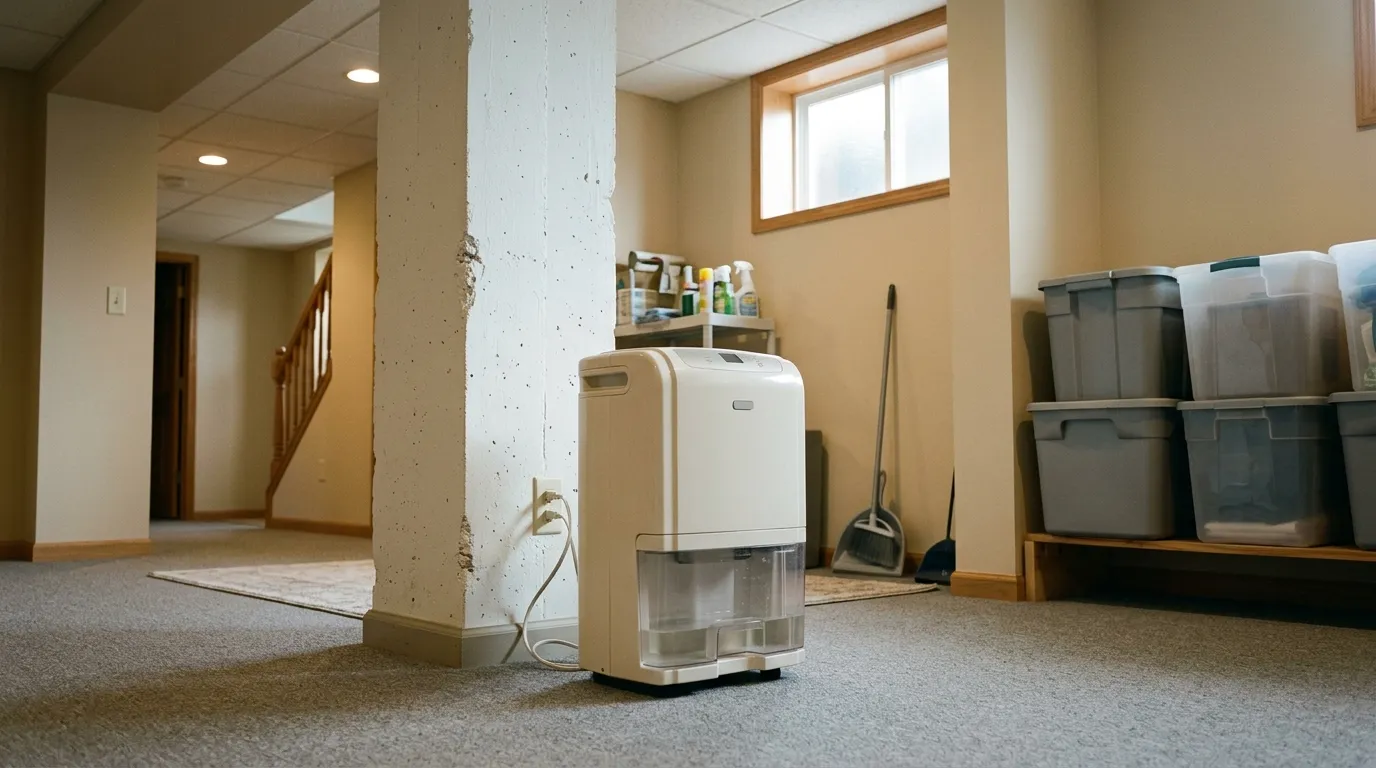
Somewhere central, with several inches of free space around the intake and exhaust, raised off the floor if you are draining by gravity, and away from stored boxes. A dehumidifier only treats the air that reaches it. A unit boxed into a corner treats very little.
Basements are where people store things, and stored things are exactly what blocks airflow. A unit surrounded by shelving and cardboard is drawing from a small dead pocket of air rather than circulating the whole space. If the basement is partitioned into rooms, a single unit will struggle to serve all of them through doorways. Either leave interior doors open, add a small circulation fan, or accept that separate rooms may need their own solution.
Energy efficient placement and ENERGY STAR ratings
An ENERGY STAR certified unit, verified by the EPA, uses meaningfully less electricity than an uncertified model with the same pints-per-day rating. That matters most in a basement, where the unit may run for months without a break. Good placement is part of energy efficient operation too — a unit fighting a dead-air corner works harder and runs longer to hit the same target. Whole-home options like Aprilaire, often ducted into the HVAC system, are worth a look if you would rather condition the whole lower level than one room at a time.
Raising the unit on a sturdy platform serves two purposes. It gets the drain outlet above the floor drain for gravity drainage, and it lifts the intake out of the coldest, stillest layer of air at slab level. Keep the plug on a properly grounded outlet rather than a light-duty extension cord — dehumidifier compressors draw meaningfully more current than most household appliances people run in basements.
What do basement owners complain about most?
Compressor failures in the second or third season, drain hoses that clog or kink unnoticed, humidistats reading several points off, frost build-up on units without adequate defrost, and the running cost of a machine that is on far more hours than expected.
Pints per day ratings vs. real-world removal
The pints per day figure on the box is measured in lab conditions — usually 80°F and 60% relative humidity — not a 65°F basement in early spring. Real-world removal at lower temperature and lower humidity is noticeably less than the rated number. Treat the box figure as a ceiling, not a promise, and size up if your basement runs cool.
Duty cycle is the honest explanation behind several of those complaints. A basement dehumidifier is not a seasonal convenience appliance. In a humid climate it may run most hours of most days from spring to autumn, and a compressor accumulating that many hours in a cold damp environment is working hard. Buying a unit with headroom, so it cycles rather than runs flat out, is the single best thing you can do for both electricity cost and longevity.
The other recurring theme is verification. Put an independent hygrometer at the far end of the basement, away from the unit's dry exhaust, and read it occasionally. That is how you find out the drain has clogged, the filter has choked, or the setpoint on the panel does not match reality — usually months before a smell or a mildew patch would have told you.
Everything above comes from aggregated real owner reviews, manufacturer specifications and the failure patterns that repeat across brands and price points — we do not buy or run the units we cover. Our How We Rank page sets out that methodology in full.


