


Affiliate Disclosure
Some links on this page are affiliate links. As an Amazon Associate, we earn from qualifying purchases — at no extra cost to you. We do not buy, test, or physically handle the products we cover; our rankings come from aggregated owner reviews, ratings and expert consensus. Commissions never change our verdicts. How we rank & full disclosure.
A whole-house humidifier is a different kind of purchase from a portable. It is plumbed in, wired in, mounted to ductwork, and generally installed by someone with an HVAC licence — and the installation frequently costs more than the unit. In exchange, it humidifies everything the furnace blower reaches, and nobody ever carries a tank to a sink again. Whether that trade is worth making comes down to your ducting, your water, and how many rooms are actually dry.
When is a whole-house system worth it over three portables?
When the dryness is house-wide rather than confined to one or two rooms, and the home already has forced air heating. Portables treat the room they stand in; moisture does not travel usefully past a closed door. Once you are running three or more, refilling and cleaning outweigh the install cost.
Dry air, forced air ductwork and HVAC prerequisites
The dividing line is genuinely about scope. If one bedroom has dry air and feels uncomfortable in January, a portable is the right answer and a ducted system is overkill. If every room in the house reads in the twenties on a hygrometer, static shocks are routine, and wood floors or an instrument are moving with the season, the ducted system is the structurally correct fix.
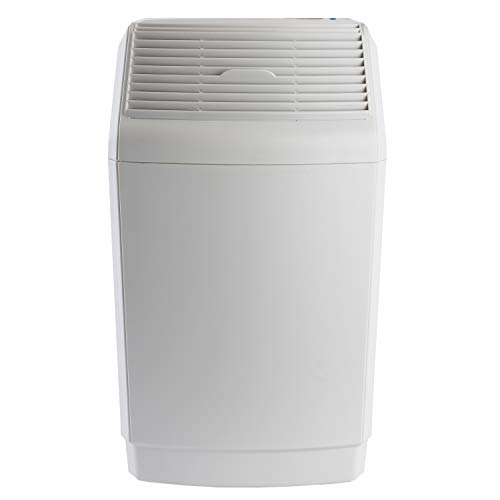
The hard prerequisite is ductwork. A whole house humidifier mounts to the supply or return plenum of a forced air furnace and relies on the HVAC blower to distribute moisture. Homes with boilers and radiators, or with ductless mini-splits, have no air path to attach to. Those households are back to portable humidifiers, or to a free-standing whole-house unit that still needs manual filling.
What is the difference between bypass, fan-powered and steam?
Bypass units route air from the supply plenum, across a wet evaporator pad, and back into the return — they have no fan of their own and need furnace heat to evaporate. Fan-powered units add their own blower for more output. Steam units boil water and inject it, working independently of the furnace.
Bypass, flow-through and evaporative pad designs
All three are variations on evaporative humidification except steam, which boils water instead of evaporating it across a pad. Bypass is the cheapest and most common. Because it borrows the furnace blower and warm supply air, it only humidifies meaningfully while the furnace is actually producing heat, and its output is modest. It also needs a bypass duct running between supply and return, which requires physical room around the furnace that not every mechanical closet has. Many installations include a manual damper that has to be switched to the summer position each spring — a step homeowners forget every year.
Fan-powered units pull air across the pad with their own blower, so they do not need the bypass duct and they deliver more moisture per hour. They still evaporate best in warm air. Aprilaire, Honeywell and Emerson all sell both bypass and fan-powered lines, while AIRCARE is better known for portable and console units. Steam humidifiers are the outlier: they generate steam electrically and inject it into the duct, so they work whenever the humidistat calls, regardless of whether the furnace is firing. They have the highest capacity, the most straightforward control behaviour, and by a wide margin the highest purchase, install and electricity cost.
How is a whole-house humidifier sized?
In gallons per day, based on the home's square footage and how leaky the building is. A drafty older house with high air-change rates needs far more capacity than a tightly sealed new build of identical size, because it is constantly exhausting humidified air and drawing in dry outdoor air.
Square footage, gallons per day and GPD sizing
This is why sizing by square footage alone produces so much disappointment. Two 2,400-square-foot houses can have very different humidification loads depending on window quality, weatherstripping, attic sealing and whether there is a fireplace flue open to the sky. Installers estimate the load from area plus a construction-tightness factor, sizing to a GPD figure rather than to square footage alone. The honest answer is that a leaky house should be air-sealed before it is humidified — you get a better result for less money.
Climate matters too. The colder the outdoor design temperature, the drier the incoming air and the larger the moisture deficit the unit has to make up. A system sized comfortably for a mild winter will lose ground during a genuine cold snap, which is exactly when occupants notice.
What does installation actually involve?
Cutting into the plenum, mounting the unit, running a cold water supply line with a saddle or compression valve, running a drain to a floor drain or condensate pump, wiring a 24V connection to the furnace control, and mounting a humidistat. It is a permit-and-professional job in most jurisdictions.
Ducted furnace mount and water panel connection
None of those steps is exotic on its own, but together they put this firmly outside plug-in-appliance territory. A furnace mount unit sits directly on the ducted plenum, so the water panel and drain lines have to be routed around whatever ductwork is already there. The water connection and the drain are where DIY installs most often go wrong: a saddle valve that weeps for two years, or a drain line pitched slightly uphill so the pan backs up into the plenum. Both failures are quiet and both do expensive damage to a furnace.
The control choice is worth insisting on. An outdoor-temperature-compensating humidistat automatically lowers the indoor humidity target as it gets colder outside, which is the correct behaviour — the colder the glass, the lower the humidity has to be to avoid condensing on it. Systems installed with a fixed manual dial are the ones that produce streaming windows in January. Because the system is tied into the furnace, it is also worth reading alongside how the rest of the heating setup performs; our guide to heating and cooling a room efficiently covers the airflow and setpoint side of that.
What maintenance does a whole-house humidifier need?
Annually, at minimum: replace the evaporator pad or water panel, flush the distribution tray, and check the drain line for scale and clogs. Hard water shortens pad life considerably. Steam units add periodic cylinder or canister service depending on the design.
Hard water and relative humidity control
The evaporator pad is the consumable that decides whether the system works. Mineral scale from hard water builds on the mesh, water stops spreading evenly, and output drops off long before anything looks obviously broken. Most manufacturers specify an annual change at the start of heating season; hard-water households often need two. Getting the pad right is what keeps relative humidity control accurate, since a scaled pad under-delivers no matter what the humidistat is set to. The EPA's guidance still applies here the same way it does to a portable unit: 30-50% is the band worth targeting, not a number to chase past.
The second annual item is the drain. Flow-through designs deliberately run more water across the pad than they evaporate, sending the excess to a drain to carry minerals away — which does mean a genuine ongoing water usage figure that owners are sometimes surprised by. If that drain scales up or clogs, water backs up into the plenum. Both jobs take an hour and both are worth doing before you need heat, not after.
What goes wrong with whole-house humidifiers?
Window condensation from a humidistat set too high, a bypass damper left in the wrong seasonal position, a solenoid valve that sticks open and floods the plenum, scaled pads that silently stop working, and standing water in a summer-idle system that turns stagnant.
Condensation is the most common owner complaint and it is almost always a control problem rather than a fault. Water condenses on the coldest surface in the room, which in winter is the glass — so a setting that is comfortable at 40°F outside will fog and drip at 10°F. Turning the target down as the temperature drops, or fitting an outdoor-compensating control that does it for you, resolves it. The comfortable, low-risk band for your home's indoor climate is a ceiling, not a target to chase.
The seasonal items catch people out year after year. A bypass damper left in the winter position all summer lets conditioned air short-circuit between supply and return, which quietly costs money in cooling season. A water supply left on to an idle unit gives a stuck solenoid an entire summer to make a mess. Shutting the water off in spring and switching the damper takes five minutes and prevents both.
Every judgment on this page is drawn from aggregated owner reviews, manufacturer specifications and installer-reported failure patterns — we do not buy, install or run the systems we cover, and our How We Rank page sets out exactly what that means for the recommendations above.