



Affiliate Disclosure
Some links on this page are affiliate links. As an Amazon Associate, we earn from qualifying purchases — at no extra cost to you. We do not buy, test, or physically handle the products we cover; our rankings come from aggregated owner reviews, ratings and expert consensus. Commissions never change our verdicts. How we rank & full disclosure.
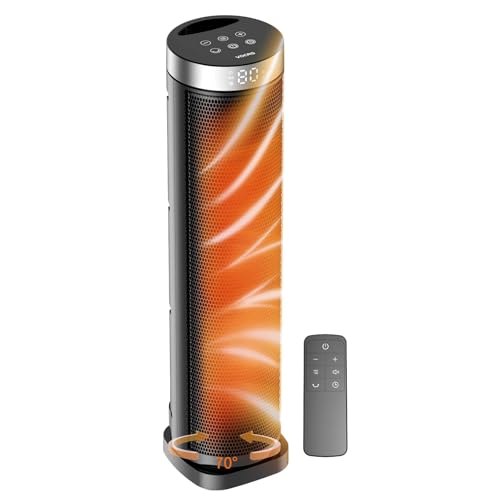
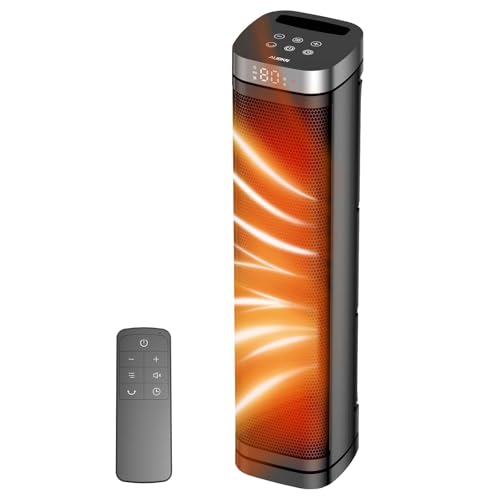
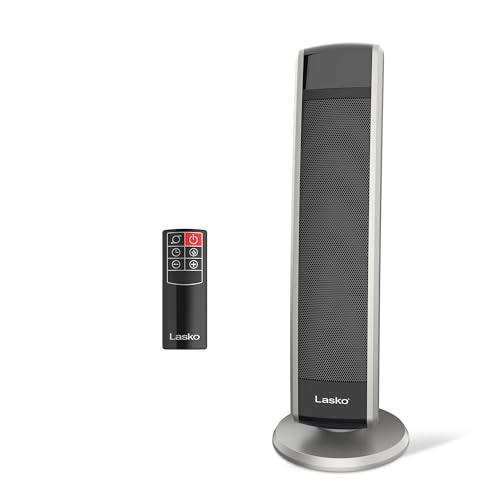
A tower heater is a shape, not a heating technology. Almost every one is a ceramic heater stood on end, which means the element, the wattage ceiling and the running cost are the same as any other plug-in unit. What you are actually buying is the footprint — a narrow column that slides between a sofa and a wall — plus the oscillation and controls that the vertical form factor makes easy to include.
What actually makes a tower heater different from any other space heater?
Height and width, not power. A tower stands roughly two to three feet tall on a base under a foot square, which puts the outlet at chest height rather than ankle height and takes up far less floor area than a boxy heater of identical output.
That geometry has a genuine effect on how the room feels. Warm air rises, so a heater discharging at floor level sends much of its output straight up the nearest wall before it reaches anyone. A tower discharges across a taller column of air and, on oscillating models, sweeps it across the room instead of into a single corner. Owners consistently describe the heat as more even than a small floor unit, which is a distribution difference rather than an output difference.
Ceramic heating element and fan-forced output
Under the hood, the mechanism is usually identical to a conventional ceramic heater: a PTC ceramic element with a fan-forced blower behind it. If you have already decided a fan-driven heater suits the room, the choice between tower and box shape comes down to where it has to live and how much floor you can spare.
Tall profile, 1500 watts and BTU explained
The tall profile is the whole point of the category, but it doesn't change the electrical ceiling. A tower on a standard 120-volt outlet tops out at 1500 watts, the same as any plug-in space heater, which works out to roughly 5,100 BTU per hour. A taller, narrower cabinet does not produce more heat than a shorter, wider one at the same wattage — it just delivers that heat from a different height and over a smaller floor print.
Does oscillation really help, or is it a marketing feature?
It genuinely helps in rooms wider than the heater can reach and does nothing useful in a small one. Sweeping the outlet across a 60 to 90 degree arc spreads the same wattage over more of the space, at the cost of any one spot feeling constantly warm.
The trade-off is worth understanding before you switch it on and leave it. Oscillation makes the average temperature across a room more even, which is what you want in a living room where several people are sitting in different places. It also means the person nearest the heater gets intermittent warmth rather than continuous warmth, which is not what you want at a desk in a cold home office. Most owners who dislike oscillation are using it in the second situation.
It is also not a substitute for output. Sweeping 1,500 watts across a bigger arc does not produce more heat, and a room that a fixed heater cannot warm will not be warmed by the same heater oscillating. If the room is genuinely too large for one plug-in unit, the honest options are two heaters on separate circuits or a different category entirely — see the space heaters hub for how sizing works across the portable range.
How much clearance does a tower heater need, and how real is the tip-over risk?
The standard three feet of clearance from anything combustible applies at the front, and the intake at the back needs breathing room too. The narrow base also demands a flat, hard, level surface — thick carpet and rug edges are the classic tip-over hazard.
Tall and narrow is an inherently less stable shape than short and wide, which is why tip-over protection is more than a checkbox in this category. Confirm the unit has a tip switch that cuts power when it leaves vertical, and then place it where it will not be knocked: not in a doorway, not at the end of a sofa where a passing leg catches it, and not on a rug with a curling edge. Households with dogs or toddlers should treat this as the deciding specification.
Overheat protection and rear intake airflow
The rear intake matters more than owners expect. A tower pushed flat against a wall or wedged behind a curtain can starve itself of air, which drops output, trips the overheat cutoff and eventually produces a hot-dust smell. Overheat protection is the backstop for exactly this situation — it shuts the element down before restricted airflow becomes a hazard. A few inches of gap behind the unit is enough, but it has to be there, and it undercuts some of the space saving people buy the shape for in the first place.
Are tower heaters quiet enough to sleep next to?
They run at ordinary fan-heater volume, which most people accept as white noise. The complaints are rarely about steady sound and almost always about change in sound: thermostat clicks, fan speed shifts on cycling, and the mechanical clunk at each end of the oscillation sweep.
If a bedroom is the destination, the features to look for are a digital thermostat with a real setpoint rather than a vague dial, a low-power setting you can actually sleep through, and the ability to run without oscillation. A unit that holds a steady fan speed while cycling the element is usually less disruptive than one that stops and restarts the fan entirely, even if the second is quieter on paper.
Owners who need silence rather than quiet consistently end up leaving this category. There is no such thing as a fan-free tower heater, and the alternative for overnight use is a fanless radiator design. That said, the bedroom is where tower heaters sell best, largely because the slim base fits beside a nightstand where a boxy heater simply will not go.
Thermostat, timer and remote control features
Because towers compete on controls as much as on heat, a digital thermostat with a real numeric setpoint is worth prioritising over a basic low-medium-high dial. A built-in timer lets the unit shut off after a set number of hours rather than running all night by default, which matters in a bedroom. And because most of that control set lives on the remote control rather than the unit body, check that the buttons you'll actually use — thermostat, timer, oscillation — are also duplicated on the heater itself.
What do tower heater owners complain about most?
Lost or unresponsive remotes, plastic housings that rattle at certain fan speeds, oscillation motors that fail before the heater does, and intake grilles that are awkward to clean. Underneath all of it, the recurring theme is that build quality varies enormously at similar prices.
The remote complaint is more consequential than it sounds. Many tower heaters put the full control set — mode, timer, oscillation, precise temperature — on the remote and leave only a basic power cycle on the unit itself. Lose the remote and you lose most of the functionality you paid for. Where a model offers full controls on the body as well, that is worth weighting heavily.
Cleaning is the maintenance job that keeps these units working. A tower pulls a lot of air through a tall, fine grille, and in a carpeted room that grille clogs with lint within a season. Most reports of a heater that "lost power" or "stopped getting hot" describe restricted airflow rather than a dead element. A vacuum brush over the intake and outlet before each winter is the whole maintenance routine, and it prevents the majority of mid-season failures people write reviews about. For where this category sits alongside the rest of the range, start at the heating pillar.
Is a portable tower heater worth more than a plain electric box heater?
Only if the footprint or the discharge height solves a real placement problem. A tower usually costs a little more for identical output, so the value sits in fitting beside a nightstand or behind a sofa where a boxy unit simply will not go.
It is worth being blunt about what you are buying. Two electric heaters of the same wattage produce the same heat, and no shape changes that arithmetic. The tower is a packaging decision, and packaging is worth paying for when it makes the difference between a portable heater that lives where you need it and one that ends up in a corner pointed at a wall because there was nowhere else to put it.
The secondary benefit is that the vertical format tends to bring better controls with it. Because towers compete on features rather than on raw output, the category skews toward digital thermostats with real setpoints, multi-hour timers, remote controls and multiple fan speeds. Those are the things that make a heater pleasant to live with day after day, and they are noticeably more common here than among the cheapest boxy units — which is a fair argument for the shape even if you have floor space to spare.
Running cost and energy efficient controls
Running cost is identical to any other 1500-watt heater — the shape does not make electricity cheaper. At 1.5 kWh per hour flat out, multiplying by your electricity rate per kWh gives the honest ceiling to plan around. Where a tower can genuinely be more energy efficient in practice is behaviour, not wattage: a precise digital thermostat that holds closer to the setpoint cycles the element less often than a loose mechanical dial, so it draws less power over an evening even though the rated wattage is the same. That is a real, if modest, saving, and it is the one honest efficiency argument for paying more for a better-controlled unit. Brands such as DREO, Lasko, Honeywell and Dyson all sell tower heaters at this price tier, and reading owner reviews for the specific model — not just the brand name — is the more reliable signal of build quality.
Every guide below is ranked from aggregated real owner reviews and manufacturer documentation, never from us buying and running a heater ourselves — see How We Rank for the full methodology.