


Affiliate Disclosure
Some links on this page are affiliate links. As an Amazon Associate, we earn from qualifying purchases — at no extra cost to you. We do not buy, test, or physically handle the products we cover; our rankings come from aggregated owner reviews, ratings and expert consensus. Commissions never change our verdicts. How we rank & full disclosure.
Carbon dioxide is the most useful single number in indoor air, and the least understood. It is not toxic at the levels found in homes, and it is not the thing that harms you — it is a proxy. CO2 accumulates wherever people breathe faster than fresh air arrives, so the reading is really a measurement of ventilation, and ventilation is what determines whether everything else in the air is being diluted or allowed to build up. That is why a CO2 monitor answers a question no other consumer instrument answers well.
What CO2 level indoors is actually a problem?
Outdoor air sits at roughly 420 ppm. Indoors, staying under about 800 ppm indicates good ventilation. Sustained readings above 1,000 ppm signal that fresh air is not keeping up, and 1,400 ppm and beyond is where people commonly report stuffiness, headaches and difficulty concentrating.
These thresholds are about air exchange, not poisoning. Occupational exposure limits sit far higher — regulators typically set workplace limits in the thousands of parts per million over an eight-hour day — and homes essentially never approach a level where CO2 itself is dangerous. What the number tells you is how much of the air you are breathing has already been breathed. At 1,500 ppm in a closed bedroom, a meaningful fraction of every breath is re-inhaled air, and everything else that room emits — VOCs from furnishings, moisture, cooking residue, whatever a person brought home on their clothes — is concentrating at the same rate.
Research linking elevated indoor CO2 to reduced performance on cognitive tasks is real but genuinely contested, with different studies reaching different conclusions about the size of the effect. The defensible position is the simple one: a room with high CO2 is a poorly ventilated room, poorly ventilated rooms accumulate other pollutants too, and the fix — more fresh air — is cheap and has no downside.
Is the CO2 reading real, or is it estimated?
Only NDIR sensors measure carbon dioxide directly, by shining infrared light through an air sample and measuring what the CO2 absorbs. Anything labelled "eCO2" is an estimate derived from a VOC sensor, and it will respond to cleaning products and cooking rather than to occupancy.
This is the single most important thing to check on a specification sheet, and it is often buried. NDIR modules cost meaningfully more than metal-oxide VOC sensors, which is why very cheap devices advertise a CO2 figure they cannot actually measure. If a listing does not say NDIR, or says "equivalent CO2", treat the number as unreliable for the one job you bought it for.
Dual-channel NDIR sensors go a step further by using a second reference wavelength to compensate for lamp ageing and window fouling, which reduces long-term drift. That is a genuine engineering difference rather than a marketing one, and it is worth paying for if the monitor will run continuously for years. Combination devices that measure particulates and VOCs alongside CO2 can be excellent, but check the CO2 channel specifically rather than assuming a well-reviewed multi-sensor unit has a good one — our air quality monitors hub covers how to read those combination specifications.
Do CO2 monitors need recalibrating?
Yes, and most do it silently. Automatic baseline calibration assumes the sensor sees clean outdoor air at some point over a rolling window, and resets its low point to about 400 ppm. In a room that is never fully aired out, that assumption is wrong and the readings drift low.
Automatic baseline calibration is a sensible default for an office that empties every night. It is a trap for a bedroom in a tightly sealed house, a basement, or any space that stays occupied. If the sensor never actually experiences outdoor air, it will progressively decide that your stale baseline is fresh air and under-report from then on — which is the worst possible failure mode, because it makes a ventilation problem look solved.
The practical answer is to check whether your monitor lets you disable automatic calibration and perform a manual one instead. Manual calibration means putting the device outdoors in shade, away from traffic, people and exhaust, letting it stabilise for the interval the manufacturer specifies, and telling it that this reading is the outdoor baseline. Doing that a couple of times a year keeps a good sensor honest. A simple sanity check anyone can run: take the monitor outside and confirm it settles somewhere near current outdoor levels. If it does not, the number indoors is not trustworthy either.
Why do bedrooms read so much higher than the rest of the house?
Because a closed bedroom is a small sealed volume with one or two people breathing into it for eight hours and almost no air exchange. Levels commonly climb well past 1,000 ppm overnight and keep rising until the door opens in the morning.
This is the finding that surprises most new owners, and it is also the easiest one to act on. The overnight curve in a closed bedroom is a near-textbook accumulation graph: it starts near whatever the house was sitting at, rises steeply for the first couple of hours, then flattens as the rate of loss through leaks and gaps starts to match the rate of production. How high that plateau sits depends almost entirely on room volume, occupancy and how well sealed the door and windows are.
The interventions are unglamorous and effective, roughly in order of cost. Leave the bedroom door ajar, undercut a door that seals tightly to the carpet, or crack a window even slightly. Run a bathroom or hallway extractor on a timer, or — in a genuinely airtight home — install proper mechanical ventilation with heat recovery. Modern airtight construction makes this worse, not better, because the incidental leakage that used to ventilate older houses has been deliberately engineered out. Our guide on how to improve indoor air quality covers the ventilation side in more detail.
Should you measure anything else while you are at it?
Radon is the other invisible gas worth measuring, and it behaves completely differently. CO2 tells you about ventilation right now; radon is a long-term exposure risk that only shows up as an average over weeks. One device rarely does both jobs well.
The two are related in one respect: both are diluted by fresh air, so a home with poor ventilation and radon-bearing soil beneath it gets a double penalty. But the measurement problems are opposite. CO2 changes minute to minute and you want a live reading; radon fluctuates daily and seasonally and a single day's number is close to meaningless. If you have never checked, read what radon actually is first — it is the one hazard on this site that no amount of ventilation awareness will reveal, because it has no smell, no colour and no immediate symptoms at all.
For most households the sensible sequence is a CO2 monitor first, because it is inexpensive, gives immediate actionable feedback, and the fixes it points to are free. Radon testing comes next, as a one-off check that either ends the question or starts a different conversation entirely.
What does a CO2 monitor actually measure?
Sensor type, reporting speed and calibration decide whether the number on the display means anything.
NDIR sensor and carbon dioxide accuracy
Only a real NDIR sensor measures carbon dioxide directly, by shining infrared light through the air and reading what CO2 absorbs. Aranet and Temtop both build their accuracy claims around genuine NDIR modules, not the cheaper metal-oxide sensors that only estimate.
ppm thresholds and real-time readings
Readings are reported in ppm, and a real-time display matters more than a logged average for deciding whether to open a window right now. Outdoor air sits near 420 ppm; a bedroom can climb past 1,500 ppm overnight with the door shut.
Calibration, alarm and threshold alerts
Automatic calibration resets the sensor's low point whenever it sees what it assumes is fresh air, which drifts wrong in a room that's never fully aired out. INKBIRD and Vitalight models generally let you set a custom alarm threshold, so alerts fire at a ppm level you actually choose rather than a factory default.
Where do CO2 monitors matter most in a home or office?
The same sensor tells a different story depending on where it sits.
Bedroom and classroom ventilation
Bedrooms and classrooms are the two spaces where poor ventilation shows up fastest, because both pack people into a small volume for hours. A closed bedroom door or a classroom with sealed windows can push CO2 well past the point where concentration visibly suffers.
Office air quality and data logging
In an office, data logging over a week reveals the pattern that a single reading can't — when meetings spike the number and how fast it clears afterward. Temtop's app-connected monitors export that log, which is useful for making the case to facilities for better ventilation.
Indoor air quality, temperature and humidity
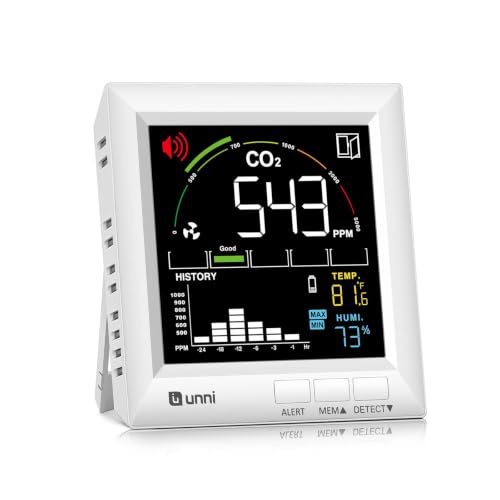
CO2 is one piece of indoor air quality, and most current monitors report temperature and humidity alongside it on the same display. Reading all three together tells you more about a room's ventilation than any single number does on its own.
See How We Rank for our full methodology: every recommendation here comes from aggregated real owner reviews, manufacturer specifications and published standards, never from us buying and running a device ourselves.