



Affiliate Disclosure
Some links on this page are affiliate links. As an Amazon Associate, we earn from qualifying purchases — at no extra cost to you. We do not buy, test, or physically handle the products we cover; our rankings come from aggregated owner reviews, ratings and expert consensus. Commissions never change our verdicts. How we rank & full disclosure.
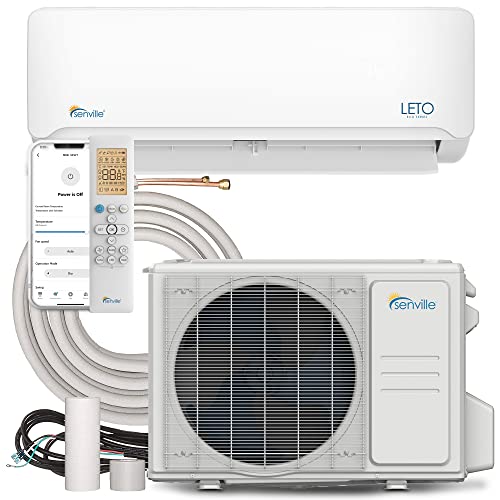
A ductless mini split is the one category in this pillar that is a genuine building improvement, not just an appliance you plug in. An outdoor condenser connects to one or more indoor air handlers through a slim refrigerant line set. That means no ducts and no window taken up. On heat pump models — now most of the market — you get heating as well as cooling from the same equipment. Brands like MRCOOL and Senville built their name on DIY kits with pre-charged line sets, while Pioneer and Daikin lean toward professionally installed systems with higher SEER ratings. The trade-off across the category is upfront cost and an installation that has to be done right.
How do you size a mini split by BTU and square footage?
Size each zone on its own square footage, not the whole house. Cooling capacity maps roughly to room size: 9,000 BTU for about 350 to 400 square feet, 12,000 BTU for 450 to 550, 18,000 BTU for a large open living space, and 24,000 BTU for a substantial great room.
BTU and cooling capacity by room size
Those numbers are a starting point, not a guarantee. Insulation moves them more than in any other cooling category, because a mini split is usually installed for years, not one summer. A well-insulated modern addition can be comfortable at the low end of its BTU range. An uninsulated garage conversion with a roll-up door and a single-pane window needs more cooling capacity than its floor area suggests, and it will still perform poorly until the envelope improves.
Inverter compressors and oversizing
Oversizing carries a real penalty here. Inverter compressors are efficient precisely because they modulate down and run continuously at low output. A unit that is far too large for its zone spends its life cycling at minimum capacity instead, which undermines both efficiency and dehumidifying. If you are choosing between two sizes for a room in the middle of the range, the smaller one running longer is usually the better-behaving system.
What do SEER, energy efficiency and remote control ratings mean?
SEER is the efficiency rating to compare across mini split models. The higher the SEER number, the less electricity a unit uses to deliver the same cooling. ENERGY STAR certification is a fast way to screen for models that clear a meaningful efficiency bar without reading every spec sheet.
SEER and running cost
A jump from a low-SEER window unit to a high-SEER inverter mini split can cut your running cost noticeably over a full summer, especially in a room you cool for months at a time. Manufacturers publish SEER on the same spec sheet as BTU and rated running cost per hour, so it is worth comparing before you compare price.
Energy efficient operation and remote control
Most current mini splits are energy efficient enough to run continuously without the running cost of an older single-stage system. Nearly every model ships with a remote control, and most add a WiFi app that lets you set a schedule from another room. The remote control is also how you switch between cooling, heat pump mode and fan-only operation.
Single-zone or multi-zone: how does zone cooling work?
Single-zone systems are simpler, cheaper per zone, and keep a failure contained to one room. Multi-zone systems share one outdoor condenser across several air handlers, which saves exterior space, but ties every room to one compressor and a more complex install.
The real decision usually comes down to how many rooms you are conditioning and how much exterior wall space you have. Two or three separate single-zone systems often cost less in equipment than one multi-zone system covering the same rooms, and each can be sized precisely for its own square footage. What they cost you is three outdoor condensers, three sets of wall penetrations, and three condensate drains to maintain.
Multi-zone systems have a modulation limit worth knowing before you buy. A shared condenser has a minimum output, so running one small air handler on a mild day can force the whole zone cooling system to work less efficiently than its rating suggests. Owners who condition just one room most of the time report exactly this: the system works, but it never quite matches the SEER number on the box.
Wall-mounted air handlers
Wall-mounted air handlers are the cheapest and easiest to install, and they dominate the market. They sit high on an interior wall and throw air across the room, which suits most bedrooms and living areas without much further thought.
Ceiling cassette air handlers
Ceiling cassette air handlers distribute air more evenly in a square room. They need a suspended ceiling or attic space above, so installation costs more than a wall-mounted unit, but the unit itself all but disappears once fitted.
Floor console and ducted air handlers
Floor-mounted consoles sit low on the wall like a radiator, which suits rooms with sloped ceilings or floor-to-ceiling glass. Slim ducted air handlers hide entirely above a ceiling and feed two or three small registers — the choice when a visible wall unit is not acceptable.
What does ductless mini split installation involve?
Some systems sell as DIY kits with pre-charged, quick-connect line sets built for owner installation — MRCOOL and Senville both built their reputation on this. Conventional systems need the line set evacuated with a vacuum pump and refrigerant handled properly, which in the United States requires EPA Section 608 certification.
Condenser placement and line set length
The outdoor condenser needs a stable pad or wall bracket, clear airflow on at least two sides, and a line set run that stays within the manufacturer's maximum length. A longer line set between the condenser and the air handler loses some efficiency and needs more refrigerant charge, so installers keep the run as short and as straight as the layout allows.
The physical work — mounting the air handler, drilling the wall penetration, setting the condenser on a pad, running the condensate line — is within reach of a competent DIYer, and DIY kits are genuinely popular for garages, workshops and studios for that reason. What people underestimate is the electrical work, which usually means a dedicated circuit and often a permit. The other risk point is the flare connections on the line set, where a poor joint leaks refrigerant slowly enough that the symptom shows up months later as fading cooling capacity.
Professional installation frequently costs as much as the equipment itself, and that varies a lot by region and by how hard the run is. See our mini split cost guide for real numbers owners report paying. That is the single biggest reason people compare this category against a window air conditioner and pick the window unit for a room they only cool a few months a year. The mini split's case is strongest where you need year-round conditioning, quiet operation, or heat pump heating and cooling from one system.
Does a mini split heat pump work as well as it cools?
Most modern mini splits are heat pumps and heat efficiently in mild and moderate cold. Cold-climate models are engineered to keep producing useful heat well below freezing, with rated operation continuing into deeply sub-freezing outdoor temperatures, though capacity declines as it gets colder.
This is what makes the category genuinely different from every other appliance in this pillar. A heat pump moves heat rather than generating it, so in its efficient operating range it delivers several units of heat energy per unit of electricity — a fundamentally different economic proposition from a resistive space heater, which can never beat one-to-one. In a room with no heating and no cooling at all, one mini split can replace both purchases.
The qualifications matter, though. Standard-range models lose real capacity as outdoor temperatures drop and may lean on backup heat in a genuinely cold winter. Defrost cycles briefly interrupt heating in damp, near-freezing weather, which surprises owners who were never warned about it. And a system sized for a cooling load can be undersized for the heating load in a cold region — sizing for the harder season is what actually matters. See our guide to heating and cooling a room efficiently for how that balance plays out across a year.
What maintenance and remote control care do mini splits need?
Wash the air handler's mesh filters monthly during heavy use, keep the outdoor condenser coil clear, and check that the condensate drain runs freely. The blower wheel inside the air handler also needs occasional deep cleaning, which is the maintenance step owners skip most.
Refrigerant lines and line set care
A leaking line set is the maintenance problem you cannot see. Watch for cooling capacity that fades gradually over a season, ice forming on the outdoor condenser, or a hissing sound near a flare fitting. All are signs the refrigerant charge is low and a technician needs to find the leak, not just top it up.
The recurring complaint in owner reviews of otherwise well-regarded systems is a musty smell from the air handler after a few seasons. The cause is biological growth on the damp evaporator and blower wheel, and it is hard to reach because the head is a sealed plastic enclosure on the wall. Many units include a self-drying or fan-only cycle that runs the blower after cooling stops. Using it cuts the problem a lot, and periodic professional cleaning resolves it once it has already set in.
Condensate is the other maintenance point. Air handlers drain by gravity through a small line to the outside, and any sag, blockage or insect nest in that line will eventually put water down the wall beneath the unit. Where gravity drainage is not possible — a basement, or a head below outdoor grade — a small condensate pump takes over, and that pump becomes one more component to check. If cooling one room permanently is not worth this level of commitment, portable air conditioners need none of it, at a real cost in efficiency and noise.
Every product recommendation below is ranked from aggregated real owner reviews and manufacturer specifications, never from us buying and running a unit ourselves — see How We Rank for the full methodology.