



Affiliate Disclosure
Some links on this page are affiliate links. As an Amazon Associate, we earn from qualifying purchases — at no extra cost to you. We do not buy, test, or physically handle the products we cover; our rankings come from aggregated owner reviews, ratings and expert consensus. Commissions never change our verdicts. How we rank & full disclosure.
Ultrasonic humidifiers exist because people wanted moisture without fan noise, and they deliver that better than any other design. The mechanism that makes them silent, though, is also the mechanism behind every complaint the category attracts — white dust on the furniture, damp patches on the floor, and a tank that turns unpleasant faster than owners expect. None of that makes them a bad buy. It makes them a buy with a routine attached.
How does an ultrasonic humidifier actually make mist?
A small ceramic disc — a piezoelectric transducer — vibrates thousands of times per second at the bottom of the water reservoir. The vibration shears microscopic droplets off the water surface, and a low-speed fan pushes the resulting cloud into the room. Nothing is heated and nothing is filtered.
That distinction matters more than it sounds. An evaporative humidifier converts liquid water to vapor, leaving minerals and debris behind in the wick. An ultrasonic humidifier does not evaporate anything — it physically breaks water into a suspension of tiny droplets. Whatever is dissolved or floating in the tank leaves with them.
The visible plume that people associate with a "working" humidifier is therefore not water vapor at all; it is liquid aerosol, which is why you can see it. It becomes genuine humidity as those droplets evaporate in the room air — and whatever they were carrying is left behind as fine particulate.
What causes the white dust, and can you stop it?
Dissolved minerals, mostly calcium and magnesium, from hard tap water. The droplets evaporate mid-air and drop their mineral content as a fine white powder on nearby surfaces. Distilled or demineralized water eliminates it entirely; a demineralization cartridge reduces it and is a consumable.
The severity tracks your water hardness exactly. Households on soft municipal water may barely notice; households on hard well water can get a visible film on a bedside table within a couple of nights. The dust itself is inert mineral, but it is abrasive on screens and lenses, it settles into keyboards and speaker grilles, and it is a nuisance to keep wiping.
The reliable fix is distilled water, and the honest downside is that buying distilled water by the gallon all winter is both a cost and a chore. Demineralization cartridges are the middle path: they reduce mineral carryover meaningfully rather than perfectly, and they need replacing on a schedule. Filtered pitcher water is not a solution — carbon filters remove taste and chlorine, not dissolved hardness. If white dust would be a dealbreaker in your house, an evaporative unit sidesteps the problem completely, and the options are covered on our cool-mist humidifiers hub.
Are ultrasonic humidifiers really quiet enough for a bedroom?
Yes — the mist generation itself is essentially inaudible, and the fan runs far slower than an evaporative unit's. What owners actually complain about in bedrooms is not the humidifier noise but confirmation beeps, bright status LEDs and occasional gurgling as the reservoir refills the base.
The acoustic profile is the genuine selling point of the category. There is no wick to force air through, so there is no broadband rush of air, and light sleepers who cannot tolerate an evaporative fan generally get along with an ultrasonic unit. What breaks the peace is the interface: a panel that beeps every time a button is pressed, a display bright enough to light a wall, or an LED nightlight with no off switch.
Look for a genuine night or sleep mode that fully extinguishes the display rather than dimming it, and check whether the beep can be silenced. The gurgle — a periodic glug as water moves from the tank into the base — is inherent to the design on most models and tends to be loudest just after a refill. It bothers some people and not others, and it is worth knowing about before it surprises you at 2am.
Why does tank cleaning matter more on an ultrasonic unit?
Because there is no boiling step and no wick to trap anything. A warm reservoir of standing water grows biofilm within days, and an ultrasonic transducer will atomize that biofilm and distribute it around the room along with the water. Empty daily, clean weekly, without exception.
This is the one non-negotiable in the category, and it is the reason a lot of public-health guidance is more cautious about ultrasonic units than about steam vaporizers. The routine is genuinely short: tip out water that has been sitting rather than topping it up, wipe the base dry, and refill fresh. Once a week, sit white vinegar in the reservoir to dissolve scale, work the transducer gently with a soft brush, and rinse thoroughly before refilling.
Two warning signs are worth acting on immediately. A sour or musty smell as the unit starts means there is something growing in the base. A slick or pink ring on the inside of the reservoir means the same thing further along. Scale on the transducer disc itself is the other maintenance item — a mineral-crusted disc simply produces less mist, and owners regularly diagnose that as a dying humidifier when it is a ten-minute vinegar soak.
How do you avoid the damp-furniture problem?
Raise the unit off the floor onto a water-safe surface, keep at least a foot of clearance from walls and soft furnishings, and aim the nozzle into open space. A dense cool plume that hits any surface within a couple of feet settles there as liquid water rather than dispersing.
Ultrasonic mist is heavier than water vapor and falls before it fully evaporates, which is why floor placement is such a reliable way to end up with a damp carpet ring. The same physics produces warped veneer on bedside tables, condensation on a nearby window, and — over a season — mildew on a wall that was in the plume's path. Height and clearance solve almost all of it.
The related risk is over-humidification. Unlike an evaporative unit, an ultrasonic humidifier does not slow down as the room gets wetter; it will keep atomizing past 60% relative humidity until something tells it to stop. Buy a model with a real humidistat, verify it against an independent hygrometer, and keep the room inside the comfortable band described in our guide to the ideal indoor humidity level.
Who should not buy an ultrasonic humidifier?
Anyone on hard water who will not buy distilled, anyone who knows they will not clean a tank weekly, and anyone humidifying a room that already runs damp. In all three cases an evaporative unit is more forgiving, even though it is louder.
That is not a criticism of the technology — it is a match-to-owner problem. Ultrasonic units reward a household that keeps a jug of distilled water beside the unit and runs a vinegar cycle on a Sunday. They punish a household that fills from the kitchen tap and forgets about it until March. Being honest with yourself about which household you live in is the single highest-value decision in this category.
It is also worth checking whether a portable is the right shape of solution at all. If the dryness is house-wide rather than confined to one or two rooms, a ducted system removes both the refilling and the water-quality problem in one move; the trade-offs are set out on our whole-house humidifiers hub.
What types of ultrasonic humidifiers are there?
Mist temperature and extra features split this category into a few clear formats.
Cool mist ultrasonic humidifiers
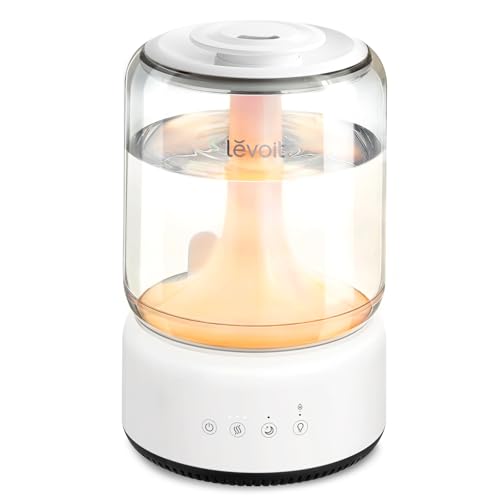
Cool mist ultrasonic humidifiers are the most common format, releasing room-temperature mist with no heating element. LEVOIT and Everlasting Comfort both build widely reviewed cool mist units. They're the safer choice around kids, since there's no hot water anywhere in the unit.
Warm mist ultrasonic humidifiers
Warm mist units add a small heater to warm the water slightly before it's atomized, which some owners believe helps with congestion. Pure Enrichment sells both cool and warm mist versions of its popular line. The added heating element means more parts that can scale and fail over time.
Filterless nursery humidifiers
A filterless design skips the wick entirely, relying only on the ceramic transducer. That makes it a popular nursery pick because there's no filter to replace on a schedule — just the reservoir to clean weekly.
Essential oil diffuser combos
Some ultrasonic humidifiers double as an essential oil diffuser, with a small tray or cup separate from the main tank. TaoTronics is one of the brands that leans into this combo format. Keep oils out of the main reservoir unless the manufacturer explicitly says it's safe.
What specs actually matter when buying one?
Past mist type, a short list of specs decides how much you refill it and how well it holds a target humidity.
Tank capacity, square footage and runtime
Tank capacity ranges from under a gallon on a small bedside unit to several gallons on a whole-room model, and it decides runtime directly. Match tank size and square footage together — a large tank in a small room just means refilling less often, not more coverage.
Humidistat and relative humidity control
A built-in humidistat holds the room at a target relative humidity instead of misting continuously. Without one, an ultrasonic unit will keep adding moisture well past a comfortable level, since it doesn't slow down the way an evaporative unit naturally does.
Auto shut-off, mist output and dry air
Auto shut-off stops the unit once the tank runs dry, protecting the transducer from running with no water. Mist output — how fast it treats dry air — is worth checking against the room size rather than assuming bigger is always better.
Distilled water and energy efficient use
Distilled water is the fix for white dust and mineral buildup on the transducer, and the EPA's guidance on humidifier hygiene backs regular cleaning alongside it. On power, ultrasonic humidifiers are already energy efficient — a small transducer and low-speed fan draw far less than a boiling steam unit.
Everything on this page comes from aggregated owner reviews, manufacturer specifications and the complaint patterns that repeat across brands and price points — not from us buying and running a unit. Our How We Rank page explains that methodology in full.