


Affiliate Disclosure
Some links on this page are affiliate links. As an Amazon Associate, we earn from qualifying purchases — at no extra cost to you. We do not buy, test, or physically handle the products we cover; our rankings come from aggregated owner reviews, ratings and expert consensus. Commissions never change our verdicts. How we rank & full disclosure.
A space heater is the cheapest way to fix one cold room and the most commonly misused appliance in the house. Almost every buying decision comes down to three questions: how big the room is, how long you need the heat to last, and whether anyone will be in the room while it runs. Get those right and everything else — brand, styling, remote control, app support — is detail.
How many watts, and how many BTU, does a space heater need for the room you're heating?
Start at roughly 10 watts per square foot. That puts a 1,500-watt heater — the practical ceiling for a standard 120-volt household outlet — at about 150 square feet of averagely insulated room, and considerably less if the ceilings are high or the windows are single-pane.
The ten-watts-per-square-foot rule is a supplemental-heat rule, not a whole-house one. It assumes the room already has some background heat, has reasonable insulation, and that you are raising the temperature a handful of degrees rather than warming a cold shell from scratch. In a finished bedroom with the door closed it holds up well. In a sunroom with three exterior walls, a converted porch, or a room sitting over an unheated crawlspace, expect to need more output than the arithmetic suggests — or to accept that the room will simply take longer to get comfortable.
1500 watts and BTU output explained
It helps to know what 1500 watts actually buys: roughly 5,100 BTU per hour. That is a genuine amount of heat for one room and nowhere near enough for a floor of a house. Listings that advertise coverage far past 300 square feet from a single 1500-watt unit are describing an ideal case — small, sealed, already warm — not the drafty room you are probably shopping for. If you need more than one heater's worth of output, the answer is a second unit on a separate circuit or a hardwired 240-volt heater, not a bigger plug-in.
Which type of space heater suits the way you actually use the room?
Fan-forced ceramic heaters warm a small room fastest. Oil-filled radiators are slower but silent and steady, which suits overnight use. Infrared warms people and objects in line of sight, which suits workshops and desks. Tower heaters trade raw output for a narrow footprint.
The categories differ less in power than in how the heat is delivered. Convection heaters — ceramic, oil-filled, most towers — warm the air, which then circulates around the room. Radiant heaters warm whatever they can see. A convection heater in a room with an open door is fighting a losing battle, while a radiant heater aimed at an empty chair is heating nothing useful. Match the delivery method to where people actually sit for hours at a time.
Ceramic heaters: fast, fan-forced heat
Ceramic heaters use a fan-forced element to push warm air out fast, so a small room feels the difference within a minute of switching on. That speed comes with continuous fan noise, which is the trade-off most owners accept without thinking about it until they try to sleep next to one. They are the closest thing to an all-purpose electric heater — cheap, small, and the default recommendation when nothing else about the room is unusual.
Infrared heaters: radiant heat for workshops and desks
Infrared heaters produce radiant heat rather than warming the air, so they heat people and objects directly in their line of sight, the same way sunlight through a window feels warm even on a cold day. That makes them well suited to a workshop, a garage desk, or any spot where you sit still and want warmth aimed at you rather than the whole room. Move out of the beam, or block it with furniture, and the effect disappears almost immediately.
Oil-filled radiators: silent, steady supplemental heat
Oil-filled radiator heaters have no fan at all, which makes them the quietest common option and the standard answer for a nursery, a bedroom, or a home office where you take calls. They are slower to warm a room than a ceramic heater, but once up to temperature they hold heat steadily, which suits overnight use as reliable supplemental heat rather than a quick burst.
Tower heaters: narrow footprint and oscillation
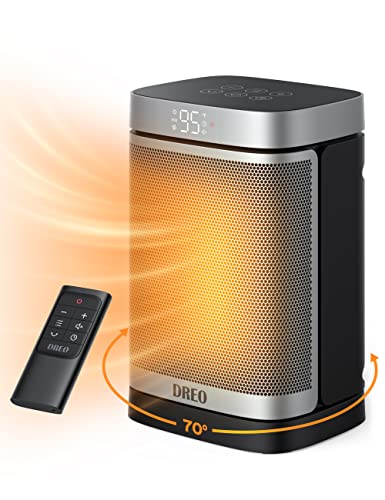
Tower heaters are usually a ceramic element stood on end, so the running cost and output match a standard fan-forced unit — what changes is the shape. A narrow base slides between furniture where a boxy heater won't fit, and oscillation sweeps the warm air across a wider arc of the room instead of into one corner. See our tower heaters hub for how the format compares in bedrooms specifically.
Neither type is better in the abstract; they solve different problems, and owners who buy the wrong one are usually the ones who return it. Brands such as DREO, Lasko, Amazon Basics and Vornado all sell across most of these categories, and reading owner reviews within one specific type — not just the brand overall — tells you more than the brand name alone.
Is a space heater more energy efficient than turning up the thermostat, and what's the real running cost?
Only if you turn the thermostat down at the same time. Zone heating — one warm room, a cooler house — usually saves money and is the more energy efficient pattern. A space heater running on top of an unchanged central setting is pure added running cost, and it is the mistake that produces surprised owners in January.
The arithmetic is easy enough to do yourself. A 1500-watt heater running flat out uses 1.5 kilowatt-hours (1.5 kWh) per hour, so multiplying 1.5 by your electricity rate per kWh gives the hourly running cost of continuous operation. Most heaters do not run flat out for long — a thermostat cycles the element on and off once the room hits temperature — so real-world cost usually lands well below that figure. But it is your ceiling, and it is the honest number to plan around rather than a manufacturer's efficiency claim.
Whether that beats your central system depends entirely on what fuels it. Against electric resistance central heat, a space heater almost always wins, because you are heating far less volume. Against a modern gas furnace or a heat pump, the comparison is much closer and can go either way. For a method you can apply to your own home's indoor climate instead of a generic dollar figure that will not hold across different houses, work through the efficiency guide before you commit to a zone-heating strategy.
What tip-over and overheat safety features should any electric heater have?
Tip-over shut-off and overheat protection — both standard on current units, both worth confirming before purchase rather than after. Beyond the heater itself: three feet of clearance from anything combustible, a wall outlet rather than an extension cord, and no unattended overnight operation.
US fire safety authorities consistently identify portable heaters as a leading cause of home heating fires, and the pattern in incident reports rarely varies: something combustible too close to the unit, or a heater left running in a room nobody was watching. The three-foot rule covers bedding, curtains, laundry, upholstered furniture and stacked boxes — all of which have a habit of migrating toward a warm heater over the course of a winter.
The extension-cord warning is the one owners ignore most, and should not. A 1,500-watt heater draws around 12.5 amps continuously, which is more than most household extension cords and virtually every power strip is rated to carry for hours on end. If the only outlet is across the room, the fix is a different heater position or an electrician, not a longer cord. Owners who report melted plugs or scorched outlets nearly always describe an undersized cord or an old, loose receptacle in the same sentence.
What do owners complain about most after a full season of use?
Three complaints dominate: a thermostat that swings too far before cycling, fan or click noise that is tolerable by day and intolerable at 2am, and a burnt-dust smell on the first run each winter. Only the first two are worth returning a heater over.
The thermostat complaint is the most legitimate one. Basic mechanical thermostats can let a room drift several degrees either side of the setting, which owners experience as "too hot, then too cold" rather than as a steady temperature. Digital thermostats with a displayed setpoint generally hold tighter, and owners consistently report more satisfaction with them in bedrooms, where the swing between cycles is exactly what wakes people up at night.
The first-use smell is normal — dust settled on a cold element burning off — and it clears within a few minutes in a ventilated room. A smell that persists, or any smell of hot plastic, is not normal and means the unit should be unplugged and returned. The other recurring theme in reviews is lifespan: plug-in heaters behave more like consumables than appliances, and one that runs daily through several winters has done well. If you want something that lasts a decade in the same spot, that is an argument for a fixed installation, not a portable.
When is a portable heater the wrong answer entirely?
When the room is cold because of a building problem rather than a heating one. Drafts around a door, an uninsulated exterior wall, a window that leaks air — a heater masks all of those permanently and expensively, and fixes none of them.
It is worth spending an hour with a hand held near frames, sills and outlet plates on a windy day before spending anything on an appliance. Cold rooms in otherwise warm houses very often have a specific, findable cause: a bathroom fan that never had a damper, a supply register closed years ago and forgotten, a return path blocked by a bookcase, or a gap where the floor meets an exterior wall. Weatherstripping and a tube of caulk solve some of those permanently for less than the price of a cheap heater.
The other wrong answer is scale. If several rooms are cold, or the whole house struggles on the coldest nights, portable heaters are an expensive way to paper over a central system that is undersized, poorly balanced or overdue for service. One heater in one room is a sensible fix. Four heaters in four rooms is a diagnosis waiting to happen, and the money is better spent finding out why.
Every guide below is ranked from aggregated real owner reviews and manufacturer documentation, never from us buying and running a heater ourselves — see How We Rank for the full methodology.


