


Affiliate Disclosure
Some links on this page are affiliate links. As an Amazon Associate, we earn from qualifying purchases — at no extra cost to you. We do not buy, test, or physically handle the products we cover; our rankings come from aggregated owner reviews, ratings and expert consensus. Commissions never change our verdicts. How we rank & full disclosure.
Mold is the category where an air purifier is most often bought to solve the wrong half of the problem. Filtration does a genuinely useful job on airborne mold spores, and it does absolutely nothing about mold growing on a surface. Because visible growth is what people notice and act on, the mismatch between expectation and mechanism is bigger here than anywhere else in air purification — so it is worth being blunt about where the machine helps and where it is the wrong tool entirely.
Can an air purifier actually remove mold spores?
Airborne spores, yes. Mold spores typically range from about 2 to 30 microns, well within what a true HEPA filter captures at very high efficiency. What a purifier cannot do is touch a colony growing on drywall, grout or a joist — that is a moisture and remediation problem, not a filtration one.
Spores become airborne when a colony releases them or when disturbed growth is stirred up. Once suspended, they behave like any other particle: they pass through a purifier's intake, hit the filter media and stay there. That is real, useful work — reducing the spore count in a room lowers the ongoing exposure and reduces how much settles elsewhere to potentially colonize new damp surfaces.
But the source keeps producing. A purifier running in a room with active growth is emptying a bucket that is still being filled. Filtration is a legitimate supporting measure during and after remediation, and a reasonable ongoing control in a home that is prone to damp — it is not a treatment for mold itself.
Why is humidity the real fix for mold?
Mold needs moisture to grow, and indoor relative humidity above roughly 60% makes almost any organic surface hospitable. Holding a home in the 30–50% band removes the condition mold depends on, which no amount of filtration can substitute for.
This is why a dehumidifier is frequently the more important purchase in a damp basement, and why pairing the two is common. The dehumidifier removes the growth condition; the purifier reduces the spore load already circulating. Running a purifier alone in a persistently damp space produces the frustrating outcome owners describe often — the air feels cleaner, the musty smell keeps coming back, and the growth continues behind the drywall.
Humidity has a second effect worth knowing about. The same band that discourages mold also discourages dust mites, which thrive above about 50%. Getting the moisture level right is the highest-leverage single change in a damp home, and the ideal indoor humidity level guide sets out the target range and how to measure it accurately.
Does a mold purifier need activated carbon?
If musty smell is part of the complaint, yes. That characteristic odor comes from microbial volatile organic compounds — gases that pass straight through HEPA media. Only a real activated carbon bed adsorbs them, and a thin carbon-coated mesh saturates quickly in a damp space.
The presence of that smell is itself diagnostic. Musty odor means there is active or recent growth somewhere, often out of sight behind a wall, under flooring or in a crawlspace. Carbon can reduce how much of it reaches your nose, but a purifier that masks a persistent musty smell without the source being found is doing you a disservice — the odor is the most reliable early signal most homeowners get.
If odor control is the priority, look for carbon quantified by weight or supplied as a separate replaceable cartridge, and expect it to need changing more often than the HEPA filter. In a basement running continuously through a humid summer, carbon can saturate well inside the manufacturer's suggested schedule with no warning, since most filter indicators count operating hours rather than sensing saturation.
Should you use a UV or ozone purifier against mold?
Be careful here. Ozone generators are marketed for mold and are not safe to run in an occupied space — ozone is a lung irritant, and concentrations high enough to affect mold are well above safe exposure levels. UV-C stages are safer but only act on organisms held in the light path long enough to matter.
This is the one place in air purification where a product category carries a genuine health caveat rather than just a performance one. Ozone is a respiratory irritant, and public health guidance is consistent that ozone generators should not be operated in occupied rooms. Manufacturer marketing in this space is frequently far more confident than the evidence supports.
UV-C is a different proposition and less risky, but its practical contribution inside a consumer purifier is limited: air moves past the lamp quickly, and contact time is what determines whether the light does anything at all. It is best treated as a possible bonus stage on top of good HEPA and carbon filtration, never as the primary mechanism. The trade-offs are laid out in more detail in UV and ozone air purifiers.
What do owners in damp homes report?
The consistent pattern is that filtration helps with symptoms and smell while the moisture problem is being addressed, and disappoints when bought as a standalone solution. Basements in particular need a purifier rated well above the room’s floor area because air movement in them is poor.
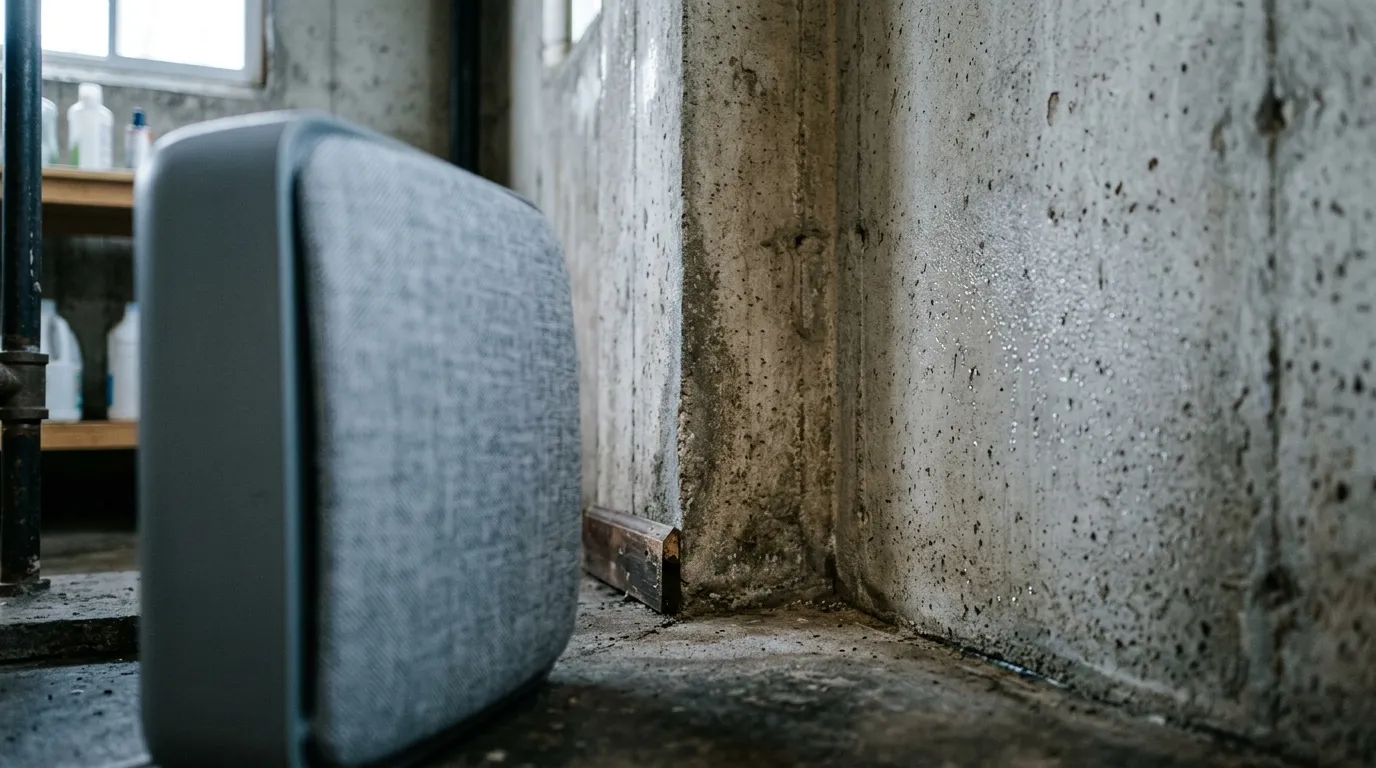
Basement placement deserves specific attention. These spaces are often partitioned, have low ceilings and poor circulation, and are frequently the coolest surfaces in the house — which is exactly where condensation forms. A purifier sized for the square footage on paper can underperform badly if the air simply does not circulate to reach it, so central placement, clear intake faces and a unit with capacity to spare all matter more here than in an open living room.
The other repeated lesson from owner reports is sequencing. Fix the leak, improve the ventilation, get the humidity into range, remediate visible growth — and then let the purifier handle what remains airborne. Done in that order it is a useful machine; done first it is an expensive air freshener. The broader running order for a home is covered in how to improve your home's indoor climate.
Does a purifier help during and after mold remediation?
Yes, and this is arguably its strongest use case here. Disturbing mold during removal releases large numbers of spores into the air, and running HEPA filtration in the adjacent living space captures what escapes the work area rather than letting it settle elsewhere.
Containment does the primary job: sealing the work zone, exhausting it directly outdoors, and keeping doors closed. The purifier belongs in the room being protected, not inside the dust cloud, where it would load its filters in days while still losing the battle. Kept just outside the containment, it catches what leaks through doorways and gaps.
Afterwards is when filtration earns its keep for a second time. Spores that were released during the work stay suspended for hours and continue to be stirred up from surfaces for days, so running the unit continuously for a week or two after remediation is a sensible precaution. Expect to replace the filter sooner than the schedule suggests — a remediation cycle can consume a substantial share of a HEPA filter's useful life in a very short period.
What size and filter type actually stops mold spores?
Sizing and filter type matter more in a damp room than almost anywhere else, because air movement is usually poor.
Square footage, air changes per hour and CADR
Size a mold purifier to your room's square footage the same way you would for allergies, but push toward more air changes per hour rather than fewer. A basement's poor air movement means a generous CADR matters more here than almost anywhere else.
True HEPA vs regular HEPA for spores
Mold spores fall well within what a true HEPA filter captures at very high efficiency. Coway, LEVOIT, Alen and Medify all publish true HEPA specs on their mold-marketed models — check for the certified claim, not just the word HEPA on the box.
Activated carbon for musty odor and VOC
Musty odor comes from microbial VOC gases, not particles, so HEPA media alone won't touch it. Only a real activated carbon bed adsorbs those compounds, and a thin carbon mesh saturates fast in a damp space.
Filter replacement in a damp basement
Filter replacement runs faster in a humid, continuously operating basement than the manufacturer's schedule assumes. AHAM-rated filter life figures are measured under normal conditions, not a damp crawlspace running a unit around the clock.
What else affects air quality and allergens in a moldy room?
Spores aren't the only thing in the air, and where the purifier sits matters as much as what's in it.
PM2.5, allergens and basement placement
PM2.5 and other allergens circulate more in a poorly ventilated basement, where a purifier sized for the square footage on paper can still underperform. Central placement with clear intake faces matters more here than in an open living room, and it directly affects the EPA-tracked air quality inside.
UV-C stages and mold spore exposure
A UV-C stage can inactivate some mold spores, but only with enough contact time — air moving quickly past a small lamp gets only a fraction of a second of exposure. Treat it as a bonus stage on top of good HEPA and carbon filtration, not the primary defense against spore exposure.
Every recommendation in this category is built from aggregated real owner reviews and published manufacturer filtration specifications, never from buying and running units ourselves — see How We Rank for the full methodology.