


Affiliate Disclosure
Some links on this page are affiliate links. As an Amazon Associate, we earn from qualifying purchases — at no extra cost to you. We do not buy, test, or physically handle the products we cover; our rankings come from aggregated owner reviews, ratings and expert consensus. Commissions never change our verdicts. How we rank & full disclosure.
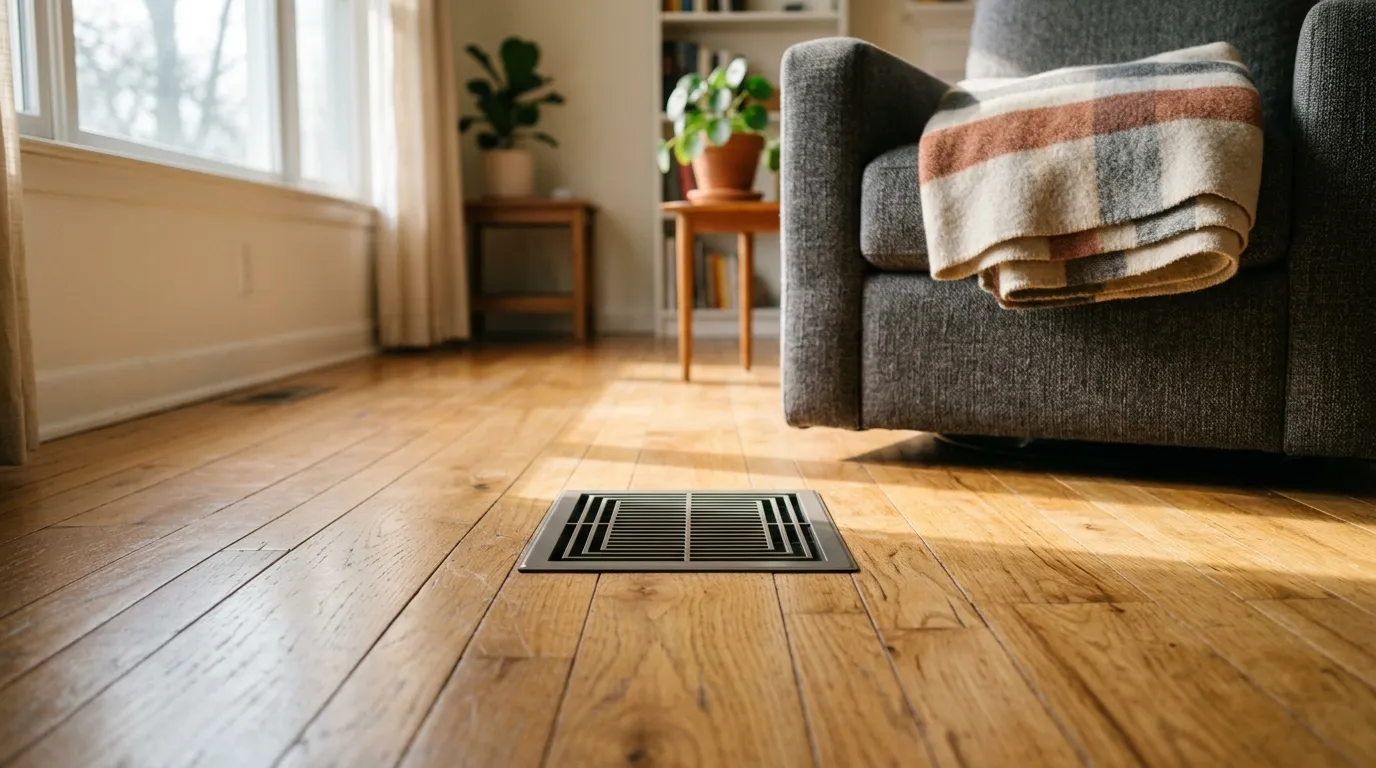
Smart vents are the most conditional purchase in this pillar. They are motorised replacements for the supply registers already in your floors, walls or ceilings, and they promise something genuinely appealing: room-by-room control layered onto a central system that was only ever designed to treat the whole house as one zone. In the right home they work well. In the wrong home they can make an HVAC system less efficient, noisier and in some cases genuinely stressed. Knowing which home you have is most of the buying decision.
What do smart vents actually do?
They replace standard registers with battery-powered motorised dampers that open and close on command. Paired with room temperature sensors and a hub or a smart thermostat, they redirect airflow away from rooms that have reached target temperature and toward rooms that have not.
Dampers, registers and hub control
Inside each unit is a small motorised damper that pivots to open or close the register. That damper is the whole mechanism — everything else is sensing and communication built around it. Most systems route their commands through a central hub, which talks to every vent in the house and to your thermostat. Brands like Flair, Keen Home and Ecovent each build this a little differently, but the damper-plus-hub pattern is common to nearly all of them.
WiFi, app control and automation
Vents themselves usually talk to the hub over a low-power radio protocol, and the hub connects to your WiFi network to reach the app. From the app you get manual override, scheduling, and automation rules — close this room's vent at bedtime, open it when the sensor reads above 74°F. Some systems integrate with Google Home or a smart thermostat so vent behaviour and whole-house automation share the same room-level data instead of working in isolation.
Fitting them is mechanically trivial. Registers come in standard sizes — 4x10, 4x12, 6x10, 6x12 and a handful of others. Installation is usually a matter of lifting the old grille out and dropping the new one in. Measure the duct opening rather than the visible faceplate, and check whether yours are floor, wall or ceiling units, since ceiling installations need a retention mechanism and not every model offers one. Non-standard or older openings are a common source of returns.
Can smart vents damage an HVAC system by restricting airflow?
They can stress one. Closing supply registers raises static pressure in the duct system and reduces total airflow across the coil or heat exchanger. In cooling that can lead to a frozen evaporator coil. In heating it can trip the furnace high-limit switch and cause short cycling.
This is the single most important thing to understand before buying, and it is not a fringe concern — it is basic duct physics. A forced air system is designed around a specific airflow volume. Choke that flow and the air passing over the cooling coil slows down. The coil gets colder than intended, and moisture on it can freeze into a block of ice that stops airflow entirely. On the heating side, insufficient airflow lets the heat exchanger run hotter than designed, and the safety limit switch shuts the burner down repeatedly. Neither failure is instant, and both shorten equipment life.
Zoning and room-by-room balancing
Smart vents are a form of zoning without the ductwork changes that a true zoned HVAC system needs. Instead of dampers built into the trunk lines, each room gets its own register-level damper doing room-by-room balancing on the fly. That is cheaper to install than real zoning, but it is also less controlled. There is no central damper coordinating the whole system, just a set of independent vents reacting to their own room sensors. Balancing works best when the system has headroom to spare, not when it is already running at its limit.
Reputable manufacturers take this seriously. Most systems include a pressure sensor that watches duct static and forces vents back open if it climbs too far, and most cap how many vents may be closed at once — commonly refusing to close beyond roughly a third of the total. Treat those safeguards as mandatory rather than optional. A smart vent product without any pressure awareness is asking you to guess at a limit you cannot see. There is also a secondary effect worth knowing: higher duct pressure pushes more air out through existing duct leaks, so a leaky system loses more conditioned air into the attic or crawlspace exactly when you are trying to be more efficient.
Which forced air homes are a good fit, and what about compatibility?
Homes with modern variable-speed or multi-stage forced air equipment, ductwork in reasonable condition, and one or two rooms that are consistently wrong while the rest of the house is fine. Older single-stage systems with fixed-speed blowers and marginal ducts are the worst candidates.
Variable-speed blowers adapt to changing static pressure by modulating their output. That makes them far more tolerant of partial vent closure. A single-stage system with a fixed-speed motor cannot adapt — it simply pushes against a higher restriction and moves less air. If you do not know what you have, the equipment label or a service invoice will usually tell you. It is worth finding out before spending money on vents.
Temperature sensors and installation compatibility
Most smart vent systems ship with small wireless temperature sensors you place around each room, separate from the vent itself. Those sensors are what drives the automation — the vent opens or closes based on what the sensor reads, not on the vent's own housing temperature. Before buying, check compatibility with your specific duct opening sizes and register style, and confirm the temperature sensors will pair with your model of hub without a separate subscription. Installation of the sensors is simple, usually double-sided tape or a small stand, but placement matters as much as it does for a thermostat.
Two other constraints rule out a lot of homes immediately. Ductless mini-split systems have no ducts and therefore no registers to replace. Hydronic and radiant systems have no airflow to redirect. And in any home where the uncomfortable room has its door closed with no return path — no return grille, no transfer grille, no meaningful undercut beneath the door — supply-side control alone will underperform, because air pushed into a sealed room has nowhere to go. Adding a transfer grille often does more for that room than any vent product.
Will smart vents deliver real energy savings?
Rarely as much as the marketing implies. There is a real saving in not conditioning rooms nobody uses, but it is partly offset by the system running longer at reduced efficiency against higher duct pressure. Buy them for comfort, and treat any energy savings as a bonus.
The reasoning is straightforward. Closing a vent does not reduce what the equipment produces — the blower still runs, the compressor or burner still fires. What changes is where that output goes. If your thermostat is satisfied sooner because the sensed room warms faster, the cycle shortens and you do save. If instead the system runs longer to satisfy a room that was previously being helped by the surplus from elsewhere, you can spend more. Which outcome you get depends on your house. An ENERGY STAR certified forced air system, with a variable-speed blower, tends to see the most genuine benefit, because it can adapt smoothly to the changing pressure instead of fighting it.
The honest sequencing advice is to exhaust the cheaper fixes first, because they are usually the actual cause. Sealing accessible duct joints, insulating ducts running through unconditioned attics, adding attic insulation, addressing a room with disproportionate window area, and having a technician balance the system at the manual dampers on the trunk takeoffs are all one-time costs with no batteries, no app and no ongoing failure mode. Our guide on heating and cooling a room efficiently covers those envelope and distribution fixes in detail, and for many homes they resolve the problem room entirely.
What do owners complain about most?
Batteries, cost multiplied across a house, and noise. Each vent needs its own batteries replaced on a cycle, a whole-house installation adds up quickly because you pay per register, and the actuator makes an audible sound every time it moves.
Battery life and hub dependence
Battery management is the recurring theme in owner feedback, and it scales badly. One vent is a non-issue. Twelve vents means twelve sets of batteries on staggered schedules, and a dead vent stuck in the closed position is worse than no smart vent at all. Cold rooms drain batteries faster, so the vents in your least comfortable spaces are also the ones that fail soonest. The whole setup also depends on the hub — if the hub loses power or WiFi, every vent it manages loses its automation at the same time.
The other frequent frustration is dependence on connectivity generally. Smart vents rely on a hub, an app and usually a cloud service, and their behaviour when that connection drops varies enormously between products. Check what happens during an outage — a well-designed vent parks itself open, which is the safe failure state for your HVAC system. A partially closed register also whistles, so if a room is quiet-critical, note that a vent doing its job is not silent. Because vents take direction from temperature data, they also work best alongside a system already using room sensors — our smart thermostats hub covers that side of the pairing.
Smart vents only make sense as one layer of your home's indoor climate, sitting on top of ductwork and equipment that are already healthy. See How We Rank for our full methodology: every recommendation here comes from aggregated real owner reviews, manufacturer specifications and established HVAC design practice, never from us buying and running a device ourselves.