
Affiliate Disclosure
Some links on this page are affiliate links. As an Amazon Associate, we earn from qualifying purchases — at no extra cost to you. We do not buy, test, or physically handle the products we cover; our rankings come from aggregated owner reviews, ratings and expert consensus. Commissions never change our verdicts. How we rank & full disclosure.
Some links below are affiliate links. As an Amazon Associate we earn a commission from qualifying purchases at no extra cost to you — it never changes which products we recommend or how we rank them.
Large rooms are where most air purifiers quietly fail: a unit that clears a bedroom can be hopelessly undersized for an open living-dining space, and your indoor climate only improves if the purifier can cycle the whole room several times an hour. The single most important number here is clean-air delivery relative to square footage. Buy for the real size of the space — including any connected areas air flows into — and favor True HEPA with enough airflow to do the job on a medium, livable setting rather than roaring at maximum.
What CADR rating do you need for a large room?
CADR (Clean Air Delivery Rate), the AHAM-certified airflow measurement, is a better sizing tool than the manufacturer's square footage claim alone. For a large room over 1000 sq ft, look for a smoke or dust CADR in the 300+ range paired with true HEPA and an activated carbon stage for odor.
Square footage claims vary by how the manufacturer defines "clean" and how many air changes per hour they assume, so two purifiers both rated for a similar large room can have meaningfully different CADR numbers underneath. AHAM-verified CADR strips that ambiguity out. Coway, Alen, Blueair and Medify are other established large-room brands that publish CADR figures worth cross-checking against the picks above if you want to compare on that number directly.
What do allergens, PM2.5 and fan speed have to do with large-room coverage?
Allergens like pollen and dust, plus fine PM2.5 particulates, are what true HEPA filtration is built to remove — but in a large room that only happens fast enough if fan speed and CADR are high enough to cycle the whole space. Auto mode helps by pushing fan speed up automatically when a sensor detects a spike, then easing back once the air quality reading normalizes.
An open floor plan is the hardest case for allergen control because pollen and dust drift in from every connected room, not just the one the purifier sits in. Running a large-capacity unit on a mid fan speed continuously, rather than a small one maxed out, keeps PM2.5 and allergen levels lower on average across the EPA's air-quality guidance for particulate exposure. Filter replacement costs scale with that runtime too — a HEPA filter carrying a heavier allergen and dust load in an open floor plan will need replacing on the shorter end of its rated life, so budget accordingly and treat energy efficient auto-mode operation as a way to stretch both filter life and your electric bill.
What size air purifier do I actually need for a large room?
One rated for more square footage than your room, so it reaches four to five air changes per hour on a lower speed. Manufacturers usually quote the largest space a unit can clean just once per hour, which is too slow for real results — so treat that headline number as a ceiling, not a target.
Measure the room and add any open-plan areas the air freely moves into; an "open concept" downstairs is effectively one large room for airflow. If a purifier is rated for 1,800 sq ft "once per hour," it will comfortably clean a 400 to 450 sq ft room several times an hour — which is the range you want. Under-buying is the single most common large-room mistake owners report.
Is one big purifier or two smaller ones better?
For a single open space, one correctly sized large unit usually wins on cost and simplicity. For a home with several separate rooms, two smaller purifiers often beat one giant unit, because a closed door stops even a powerful purifier from cleaning the next room.
Airflow does not go around corners or through walls. If your "large room" is genuinely open, a single high-capacity unit placed centrally is efficient. If it is really two or three rooms you leave connected, think about where doors close and whether a second unit would serve a bedroom better than shuttling one machine around.
Will a large purifier be too loud?
Only if you undersize it. A unit rated well above your room clears the air on medium and settles to a quiet low, while a too-small one runs flat-out and stays loud. Buying more capacity than you strictly need is the reliable route to a quiet large-room purifier.
Where should you place an air purifier in a large room?
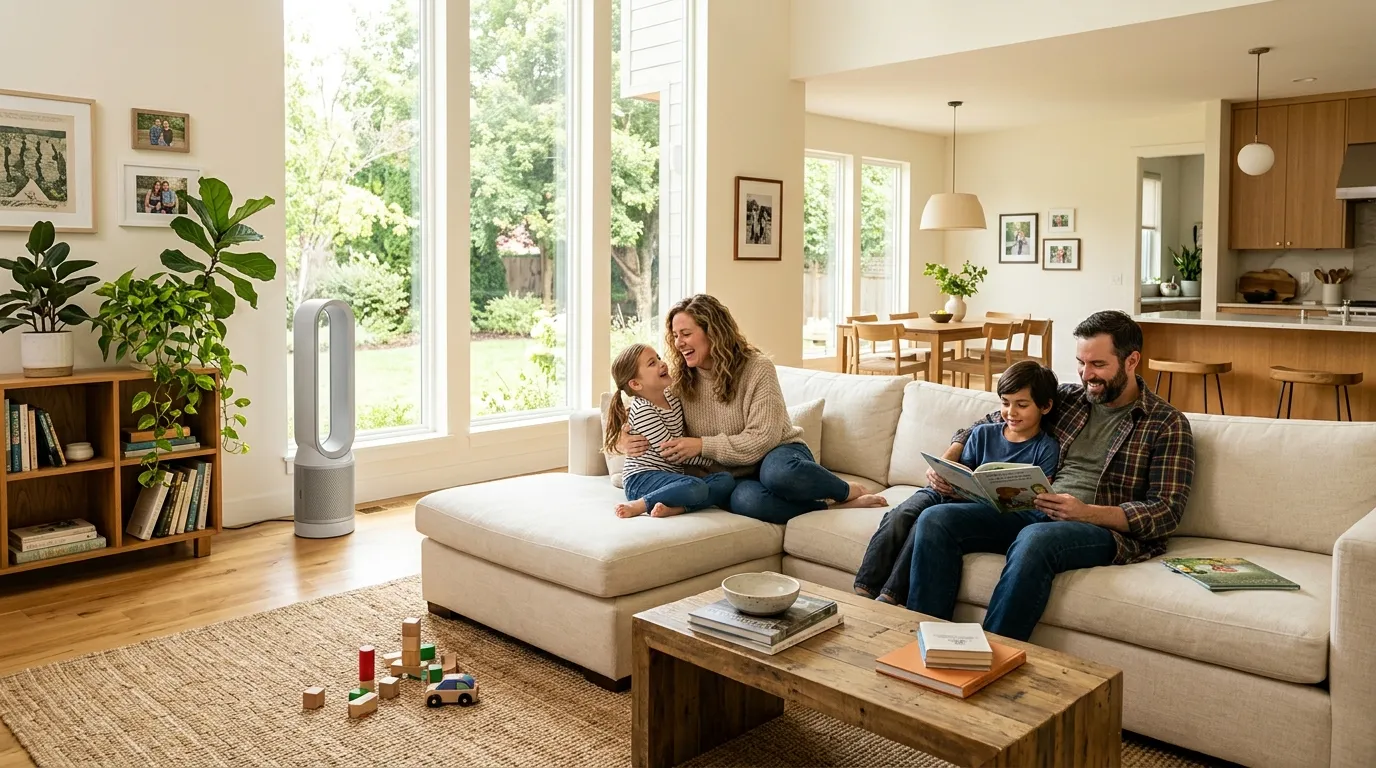
Central placement, away from walls and corners, lets a large-room purifier pull air in and push it back out evenly across an open floor plan. Corners restrict intake on at least one side, which quietly cuts into the coverage a unit is actually capable of delivering.
In a genuinely large room, airflow matters as much as raw CADR — a unit tucked in a corner behind furniture will underperform its rating no matter how strong the fan is. If the space is open-plan and connects a kitchen, living and dining area, placing the purifier near the center of that combined footprint, or at the boundary between the zone with the most PM2.5 sources (cooking, a fireplace) and the rest of the space, gives it the best shot at clearing the whole area rather than just the corner it sits in. Elevating it slightly off the floor on a low table can also help intake in a room with a lot of low furniture blocking airflow at ground level.

Best for Large living rooms wanting strong coverage plus automation
- Rated for large rooms up to roughly 1,875 sq ft
- Auto mode driven by an air-quality sensor for hands-off running
- App and voice control with scheduling
- Washable pre-filter catches large particles first
Why buy it: The best balance of coverage, smarts and value for a big room. Owners consistently report the auto mode quietly managing everyday changes on its own; the common gripe is that the app takes a little patience to set up.

Best for Large rooms where odor and smoke control matter as much as dust
- True HEPA rated for large rooms up to about 1,881 sq ft
- Strong deodorization stage for smoke and cooking odors
- App support with an auto mode and air-quality sensor
- High clean-air delivery for quick whole-room turnover
Why buy it: The pick when a large room has odor problems, not just dust. Owners consistently praise its deodorization, and reviewers frequently mention it recovering a smoky or cooking-heavy room faster than lighter units.

Best for Very large open areas needing one high-capacity unit
- Rated for very large areas up to about 2,200 sq ft
- Real-time PM2.5 display and air-quality sensor
- Washable filter component to lower running costs
- High fan speeds for rapid air changes
Why buy it: Maximum coverage for the money, with a live PM2.5 readout owners lean on to confirm it is working. The trade-off is noise at the top speeds, so most people settle it on medium once the room clears.

Best for Large rooms on a tighter budget
- Cleans rooms up to about 1,695 sq ft in an hour
- Multi-stage filter including True HEPA
- Higher airflow tuned for open spaces
- Straightforward controls, no app required
Why buy it: Serious large-room coverage without a premium price. Owners consistently report it holding its own in rooms that overwhelm smaller units, making it the value benchmark in this category.

Best for Great-rooms and open floors that need the widest reach
- Rated to clean up to about 2,400 sq ft in 30 minutes
- 3-stage True HEPA filtration with 360-degree airflow
- Large touch display with real-time air-quality readout
- Draws and returns air on all sides for even coverage
Why buy it: The reach champion here, with 360-degree intake that suits a unit placed in the middle of an open floor. Owners consistently report fast whole-room turnover; the trade-off is a larger footprint than the compact units.

Best for Connected living-dining-kitchen spaces
- True HEPA rated for rooms up to about 2,200 sq ft
- Multi-stage filtration for dust, pollen and smoke
- Strong airflow for large connected areas
- Simple controls with high clean-air delivery
Why buy it: A high-capacity HEPA unit well suited to open plans where one appliance covers several zones. Owners consistently report it keeps a connected downstairs consistent rather than clean in one corner and stale in another.
How we picked
We do not buy or run these purifiers ourselves. Energy Efficient HVAC System ranks them from aggregated owner reviews, manufacturer coverage and clean-air-delivery specs, and the complaint patterns that only surface across many buyers. For large rooms the consensus favors generous, honestly rated coverage and True HEPA over gimmicks, since undersizing is what disappoints owners most. See how we rank for the full method.
Start with the air purifiers for large rooms hub for the buying guide and sizing help, step back to the air purification pillar, or read how to improve indoor air quality for the wider picture.