
Affiliate Disclosure
Some links on this page are affiliate links. As an Amazon Associate, we earn from qualifying purchases — at no extra cost to you. We do not buy, test, or physically handle the products we cover; our rankings come from aggregated owner reviews, ratings and expert consensus. Commissions never change our verdicts. How we rank & full disclosure.
Some links below are affiliate links. As an Amazon Associate we earn a commission from qualifying purchases at no extra cost to you — it never changes which products we recommend or how we rank them. We do not buy, test or physically handle these units; our verdicts come from aggregated owner reviews and manufacturer documentation.
These are two of the most capable air purifiers for large rooms, and both are rated for roughly the same enormous coverage, so the choice is less about raw size and more about how your indoor climate problem behaves. The Coway Airmega 400 wins as the all-round pick, with dual-side true HEPA, an activated carbon stage and a sensor-driven auto mode that quietly manages a great room. The Blueair Blue Pure 211i Max wins for the very biggest open floor plan, using its HEPASilent design to move a lot of air at a low noise level. Both clean large spaces well; the decision is Coway's do-everything balance versus Blueair's quiet high-volume output. Other large-room names worth knowing are Alen and Medify, which compete in the same square footage tier as these two.
| Product | Best for | Buy |
|---|---|---|
| Coway Airmega 400 Air Purifier, up to 3,120 sq ft | Best Overall | Check Price (paid link) |
| Blueair Blue Pure 211i Max Air Purifier, up to 3,235 sq ft | Best for the Biggest Spaces | Check Price (paid link) |
Coway vs Blueair air purifiers for large rooms: do they cover the same square footage? CADR and coverage compared
Effectively yes. Both are rated in the same very-large CADR range — roughly 3,120 to 3,235 sq ft of coverage on a once-per-hour basis — so for practical room sizing they're interchangeable. Size either one for four to five air changes per hour by choosing a room well under that rated ceiling.
Coverage numbers assume a sealed room and top fan speed, so treat them as ceilings rather than promises. AHAM, the industry body behind the CADR test, rates coverage on a once-per-hour air exchange, which is why sizing for four to five air changes per hour instead pushes you toward buying a size class up. In a merely large room both units coast on low; in a genuine open great room, buying near their rated maximum lets either run at a quieter mid speed and still keep up with allergens and dust. Match the unit to four-to-five air changes for the space, not to the biggest CADR number on the box.
Both manufacturers publish their AHAM-verified CADR numbers separately for smoke, dust and pollen, so check the specific figure that matches your household's main concern rather than a single blended coverage claim.
Open floor plan sizing: air changes per hour beyond 1000 sq ft
Open floor plans that combine a kitchen, dining and living area into one continuous space are exactly the scenario these two large-room units are built for. A purifier rated for roughly 1000 sq ft — the size most mid-tier models top out at — typically can't hit real air changes per hour once walls disappear and the effective square footage triples.
If your open floor plan runs well past 1000 sq ft, both the Coway and the Blueair are sized for it where a smaller purifier isn't. Below that, either brand's smaller sibling models are worth comparing instead of paying for coverage you won't use.
Which is quieter at the fan speed you actually use? True HEPA and HEPASilent explained
The Blueair, generally. Its HEPASilent design — a true HEPA-grade filter paired with an electrostatic charging stage — is built to push a high volume of air at a lower noise level, and owners consistently report it stays unobtrusive even at a higher fan speed. The Coway is quiet on low and in auto mode, but its top fan speed is more audible.
Both have to spin fast to hit their large-room ratings, so at maximum fan speed neither is silent — that's the physics of moving a lot of air. The difference is behavior at the mid speeds most people run: the Blueair holds a lower noise floor for a given airflow, while the Coway leans on its auto mode to spend most of its time on a quiet low fan speed.
Which is easier to live with day to day? Auto mode, PM2.5 sensors and allergens control
The Coway, for most people. Its sensor-driven auto mode reads PM2.5 and other allergens in the room and adjusts automatically, and its washable pre-filter with a clear filter-change timer makes it genuinely set-and-forget once it's running in a large room.
The Blueair also offers auto mode driven by a particle sensor and app control, but its ecosystem and proprietary filters are more of a commitment. If you want a purifier that simply reads PM2.5 and allergen levels and adjusts itself with minimal fuss, the Coway is the more comfortable everyday companion. If you're happy inside the Blueair app and want its quiet high-volume output, the extra setup is a fair trade.
Which is cheaper to own? Filter replacement and energy efficient running cost
Both are premium large-room units with premium filters, so neither is cheap to feed, and neither has a meaningful edge on being more energy efficient than the other at the wattage level. The Coway's washable pre-filter and widely stocked filter replacement options make its running cost more predictable, while the Blueair's proprietary filters are the main ongoing expense and a form of lock-in.
Running cost on units this size is dominated by filter replacement, not the sticker price or electricity, since both are reasonably energy efficient for the air volume they move. Both reward a rinse of the washable pre-filter to stretch HEPA life. For how large-room filtration fits alongside ventilation, see our guide to improving indoor air quality.
HEPA and activated carbon: how each clears air quality in a large room
Both pair a true HEPA stage for particulates and allergens with an activated carbon stage for odors and VOC gases, which is the standard combination for serious large-room air quality work. Neither substitutes one stage for the other — HEPA and activated carbon solve different problems.
Because both units move a large volume of air continuously in a great room, expect to replace the main filter set roughly once or twice a year depending on dust and allergen load — budget that recurring cost in alongside the purchase price when comparing the two on value.
Neither the true HEPA layer nor the activated carbon stage can be meaningfully extended past its rated life by rinsing, unlike the washable pre-filter that sits in front of both. Skipping a filter replacement doesn't damage the unit, but it does let CADR quietly decay well before you notice a change in air quality, since a saturated filter still moves air, it just stops trapping much of it.
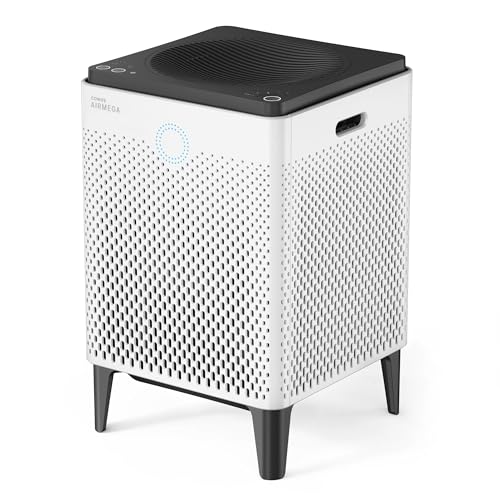
Best for a large living room where you want sensor-driven automation
- Dual-side True HEPA plus an activated-carbon stage
- Rated for large rooms up to roughly 3,120 sq ft
- Air-quality sensor with auto and sleep modes
- Washable pre-filter and filter-change timer
Why buy it: The Coway Airmega 400 is the pick when a big room needs one purifier to manage itself, because the air-quality sensor and auto mode ramp the dual-intake fan up and down without any input. Owners consistently report it keeps a great room clear. A common complaint is the larger footprint and the cost of its genuine filters.
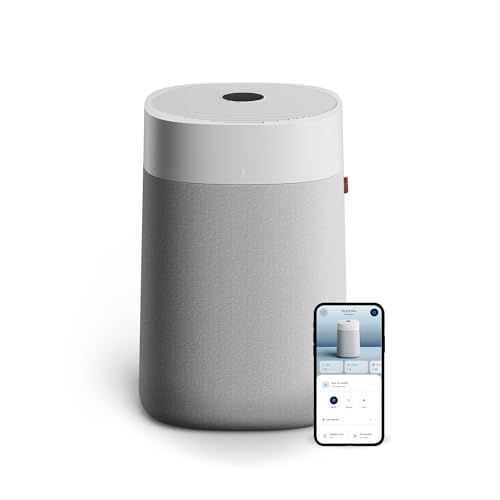
Best for the largest open floor plans where quiet high output matters
- HEPASilent filtration for a high clean-air delivery rate
- Rated for very large rooms up to roughly 3,235 sq ft
- Auto mode driven by a built-in particle sensor
- Washable fabric pre-filter and Wi-Fi app control
Why buy it: The Blue Pure 211i Max leans on its HEPASilent design to move a lot of air quietly, and owners consistently report it clears the very largest open spaces at a lower noise level than most rivals. A common complaint is that its proprietary filters and app are the main ongoing cost and lock-in.
The verdict
Choose the Coway Airmega 400 if you want the balanced, do-everything large-room air purifier — dual-side true HEPA, an activated carbon stage and a sensor that quietly manages a great room with almost no input. Choose the Blueair Blue Pure 211i Max if your open floor plan is genuinely enormous and you want its HEPASilent design to move a lot of air at a low noise level. On CADR and coverage they're a near tie, so let automation-and-balance versus quiet-high-output decide, and don't be afraid to measure your actual square footage before assuming you need a unit this large in the first place. Need more? The air purifiers for large rooms hub covers sizing in depth, the air purification pillar puts it in whole-home context, and how we rank explains our research-only method.