
Affiliate Disclosure
Some links on this page are affiliate links. As an Amazon Associate, we earn from qualifying purchases — at no extra cost to you. We do not buy, test, or physically handle the products we cover; our rankings come from aggregated owner reviews, ratings and expert consensus. Commissions never change our verdicts. How we rank & full disclosure.
Some links below are affiliate links. As an Amazon Associate we earn a commission from qualifying purchases at no extra cost to you — it never changes which products we recommend or how we rank them.
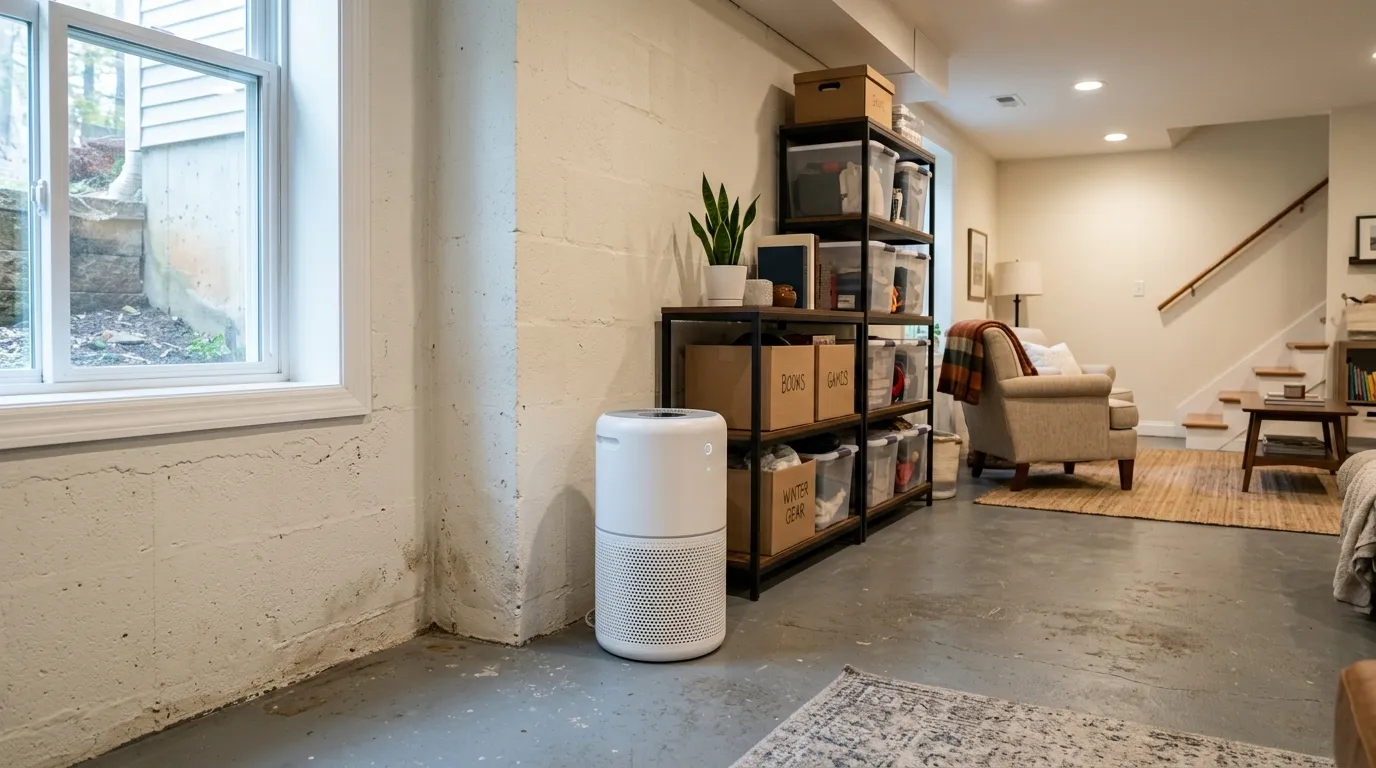
An air purifier is a useful tool against mold, but it is important to be clear about what it does: a True-HEPA unit captures airborne mold spores and, with a carbon stage, helps with the musty smell — it does not kill mold growing on surfaces or fix the damp conditions that let mold thrive. Treat a purifier as one part of your indoor climate plan alongside controlling humidity and removing any visible growth. Mold spores are large enough for any True HEPA filter to trap, so the real questions are coverage, odor control and running the unit continuously.
Do air purifiers actually get rid of mold?
They remove airborne spores, not the mold itself. A True-HEPA purifier captures the spores floating in the air, which reduces how many you breathe and how easily mold spreads to new spots. It cannot remove mold already growing on a wall, and it does not lower the humidity that feeds it.
The honest way to see a purifier is as spore control, not mold removal. If there is visible growth, that has to be cleaned or remediated separately, and the underlying moisture — a leak, poor ventilation, high humidity — has to be fixed, or the mold simply returns. Run the purifier alongside those steps and it keeps the air in the room cleaner while you deal with the source.
What features matter most for mold?
True HEPA to capture spores, plus an activated carbon stage to tackle the musty odor and VOC off-gassing that HEPA alone leaves behind. Coverage matters too, because spore-prone rooms benefit from continuous, high-turnover filtration. Skip ozone generators marketed for mold — ozone is a lung irritant and not something to run in an occupied room.
Mold's signature complaint is the smell, and that musty odor is largely VOCs — volatile organic compounds released as mold grows — which is a gas-and-odor problem activated carbon handles, not particles. So the best mold purifiers pair genuine true HEPA with a meaningful activated carbon layer. A washable pre-filter is a bonus in damp spaces, where filters otherwise load up faster and need filter replacement sooner than in a dry room.
What is CADR, and does it matter for mold spores and allergens?
CADR — Clean Air Delivery Rate — is an AHAM-certified measurement of how much filtered air a purifier actually delivers per minute. Mold spores fall in the same particle-size range as many common allergens, so a unit with a strong CADR for dust and pollen also handles airborne spores well.
Match a purifier's CADR and square footage rating to your room size, then aim for enough capacity to hit roughly four to five air changes per hour — the point at which spore concentration in the room stays consistently low rather than building back up between filtration passes. A damp basement with an active moisture problem releases spores faster than a dry room, so it benefits from sizing up beyond what the square footage rating alone would suggest, the same way you'd size up for heavy pollen season.
Do UV-C air purifiers kill mold better than HEPA alone?
Not meaningfully, in most portable purifiers. UV-C light is sometimes marketed as an extra mold-killing stage, but the brief exposure time as air passes through a small unit is generally too short to reliably neutralize spores — true HEPA filtration, which physically traps the spore rather than trying to destroy it, remains the mechanism doing the real work.
If a purifier includes a UV-C lamp as a bonus alongside a genuine true HEPA filter, there's no harm in it — just don't buy a unit specifically for its UV-C claim while skimping on the HEPA stage or the activated carbon that actually handles the smell. The filter replacement schedule matters more to long-term performance than any UV-C add-on: a loaded HEPA filter loses capacity gradually, and letting it run well past its rated life quietly undoes a lot of the purifier's benefit against spores and allergens alike.
Where should I run it, and how often?
In the room with the mustiest air — often a basement, bathroom-adjacent space or a room that stays damp — and continuously, not in short bursts. Spores are released constantly where mold is active, so a purifier only stays ahead of them if it runs all the time with the room kept as dry as possible.
Does controlling humidity matter more than the purifier itself?
For actually stopping mold growth, yes. Mold needs moisture to spread, so keeping indoor humidity below roughly 50% does more to prevent new growth than any purifier — the purifier's job is cleaning the air that's already contaminated, not addressing why spores keep appearing.
A purifier running in a room with unresolved humidity problems is fighting a losing battle: it clears the air, but the damp conditions keep feeding new spore growth on surfaces, and the cycle repeats. A basement or bathroom that reads high on a hygrometer benefits from a dehumidifier running alongside the purifier, not instead of it — the two solve different halves of the same problem. Many purifiers with a PM2.5 sensor and air quality display also show relative humidity on the same screen, which is a convenient way to watch both numbers without buying separate equipment. If the humidity number keeps climbing back up no matter how long the purifier runs, that's the sign to look at ventilation or a leak before buying a bigger unit.
How do I know the purifier is actually helping with mold?
A visible drop in musty odor within the first week is the most common early sign owners report, followed by a lower PM2.5 reading on units with a built-in air quality sensor. Neither is a lab-grade mold test, but both are reasonable everyday indicators that the unit is doing its job.
If you want a more rigorous check, a standalone air quality monitor or a professional mold-spore test gives a harder number than any consumer purifier's onboard sensor. For most households, though, tracking the musty odor and the PM2.5 trend on the purifier's own display, combined with a hygrometer reading for humidity, is enough to confirm the unit is pulling its weight — and to notice quickly if the filter needs replacement sooner than expected because the room stays damper than usual.

Best for Capturing airborne mold spores in bedrooms and small rooms
- H13 True HEPA captures mold spores, which are well within its 0.3-micron range
- Activated-carbon layer helps reduce musty odor
- Quiet sleep mode for continuous overnight running
- Compact footprint for a single room
Why buy it: The most reliable all-round pick for airborne spores. Owners consistently report a fresher, less musty room within days, and the carbon layer is what they credit for tackling the smell alongside the particles.

Best for Larger rooms wanting HEPA plus odor control on a budget
- True HEPA rated for larger rooms
- Captures mold spores along with dust, pollen and pet dander
- Activated-carbon stage for musty and everyday odors
- Long-established, widely available replacement filters
Why buy it: A long-running budget favorite that covers a bigger room than most cheap units. Owners consistently report it cutting mustiness noticeably, making it a sensible first purchase while you also address the moisture source.

Best for Large rooms wanting automatic response and app control
- Rated for large rooms up to roughly 1,875 sq ft
- Auto mode reacts to airborne particle spikes
- Washable pre-filter catches large debris first
- App and voice control for hands-off running
Why buy it: The smart, high-coverage option for spore control in a big room. Owners consistently praise the auto mode keeping the air consistent without attention, though the common gripe is a fiddly first-time app setup.

Best for Rooms where the musty smell is the main complaint
- True HEPA captures airborne mold spores
- Carbon stage aimed at odor reduction
- Turbo speed for quickly clearing a medium room
- Simple controls with an air-quality indicator
Why buy it: A medium-room unit that leans into odor. Owners consistently report the turbo setting knocking down mustiness fast, which makes it a good fit when the smell of mold bothers you more than anything visible.

Best for Damp, larger spaces prone to musty air
- Rated for very large areas up to about 2,200 sq ft
- Washable filter component copes better with damp, dusty air
- PM2.5 display and air-quality sensor
- High fan speeds for rapid air changes
Why buy it: A high-coverage pick for the bigger, danker spaces where spores concentrate. The washable component is a practical plus in humid rooms, and owners consistently report it keeping a large basement noticeably fresher.
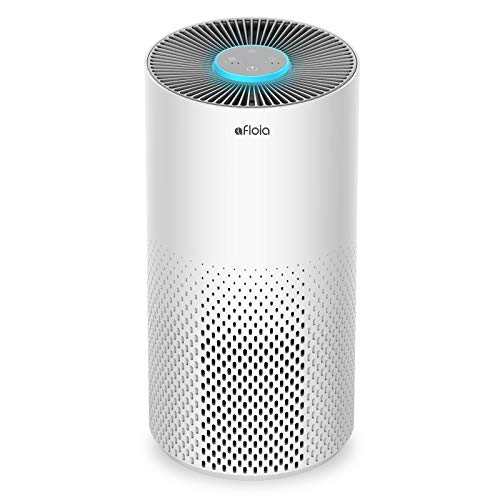
Best for Living rooms and open areas needing steady spore control
- Covers rooms up to about 1,500 sq ft
- Multi-stage filtration including True HEPA for spores
- Carbon layer to help with musty odor
- Quiet operation for all-day running
Why buy it: A solid large-room option that runs quietly enough to leave on continuously — which matters, since spore control depends on constant filtration. Owners consistently report a fresher room without an intrusive noise level.
How we picked
We do not buy or run these purifiers ourselves. Energy Efficient HVAC System ranks them from aggregated owner reviews, manufacturer filtration specs and the complaint patterns that only appear across many buyers. For mold the consensus favors true HEPA with a real activated carbon stage and enough CADR and square footage coverage to run continuously — and treats the purifier as spore control, never a substitute for fixing moisture. LEVOIT shows up repeatedly across this list, and Coway, Alen, and Medify are the other brands worth comparing if you need more coverage than what's here. See how we rank for the full method.
Read the air purifiers for mold hub for the full picture, step back to the air purification pillar, or see how to improve indoor air quality — including managing the humidity that mold depends on.