
Affiliate Disclosure
Some links on this page are affiliate links. As an Amazon Associate, we earn from qualifying purchases — at no extra cost to you. We do not buy, test, or physically handle the products we cover; our rankings come from aggregated owner reviews, ratings and expert consensus. Commissions never change our verdicts. How we rank & full disclosure.
Some links below are affiliate links. As an Amazon Associate we earn from qualifying purchases at no extra cost to you. We do not buy, test or physically handle these units — our rankings come from aggregated owner reviews and manufacturer documentation, and a commission never changes them.
Smoke is one of the harder problems in your home's indoor climate, because it is really two problems at once — ultrafine particles you can see as haze, and the smell and gases that cling long after the haze clears. This roundup suits anyone dealing with everyday smoke sources like cooking, a fireplace, incense, or tobacco, who wants a specific room to stay fresh. It is not the page for someone expecting to erase years of smoke residue baked into walls and carpet; a purifier cleans the air, not the surfaces, so pair it with cleaning and ventilation rather than treating it as a cure.
What CADR and PM2.5 numbers mean for smoke
CADR (Clean Air Delivery Rate) is the AHAM-certified measure of how much filtered air a purifier actually produces — the closest thing to an apples-to-apples spec across brands. PM2.5 is the fine-particulate measurement smoke shows up as; a purifier's smoke or dust CADR number tells you how fast it can pull those particulates down.
Wildfire smoke and everyday cigarette smoke are both mostly fine particulates in the PM2.5 range, plus the gaseous VOC compounds that carry the smell. A high smoke-specific CADR number, tested and certified by AHAM, is a far more reliable buying signal than a vague square footage claim on the box, because two purifiers rated for the same room size can have very different real-world CADR. If you can find a unit's AHAM smoke CADR listed, use it — it is the single best predictor of how fast a room clears during a wildfire smoke event or after cooking.
How often do you need to replace the carbon and HEPA filters?
Expect true HEPA filter replacement roughly every 6 to 12 months and carbon filter replacement more often — every 3 to 6 months in a smoky home — since the carbon saturates with odor gases well before the HEPA media clogs with particulates. Auto mode, which ramps fan speed to the air-quality sensor, can extend both by running the purifier less when the air is already clean.
Filter replacement is the real ongoing cost of owning a smoke-focused air purifier, and it is worth checking before you buy: a cheap unit with expensive, hard-to-find replacement filters costs more over two years than a pricier one with a widely stocked carbon filter using genuine activated carbon rather than a thin coated layer. Coway, Winix and Blueair are three other brands with a strong reputation for real activated carbon media, worth cross-shopping alongside the Levoit, VOOPNU and MOOKA picks above. Auto mode also matters for smoke specifically, since it reacts the moment cooking smoke or an outdoor wildfire smoke event pushes PM2.5 up, then throttles back once the air quality reading drops — running the purifier hard only when it needs to.
What kind of filter actually removes smoke smell?
A true-HEPA filter for the particles plus an activated-carbon stage for the odor. HEPA alone leaves a room that looks clear but still smells of smoke, because the smell is gases carbon must absorb, not particles.
This is the single most important thing to check before buying: many cheap "smoke" purifiers skip real carbon or include only a token amount, and owners report they do little for smell. The carbon is also a consumable that fades faster than the HEPA, especially in a constantly smoky home, so more carbon means longer odor performance between replacements. Skip anything that relies on ionizers or ozone in place of a filter, because those do not physically capture smoke particles.
Will an air purifier remove cigarette or cigar smoke?
It removes what is airborne — the drifting smoke and much of the smell while it runs — but not the residue that settles into walls, fabric and carpet. Owners in smoking homes report real improvement, not a completely odor-free room.
Third-hand smoke, the sticky residue on surfaces, keeps re-releasing odor no purifier can reach, which is why a unit with a washable pre-filter and a generous carbon stage matters most in these homes. During a wildfire smoke event, the EPA's own air-quality guidance points to the same fix: run a HEPA purifier, keep windows shut, and check outdoor PM2.5 readings before opening the house back up. The honest expectation from owner reviews is a noticeably fresher room that needs frequent carbon changes, alongside surface cleaning and open windows when possible. A purifier reduces the problem; it does not delete its source.
How do you size an air purifier for a smoky room?
Buy for more coverage than the room's square footage, so you can run a higher air-change rate on a lower, quieter speed. Under-sizing is the most common reason owners feel a purifier "does nothing" for smoke.
Coverage ratings usually assume a low turnover rate and a sealed room, so a unit rated exactly for your room will feel underpowered once smoke is actively being produced. Sizing up lets the purifier cycle the air several times an hour without running flat-out, which keeps both odor and noise in check — aim for 4 to 5 air changes per hour in a room with an active smoke source, closer to the rate a specialist brand like Austin Air targets in its coverage claims. That is why the large-coverage models lead this list for open spaces while the compact picks stay matched to a single bedroom.
What do owners wish they had known?
That carbon filters need replacing far more often than the HEPA in a smoky home, and that a purifier is not a substitute for ventilation. The best results come from filtering and airing the room, not choosing one over the other.
The recurring lesson in reviews is running-cost realism: budgeting for filters, keeping a spare on hand, and rinsing the pre-filter on schedule separate the owners who stay happy from those who give up. For the bigger picture on how filtration, ventilation and source control fit together, see our guide to improving indoor air quality.

Best for a bedroom or den where smoke odor bothers you most
- H13 True HEPA plus an activated-carbon odor stage
- Sized for bedrooms and small-to-medium rooms
- Quiet sleep mode near 24 dB for overnight use
- Compact, with widely available replacement filters
Why buy it: Owners consistently report it pulls cooking, tobacco and fireplace smell out of a single room fast, and the carbon stage is why it beats HEPA-only units on odor. A common complaint is that it is undersized for open floor plans, so keep it to one room.

Best for a large living room cleaned automatically
- True HEPA plus carbon, rated up to roughly 1,875 sq ft
- Auto mode reacts to a built-in air-quality sensor
- Washable pre-filter for ash and large particles
- App and voice control for scheduling
Why buy it: The consensus favors this one for a big living space, because auto mode ramps up when someone cooks or lights a fire and settles down after. Owners report the sensor takes the guesswork out of when to run it. A common complaint is the price.

Best for covering a medium-large room on a budget
- High-efficiency HEPA-grade filtration with carbon
- Rated for rooms up to roughly 1,076 sq ft
- Simple controls with timer and sleep mode
- Low filter cost keeps running expenses down
Why buy it: Owners consistently report it clears everyday cooking haze and smoke smell for far less than a premium unit. A common complaint is that its carbon layer is thinner, so the heaviest, most stubborn odors linger longer than on a flagship model.

Best for an open-plan kitchen-living space
- Highest coverage here, up to roughly 2,200 sq ft
- HEPA filtration with a PM2.5 sensor and display
- High airflow for faster whole-room turnover
- Washable pre-filter for coarse smoke and ash
Why buy it: Owners report it is the unit that actually keeps up when cooking or fireplace smoke drifts across a large open floor, and the live PM2.5 readout confirms it. A common complaint is that its top fan speed is loud, which is the trade for this much coverage.

Best for a home office or mid-size bedroom
- Multi-stage HEPA-grade and carbon filtration
- Rated for mid-size rooms up to roughly 880 sq ft
- Adjustable speeds with a quiet night mode
- Pre-filter slows how fast the HEPA loads
Why buy it: Owners report it holds a mid-size room clear of smoke smell and runs quietly at a desk. A common complaint is that replacement filters are harder to find than for big brands, so it pays to confirm filter availability before you commit.
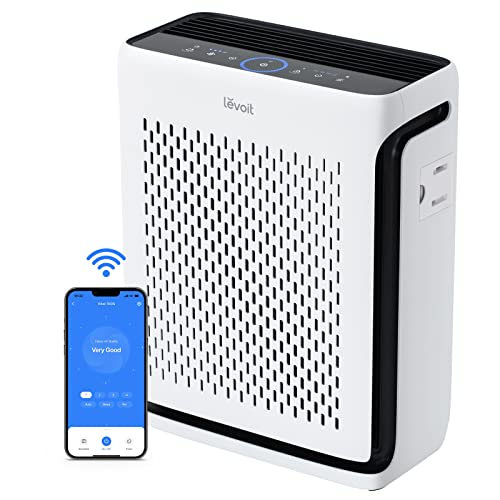
Best for homes with regular tobacco or cigar smoke
- HEPA-grade filtration with a carbon odor stage
- Washable pre-filter captures the coarsest smoke residue
- Built for bedrooms and personal spaces
- Quiet enough to run continuously
Why buy it: The consensus is that a rinseable pre-filter is what keeps a purifier working in a genuinely smoky home, since it stops the expensive HEPA from clogging quickly. A common complaint is that carbon still needs replacing often where smoke is constant.
How we picked
We did not buy or run these units ourselves. Energy Efficient HVAC System ranks products from aggregated owner reviews, manufacturer specifications and the recurring complaint patterns that surface once a purifier meets real smoke — odor control, carbon life and honest coverage. We favored units that pair genuine HEPA-grade media with a real activated-carbon stage, since that combination is what actually addresses smoke rather than just haze. Compare the rest of the field on the air purifiers for smoke hub, browse the air purification section for how this fits your whole home, and read How We Rank for the full method.