

Affiliate Disclosure
Some links on this page are affiliate links. As an Amazon Associate, we earn from qualifying purchases — at no extra cost to you. We do not buy, test, or physically handle the products we cover; our rankings come from aggregated owner reviews, ratings and expert consensus. Commissions never change our verdicts. How we rank & full disclosure.
Some links below are affiliate links: if you buy through one we earn a small commission at no extra cost to you. We never buy or physically handle these coolers, and a commission never changes where a product lands in this ranking.
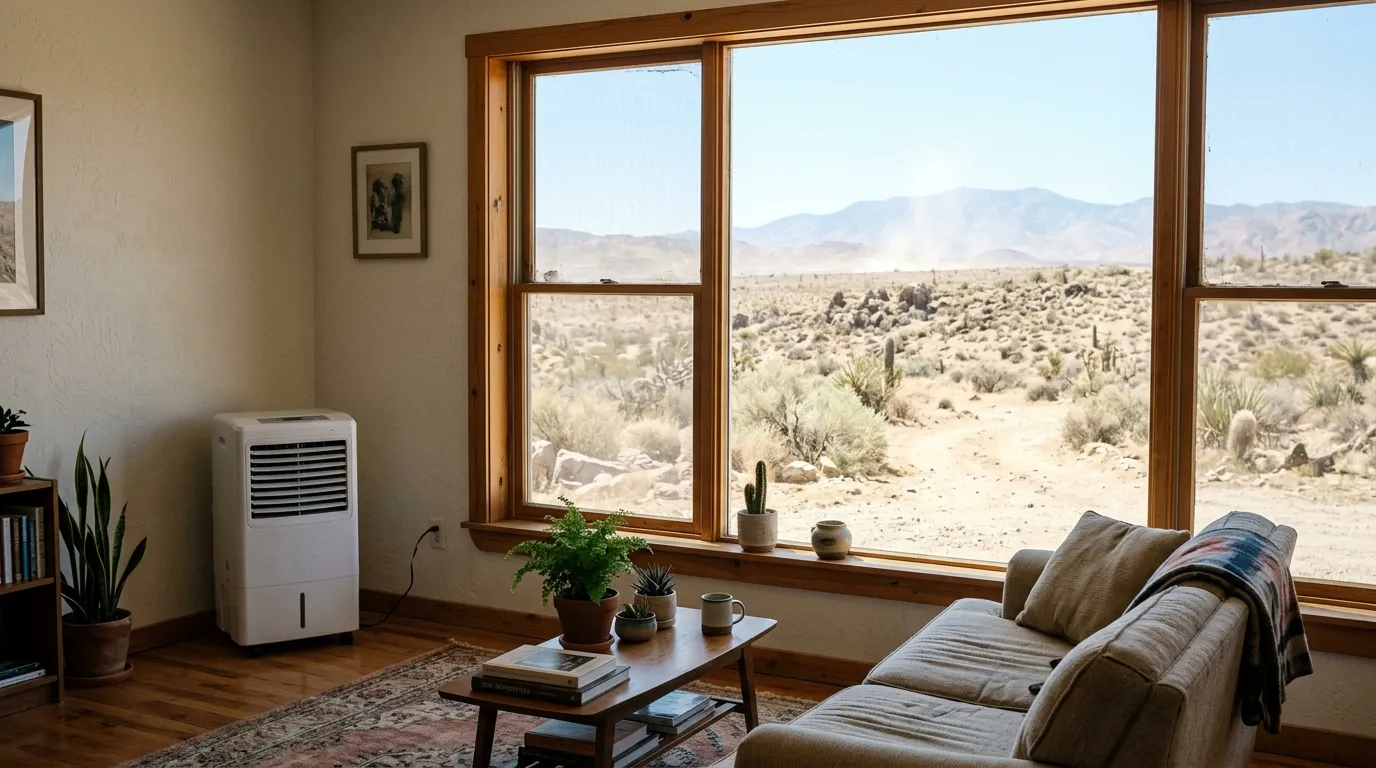
An evaporative (swamp) cooler cools by passing air over a wet cooling pad, so it genuinely lowers temperature — but only when the air is dry. In a low humidity indoor climate it can outperform a fan and use a fraction of an air conditioner's power. In humid air it barely works and only adds moisture, so if you live somewhere muggy, skip this category and look at a portable AC instead. It suits a garage, workshop, covered patio or bedroom in a dry climate — indoor or outdoor — and it is the cheapest way to move a lot of cool airflow without a compressor.
What types of evaporative coolers are there — portable, tower and outdoor units?
Evaporative coolers come in three common shapes: portable box units for indoor rooms, tall tower coolers that oscillate to spread airflow wider, and rugged outdoor models built for a patio, deck or job site. All three use the same wet cooling pad, just packaged for a different space.
A portable cooler is meant to be wheeled from an indoor bedroom to a living room as needed, while a tower cooler trades some of that portability for a slimmer footprint and oscillation that reaches more of a room the way a tower fan does. Outdoor evaporative coolers, like the units built for a patio or garage bay, are sealed and finished to handle sun, dust and being left outdoor between uses — check the listing before assuming an indoor-rated cooler can live outside.
Do evaporative coolers actually work?
Yes, but only in dry air. They cool by evaporating water, which lowers temperature effectively when humidity is low — think desert and high-plains climates. As humidity rises the cooling effect fades, and above roughly 60% relative humidity they mostly just add moisture.
This is the make-or-break fact for the whole category, and it is why owner reviews swing so hard: people in Arizona rave, people in Florida are disappointed. Before buying, check your typical summer humidity. If you are in a dry climate with low humidity, an evaporative cooler is a cheap, low-power win; if not, it is the wrong tool. See how cooling affects your home's indoor climate for how humidity changes what cooling works.
How big a cooler do you need — CFM, water tank size and square footage?
Match CFM and airflow to your room's square footage: a small personal unit suits a desk, a 2,000–3,600 CFM cooler suits a bedroom or living room, and 3,100–4,000 CFM suits a garage, patio or large open area. Undersizing is the most common cause of "it does not cool" complaints.
Water tank size matters just as much for runtime — a bigger tank like the 18.4-gallon unit runs far longer between refills, while a 5-gallon portable needs topping up more often. Dropping an ice pack into the tank before a heat spike is a simple way to squeeze a few extra degrees of airflow out of the same unit without buying a bigger one. For a large space you run all day, the consensus favors more CFM and a bigger water tank; for a bedroom, a mid-size unit is easier to live with.
How much power does an evaporative cooler use, and what's the running cost?
Evaporative coolers are cheap to run because a fan and a small water pump draw far less power than a compressor — expect well under a kWh over several hours of use, a fraction of what a portable air conditioner of similar CFM would use.
That low draw is what makes evaporative cooling genuinely energy efficient in a dry climate, and it keeps running cost low enough that owners frequently run them all day without worrying about the electric bill the way they would with an air conditioner. The trade is water, not electricity: budget for refilling the water tank, and expect the cooling pad to need periodic replacement as mineral deposits build up, especially with hard tap water.
Do you need a window or drain?
No — unlike a portable AC, an evaporative cooler needs no window kit or exhaust hose, because it does not produce hot exhaust air. You just add water. That is a real advantage for windowless rooms, garages and spaces where you cannot vent a hose.
You do need airflow, though: swamp coolers work best with a door or window cracked so fresh dry air keeps moving through. Owners consistently report that running one in a sealed room raises humidity and kills the cooling effect. A little cross-ventilation is the difference between comfortable and clammy, whether the unit is indoor in a bedroom or outdoor on a covered patio.
How do you keep an evaporative cooler running well?
Change the water regularly, rinse the tank to stop algae and mineral buildup, and replace the cooling pad on the schedule the manufacturer lists — usually once a season with regular use. A neglected pad is the top reason a once-strong cooler starts to feel weak.
Stale water is the main maintenance headache owners report, particularly on a portable unit left half-full between uses; empty and rinse the tank every few days rather than topping up old water. Hard tap water accelerates pad buildup, so if your area has hard water, plan on replacing the cooling pad more often than the box suggests. An outdoor unit left exposed to dust needs the same attention plus an occasional wipe-down of the housing, since dust that gets pulled through the pad clogs it faster than indoor use ever would.

Best for a garage, patio or large open space in dry heat
- High 3,100 CFM output for large areas
- Rigid honeycomb cooling media
- Continuous water-fill connection option
- Rugged, wheeled build from an established brand
Why buy it: The consensus favors the Hessaire MC37M as the benchmark swamp cooler: owners consistently report it drops the temperature noticeably in dry heat and holds up over years of use, which is why it is the one people compare newer coolers against.

Best for the biggest rooms and long, unattended runtimes
- High 4,000 CFM airflow
- Large 18.4-gallon water tank for long runs
- Includes ice packs, remote and a 12-hour timer
- 120-degree oscillation for wide coverage
Why buy it: Owners consistently report the big tank is the draw here — it runs far longer between refills than most portables. A common complaint is its size and weight, so treat it as a stay-put cooler for a large room rather than a carry-around unit.

Best for a windowless room that needs affordable cooling
- 2,100 CFM windowless portable cooler
- Three speeds with four included ice packs
- 8-gallon tank for extended running
- Compact enough for a bedroom or office
Why buy it: The consensus favors the CENSTECH as the best-balanced budget pick: owners consistently report good cooling for the price in dry conditions, with a tank large enough to avoid constant refills.

Best for a mid-size living room or workshop
- 3,600 CFM output for medium-to-large rooms
- 8.1-gallon tank with a 7-hour timer
- 100-degree swing for broad coverage
- 3-in-1 cooling, fan and humidify modes
Why buy it: A strong middle option between a big garage cooler and a small portable. Owners consistently report solid airflow and coverage; the consensus is it is the sensible pick when 4,000 CFM is overkill but a small unit is not enough.

Best for moving cooling between rooms as needed
- Compact wheeled swamp-cooler design
- 5-gallon tank for reasonable runtime
- Simple controls, easy to relocate
- Works without a window or exhaust hose
Why buy it: Owners consistently report this is easy to wheel from room to room, which is its main appeal. A common complaint is that a 5-gallon tank empties faster than the big-tank units, so plan on more frequent refills.
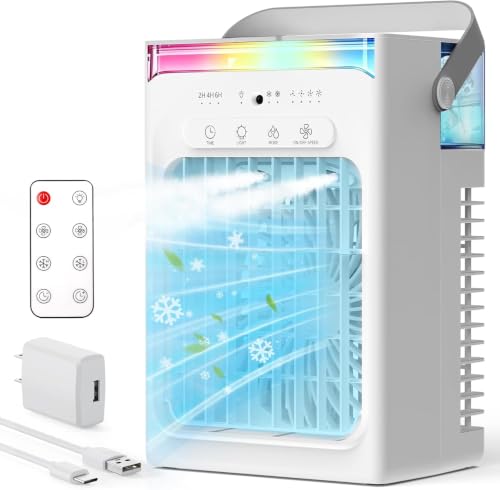
Best for a desk, bedside or personal cooling zone
- Small 4-in-1 personal evaporative cooler
- Cools, fans, humidifies in one unit
- Compact footprint for a desk or nightstand
- Low power draw
Why buy it: A sensible personal cooler for close range. The consensus is clear that this is a spot cooler, not a room cooler — a common complaint is expecting it to cool a whole room, which no unit this small can do.
Where should you place an evaporative cooler for the best airflow?
Set it near an open window or door on the upwind side of the room so it pulls fresh, dry outside air through the cooling pad, and leave a door or window cracked somewhere else in the space so the air has a path out. A cooler in a dead-sealed room quickly runs out of dry air to work with.
Indoor placement in a bedroom or living room works best a few feet from where you sit, angled so the airflow reaches you rather than a wall. Outdoor placement on a patio or in a garage bay benefits from a bit of shade — the unit works a little harder pulling in already-hot direct sun than it does with airflow from a shaded or covered area. Oscillating tower models help spread that airflow across a wider seating area without needing to physically re-aim the unit through the evening.
How we picked
We do not buy, test or physically handle these coolers. Evaporative cooling is unusually climate-dependent, so our ranking leans on aggregated owner reviews read in context — matching who was satisfied to how dry their climate is — alongside manufacturer specifications for CFM and water tank size. Alongside Hessaire, other names that show up often in this category include Honeywell, NewAir and Portacool, especially for the larger outdoor and garage-rated units. When owners in genuinely dry regions consistently report the same result, that consensus drives the order. See how we rank, browse the full evaporative coolers hub, or compare against other options in the wider cooling guides.