
Affiliate Disclosure
Some links on this page are affiliate links. As an Amazon Associate, we earn from qualifying purchases — at no extra cost to you. We do not buy, test, or physically handle the products we cover; our rankings come from aggregated owner reviews, ratings and expert consensus. Commissions never change our verdicts. How we rank & full disclosure.
Affiliate disclosure: Some links below are affiliate links. As an Amazon Associate we earn from qualifying purchases at no extra cost to you. We do not physically handle the products we cover, and commissions never change our verdicts.
A ductless mini split air conditioner is the most efficient way to add real, permanent cooling and heating to a single room, without touching your central system. That's exactly who this category suits: homeowners who want to condition one room — a bedroom, a garage conversion, a sunroom — properly, and are comfortable mounting an outdoor condenser and running a small line set through the wall. If you rent, can't mount anything outside, or want something you plug in and roll away at the end of summer, this is the wrong category for you. A portable or window unit fits your indoor climate far better. The picks below are ranked by cooling capacity matched to real room square footage, not by sticker price.
What makes a mini split different from a window or portable air conditioner comes down to two parts working together. An outdoor condenser does the actual refrigeration work. An indoor air handler, mounted high on the wall, blows conditioned air into the room quietly. A thin line set — power cable and two refrigerant lines — connects the two through a small hole in the wall. That's why installation, not the equipment itself, is usually the bigger project. Because the compressor and its noise live outside, a mini split runs noticeably quieter indoors than a window unit. And because it's a heat pump rather than cooling-only, the same system reverses in winter to provide efficient supplemental heat for the room — a genuine two-season upgrade, not a cooling-only purchase.
What types of mini split systems are there, and what size do you need?
Every unit here is a single-zone system: one outdoor condenser paired with one indoor air handler. Multi-zone systems run several indoor air handlers off one larger outdoor condenser for whole-home zone cooling, but they cost far more and need a pro install. Roughly 9,000 BTU cools a small room up to about 350 sq ft, 12,000 BTU suits a typical 400–500 sq ft room, and 18,000 BTU covers open-plan spaces approaching 1,000 sq ft of square footage.
Ductless single-zone systems
A ductless mini split like this is one outdoor condenser paired with one indoor air handler, connected by a thin line set. Oversizing is the most common sizing mistake, and it backfires. An oversized unit blasts the room cold and satisfies the thermostat, then shuts off before it has run long enough to pull moisture out of the air. The room ends up cold and clammy at the same time. An undersized unit runs flat out and never quite gets there.
BTU and cooling capacity by square footage
Measure the room's square footage, account for big windows, high ceilings and sun exposure, and pick the closest BTU cooling capacity rather than rounding up "to be safe."
Multi-zone systems for more than one room
If you're heating and cooling more than one room, a multi-zone system with a shared condenser is worth pricing against installing two separate single-zone units.
115V or 230V — which matters for your home?
Most 9,000–12,000 BTU mini splits run on a standard 115V household outlet, so no electrical work is needed. Larger 18,000 BTU units generally require a dedicated 208–230V circuit, which usually means hiring an electrician.
This single detail changes the real installation cost of a mini split more than the price tag does. A 115V unit is genuinely plug-and-mount for a handy owner. A 230V unit that needs a new circuit run to the panel can add a meaningful electrician bill on top of the purchase. Owners who skip this check are the ones surprised at install time. Confirm the voltage a unit needs against what your room already has before you buy.
Is a DIY mini split installation realistic, or do you need a pro?
Pre-charged, plug-in mini splits are designed for DIY-capable owners and ship with the refrigerant sealed in the line set. Still, mounting the indoor air handler, drilling the wall pass-through and vacuuming the lines takes tools and care. Many owners hire a pro for exactly that step.
Condenser, air handler and line set
The consensus favors the pre-charged "DIY" units for people comfortable with basic tools and following instructions to the letter. The parts that trip owners up during installation are getting the outdoor condenser level and secure, sealing the wall penetration against weather, and handling the electrical connection between the condenser and the indoor air handler.
Refrigerant lines and warranty risk
If any of that is outside your comfort zone, budget for an HVAC tech. A bad install is the fastest way to a refrigerant leak or a short lifespan, and it can void the warranty.
How much does mini split efficiency (SEER2) really save on running cost?
SEER2 measures cooling efficiency — a higher number means more cooling per watt. Most units here sit at 17–21 SEER2, well above what most window units achieve, and above ENERGY STAR's efficiency bar for the category. The jump from a base unit to a high-SEER2 model lowers running cost, but the payback depends on how many hours you actually run it.
Inverter compressors and energy efficient heat pump mode
Inverter compressors — standard across every unit on this list — are the reason mini splits beat window and portable ACs on efficiency. Instead of slamming on and off, they modulate to hold a steady temperature. That's both quieter and cheaper to run, as an energy efficient heat pump system, in both cooling and heating mode.
SEER2 payback and remote control
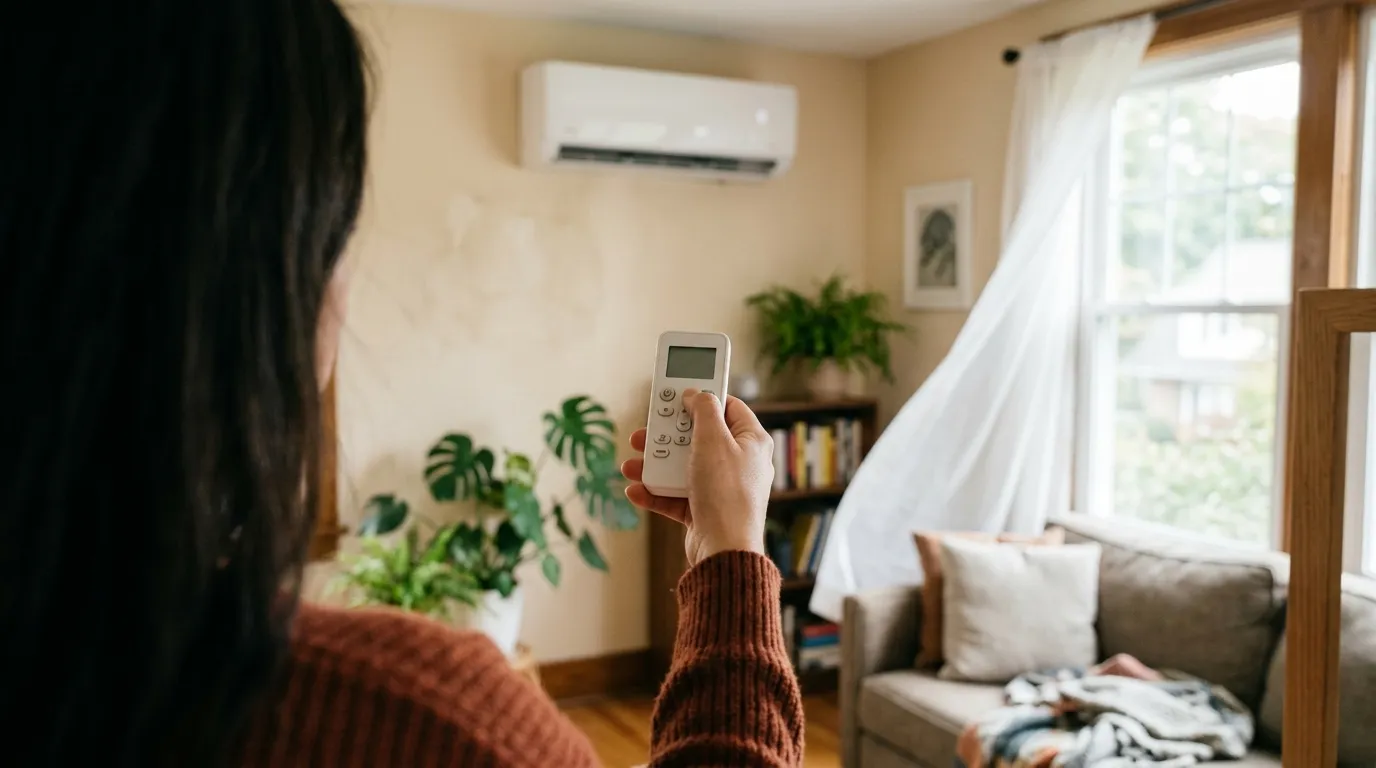
A 21 SEER2 unit costs less per hour than an 18 SEER2 one. But if the room only gets cooled a few weekends a year, the efficiency premium takes a long time to pay back. Run it daily through a long cooling season and the higher rating earns its keep. Every unit here also ships with a remote control for basic temperature and mode settings, and the Wi-Fi-equipped model above adds app control on top.
How do these budget brands compare to MRCOOL, Senville, Pioneer, and Daikin?
MRCOOL, Senville, Pioneer, and Daikin are the more established mini split names, generally carrying longer parts availability and wider HVAC-tech familiarity than newer budget brands like Rellytech or Albott, at a real price premium for otherwise similar SEER2 and BTU specs.
For a straightforward single-room install, the budget brands above hold up well in owner reviews. They cost meaningfully less for the same cooling capacity and heat pump performance. Where the established names earn their premium is long-term support. An HVAC tech is more likely to already stock parts for a Daikin or MRCOOL condenser than for a newer budget brand — that matters more the longer you plan to keep the unit installed.

Best for a single 400–500 sq ft room on a standard 115V outlet
- 12,000 BTU cooling with heat-pump heating
- 19 SEER2 inverter efficiency
- Runs on a standard 115V/110V outlet
- Pre-charged lines for a DIY-style install
Why buy it: Owners consistently report this is the do-everything pick for one room — enough capacity for a bedroom or home office, efficient enough to run all day, and it plugs into a normal wall circuit instead of needing a dedicated 230V line.

Best for buyers who want inverter cooling and heat at the lowest entry price
- 12,000 BTU cooling with heat-pump mode
- 18 SEER2 inverter compressor
- Plugs into a 115V outlet
- Includes mounting hardware and line set
Why buy it: A common reason owners choose Albott is the price-to-capacity ratio — the same 12,000 BTU class as pricier units for less money. The trade-off is a slightly lower SEER2 rating and a less-established brand for long-term parts support.

Best for larger open-plan spaces and buyers who want app and voice control
- 18,000 BTU for rooms up to roughly 1,000 sq ft
- 21 SEER2 — the highest efficiency here
- Wi-Fi with Alexa voice control
- Requires a dedicated 208–230V circuit
Why buy it: The consensus favors this unit when the room is bigger than a single bedroom. Owners highlight the higher 21 SEER2 rating and smart controls, but it needs a 230V circuit, so factor an electrician into the budget if you do not already have one.
Best for small bedrooms, offices and rooms under about 350 sq ft
- 9,000 BTU — right-sized for small rooms
- 19 SEER2 inverter efficiency
- Standard 115V outlet
- Cooling and heat-pump heating
Why buy it: Owners consistently report that matching BTU to room size matters more than buying big — a 9,000 BTU unit in a small room cycles less and dehumidifies better than an oversized one, which short-cycles and leaves the air clammy.

Best for a straightforward 12,000 BTU install without extra features
- 12,000 BTU cooling and heating
- Inverter compressor
- Pre-charged refrigerant lines
- No-frills control set
Why buy it: A common complaint about feature-heavy units is fiddly apps and menus. Owners who want none of that pick a plain 12,000 BTU unit like this and value that there is simply less to go wrong.

Best for a second-room or garage-conversion setup on a tight budget
- 12,000 BTU cooling with heat mode
- Inverter operation
- Remote control included
- Wall-mounted indoor head
Why buy it: Owners choosing COSTWAY typically want basic mini-split comfort for a secondary space and accept that budget brands carry more variance in long-term reliability and support than established HVAC names.
How we picked
We do not buy or physically handle these units. Every ranking above comes from aggregated owner reviews, recurring complaint patterns and manufacturer specifications, weighed against how well each unit's cooling capacity fits a specific room's square footage and install situation. That is why a budget unit can still win its category, and a premium one is only "best" for the room it actually suits. We also weighted 115V versus 230V power requirements, since that single spec often decides whether a room is a realistic DIY job or one that needs an electrician before the unit ever gets mounted. See our full How We Rank methodology for the sources behind every pick.
For the wider context — how ductless cooling fits alongside window units, portables and evaporative coolers — start with the Mini-Split Air Conditioners hub, or step up to the full Cooling section to compare this against every other way to cool a room.