

Affiliate Disclosure
Some links on this page are affiliate links. As an Amazon Associate, we earn from qualifying purchases — at no extra cost to you. We do not buy, test, or physically handle the products we cover; our rankings come from aggregated owner reviews, ratings and expert consensus. Commissions never change our verdicts. How we rank & full disclosure.
Affiliate disclosure: Some links below are affiliate links. As an Amazon Associate we earn from qualifying purchases at no extra cost to you. We do not physically handle the products we cover, and commissions never change our verdicts.
A garage is the hardest indoor climate zone in most homes — usually uninsulated, often the hottest space you spend time in, and with no ductwork to help. A pedestal fan does not lower the temperature there; it moves enough air to make the heat bearable while you work, drying sweat and breaking up the stale, still air a closed garage traps. That is who this page is for: anyone who wants airflow and ventilation over a workbench or across a bay. If you need the garage actually cooler — not just moving air — a fan is the wrong tool, and a portable AC or evaporative cooler belongs on your list instead. The picks below are chosen for reach, sturdiness and the ability to shrug off garage dust — not for how quiet they sound in a bedroom, since a garage rewards a completely different set of priorities.
How much airflow does a garage fan actually need?
More than a bedroom fan. A garage is a large, open, often-hot space, so airflow reach — how far the fan throws air, roughly related to its CFM rating — matters more than gentle air circulation. Look for a pedestal fan rated to push air 90–100 ft rather than modest desk-fan output.
In a bedroom a fan only has to stir a small volume of air; in a garage it has to move air across an open bay, past a parked car, to where you are standing. That is why throw distance and CFM are the specs that count here. The high-airflow DC models above are built for exactly this reach, while a high-velocity blade fan like the Cyclone trades quiet for raw output — either approach beats a small oscillating fan that runs out of push halfway across the floor.
Oscillation, tilt head, or fixed — what actually helps in a garage?
Oscillation spreads air circulation across a wide garage bay, while a tilt head aims a steady stream straight down onto a workbench. A fixed, non-oscillating standing fan concentrates all its airflow on one spot, which is better when you're working in exactly one place.
Most garage work happens in a mix of both modes — oscillation to keep the whole bay from going stale and still, then a locked, tilted head aimed directly at you while you're bent over an engine bay or a workbench. A pedestal fan that offers both, rather than just one, earns its keep across more tasks. Owners who only ever work in one fixed spot often prefer to skip oscillation altogether and just tilt the head down at the bench — less moving-parts wear over years of garage use.
Should a garage fan be AC or DC motor?
DC-motor fans move more air per watt, run quieter, and cost less to leave running for hours — ideal for long garage sessions. AC-motor fans are cheaper up front and perfectly fine for occasional, shorter use where noise and running cost matter less.
If the garage fan runs all afternoon while you work, a DC motor pays you back in lower power draw and less noise fatigue — it is the more energy efficient choice over a full work session. If it only comes on for the odd job, a basic AC-motor fan is the sensible spend — there is no point paying for efficiency you will barely use. The honest split among owners follows how they use the space: hobbyists and home mechanics gravitate to DC; occasional users stick with a cheap AC fan they will not miss if it gets knocked over.
How tall should a pedestal fan be for a garage?
Tall enough to clear the obstacles in your garage. A head with adjustable height reaching 47–54 inches sits above a workbench and over the hood of a car, so the airflow reaches you instead of hitting a tool chest or bumper first.
Height is the quietly important spec garages punish you for ignoring. A short fan aimed across a cluttered garage mostly cools the side of a shelving unit. The taller Lasko models here let you set the head above bench height with adjustable height and tilt it down onto the work area, which is why a common upgrade owners make is simply going taller — not more powerful.
Speed settings, remote control, and timer — worth paying for in a garage?
Multiple speed settings let you match airflow to the task, from a low white noise hum for background circulation to full blast on a hot afternoon. A remote control and timer are genuine conveniences in a cluttered garage where walking back to the fan means dodging tools and a parked car.
A fan with several speed settings, not just high/low, means you can dial in exactly the right amount of noise and airflow for the job — a low setting is often just enough white noise to mask shop equipment without drowning out a phone call, while the top setting clears the air fast after a dusty task. A remote control matters more here than in almost any other room of the house, since a garage is full of obstacles between you and the fan. A built-in timer is handy for letting the fan run down after you've finished for the day rather than remembering to walk back and switch it off. Beyond Lasko, brands like Rowenta, PELONIS, and Honeywell show up often in pedestal fan comparisons, and models carrying an ENERGY STAR-adjacent efficiency rating tend to be the DC-motor units that cost less to run for hours at a time.
What holds up to garage dust and abuse?
A stable, weighted base and a simple, wipe-clean design last longest in a garage. Fans get knocked, coated in sawdust and run hard, so owners favor sturdy builds and blades and grilles that pop off for cleaning over delicate, feature-heavy units.
Garage duty is rough on a fan: dust clogs the motor, and a top-heavy fan tips when bumped. The practical picks are either a cheap unit you accept as replaceable, or a well-built fan with a solid base and blades you can actually get at to clean. A common complaint owners raise is a sealed-up room fan that clogs with dust and cannot be opened — so cleanability is worth checking before you buy.
Can a pedestal fan replace air conditioning in a garage?
No — a pedestal fan moves air but does not lower the room's actual temperature. It helps by evaporating sweat and breaking up stagnant, still air, which makes a hot garage more tolerable without changing the thermometer reading.
This distinction trips up a lot of first-time buyers. On a genuinely brutal summer afternoon, even the best pedestal fan just circulates hot air faster — it cannot substitute for a portable AC or an evaporative cooler if the goal is a measurably cooler garage. Where a fan earns its keep is everywhere air circulation alone solves the problem: clearing out stale, humid air after the door's been shut all day, keeping sawdust and fumes moving during a project, and taking the edge off heat while you work rather than trying to fully condition the space. Most garage owners are better served pairing a strong pedestal fan with an open door or window than chasing a fan powerful enough to feel like air conditioning, because that fan does not exist.

Best for moving air across a whole two-car garage
- DC motor with airflow up to about 100 ft
- Wide 120° oscillation for broad coverage
- 9 speeds and 4 modes
- Quieter and lower-draw than classic shop fans
Why buy it: Owners consistently report the long airflow throw is exactly what a garage needs — enough reach to stir the air in a large open bay, with a DC motor that sips power if you leave it running through a work session.

Best for high-velocity air on a budget in a workshop
- Cyclone high-velocity blade design
- Adjusts up to 54 inches tall
- Three speeds, AC motor
- Weighted base for stability
Why buy it: A common reason garage owners pick the Cyclone is raw airflow per dollar. It is loud, but it moves a lot of air and stands tall enough to clear a workbench, which is often all a garage fan really needs.
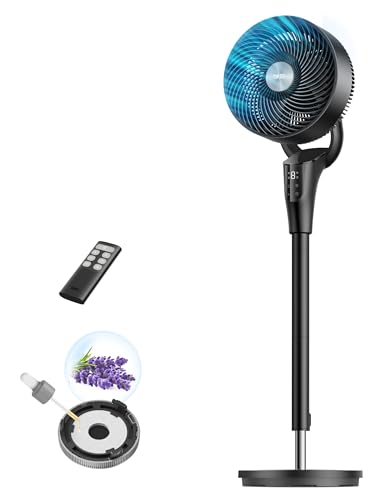
Best for a garage-workshop where noise still matters
- 90 ft airflow with a DC motor
- 90° oscillation
- 8-plus speeds and 3 modes
- Low noise for a high-output fan
Why buy it: The consensus favors this DREO when a garage doubles as a hobby or work space and constant fan roar gets tiring — it delivers strong airflow while staying notably quieter than a classic shop fan.

Best for a simple, cheap, replaceable garage fan
- 16-inch AC-motor fan head
- 3 speeds with 90° oscillation
- Adjustable height and tilt
- Basic, durable build
Why buy it: Owners who do not want to baby a fan in a dusty garage pick a plain Comfort Zone — cheap enough to replace without a second thought, with tilt to aim air right at a workbench.

Best for directing air down onto a work area from above
- Adjustable up to 47 inches
- Oscillating head with tilt
- Three quiet speeds
- Lightweight and easy to reposition
Why buy it: A common complaint about short fans in a garage is that shelving and vehicles block the airflow. Owners solve it with a taller Lasko that clears obstacles and points air where they are actually standing.

Best for changing speed without crossing a cluttered garage
- 16-inch fan with remote control
- Adjustable height
- 3 speeds and 3 modes
- Built-in timer
Why buy it: Owners like the remote in a garage specifically because you can dial the fan up or down from across the bay without walking back to it around tools and parked vehicles.
How we picked
We do not buy or physically handle these fans; the rankings above come from aggregated owner reviews, recurring complaint patterns and manufacturer specifications, weighted toward what a garage specifically demands — CFM reach, adjustable height and durability rather than bedroom quiet. See our full How We Rank methodology for the sources behind every pick.
For general-purpose picks and the wider category, browse the Pedestal Fans hub, or step up to the full Cooling section to weigh a fan against actually cooling the space.