


Affiliate Disclosure
Some links on this page are affiliate links. As an Amazon Associate, we earn from qualifying purchases — at no extra cost to you. We do not buy, test, or physically handle the products we cover; our rankings come from aggregated owner reviews, ratings and expert consensus. Commissions never change our verdicts. How we rank & full disclosure.
Affiliate disclosure: Some links below are affiliate links. As an Amazon Associate we earn from qualifying purchases at no extra cost to you. We do not physically handle the products we cover, and commissions never change our verdicts.
A pedestal fan is the cheapest, simplest way to make a warm room feel cooler — but it is worth being clear about what it does to your indoor climate: it does not lower the temperature, it moves air, and moving air lifts sweat off your skin so you feel a few degrees cooler than the thermostat reads. That makes a good fan the ideal partner to an AC (you can set the thermostat higher and still feel comfortable) and a fine standalone option in mild heat. If the air itself is genuinely hot or muggy and you need the room cooler rather than breezier, a fan alone will not get you there — pair it with a portable air conditioner or run it alongside central cooling to push conditioned air circulation further into the room instead. Everything below is picked on airflow, noise and how long owners keep them running.
What specs actually tell you how much air a pedestal fan moves?
Airflow (measured in CFM, cubic feet per minute) and throw distance matter more than motor wattage. Blade count and blade pitch shape how much air circulation you get per rotation, while oscillation angle and adjustable height decide how much of the room that air actually reaches.
Manufacturers don't always publish a CFM rating the way box fans do, but throw distance — how far the airflow is still noticeable — is the practical stand-in, and it's what the "90 ft" and "100 ft" figures on the DREO models describe. Bigger blades moved slowly can push as much air circulation as smaller blades spinning fast, often with less noise, which is one reason a well-engineered standing fan can out-cool a screaming budget model on the same speed setting. Adjustable height and a tilt head let you aim that air at seated or standing height instead of just across the floor, and speed settings beyond a basic low-medium-high give finer control than most owners think they need until they have it.
What makes one pedestal fan better than another?
Four things: how much air it moves (airflow and throw distance), how quiet it is, how wide it oscillates, and how well it holds up. Blade size and motor type drive the first two, and they are where cheap and good fans really diverge.
Almost every pedestal fan looks similar on a shelf, so the meaningful differences are the ones you cannot see: a stronger motor and better blade pitch move more air with less noise, and a wider oscillation angle spreads that air circulation across more of the room. A fan that is loud on the only speed strong enough to help is a fan you will not enjoy — which is why the airflow-to-noise balance, not the price tag, separates the picks above. A remote control is a genuine convenience rather than a gimmick once the fan is set up across the room from your chair or bed.
Is a DC-motor fan worth the extra money, and is it energy efficient?
For a fan you run often, yes. DC motors are more energy efficient — they move more air per watt, run dramatically quieter on low, and offer finer speed settings — so they lower running cost and are far nicer to sleep beside. For occasional use, a cheaper AC-motor fan is perfectly adequate.
The DC-versus-AC gap is the single biggest quality divide in this category. Owners who upgrade from an old AC fan to a DC model most often mention two things: the low speed is finally quiet enough to sleep with — closer to a steady white noise than a mechanical whir — and the electricity use is lower for the same cooling. Running cost on a DC pedestal fan is typically a few cents a day even left on overnight, versus a noticeably higher draw on an older AC-motor room fan. If the fan runs most days or all night, that's worth the premium. If it only comes out on the hottest afternoons, an AC fan like the Lasko or Comfort Zone above is the smarter buy. Look for ENERGY STAR certification on the box as a quick efficiency signal when comparing models the reviews don't cover.
How much oscillation and height do you need?
A head that adjusts in height and oscillates 90° or wider covers a normal room from one spot. For large or open-plan spaces, look for a taller stand and wider oscillation so the airflow actually reaches the far side rather than sweeping a narrow arc.
Coverage is where the picks split by room size. A standard 90° oscillating fan is plenty for a bedroom; a big living room benefits from the wider 120° sweep and longer throw of the premium DREO, which reaches across the space instead of cooling only the seats nearest it. Match the sweep and adjustable height to the room and one standing fan does the job — undersize it and you end up buying a second.
How does Lasko compare to Rowenta, PELONIS, and Honeywell?
Lasko and Honeywell lead the budget-to-midrange AC-motor segment on reliability and price; Rowenta and PELONIS show up more in the DC-motor, app-and-remote-control tier alongside DREO, generally at a similar premium for quieter, more energy efficient operation.
Owners comparing brands report Lasko as the name that "just keeps running" year after year in the budget tier, which is why it repeatedly wins the value pick in this category. Rowenta and PELONIS trade on quieter DC motors and more refined oscillation control, closer to the DREO models above than to a bargain AC fan. Honeywell sits in between, usually AC-motor but with more speed settings and features than the cheapest options. None of the four differ dramatically in raw airflow at a given blade size — the real differences are noise, speed settings, and finish quality.
What do owners complain about most?
The recurring complaints are a wobbly base, fiddly assembly, and a low speed that is still too loud to sleep beside. Cheaper AC-motor fans draw the noise complaint most; a wide, weighted base and careful assembly fix most of the wobble.
Almost no one regrets the airflow of these fans — the friction points are stability and noise. A common complaint is a base that rocks on hard floors, usually cured by fully tightening the stand and using the weighted base as intended. The noise complaint is real and points straight back to motor type: if quiet matters enough that you want the fan's hum to sit closer to white noise than mechanical rattle, that's the case for spending up on DC rather than hoping a budget AC fan will be library-silent.
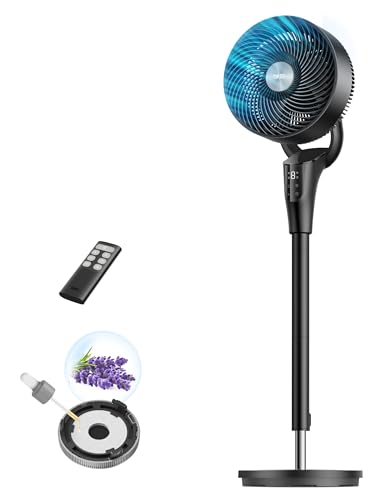
Best for a quiet, efficient main fan for a living room or bedroom
- DC motor with airflow up to about 90 ft
- 90° oscillation
- 8-plus speeds and 3 modes
- Low noise and low power draw
Why buy it: Owners consistently report the DC motor is the upgrade that actually matters — strong airflow on high, a near-whisper on low for sleeping, and a lower running cost than an older AC-motor fan.

Best for reliable everyday cooling at a low price
- Adjustable up to 47 inches
- Oscillating head, three speeds
- Simple AC-motor reliability
- Lightweight and easy to move
Why buy it: A common reason owners keep buying Lasko is longevity for the price — a plain, no-app fan that tends to keep running season after season, which is exactly what most rooms need.

Best for large rooms that need air moved a long way
- DC motor with airflow up to about 100 ft
- Wide 120° oscillation
- 9 speeds and 4 modes
- Remote and timer
Why buy it: The consensus favors this DREO for big open-plan rooms — the wide oscillation and long throw cover far more floor area than a standard fan, and it stays quiet doing it.

Best for a cheap second fan with a remote and timer
- 16-inch fan with remote control
- Adjustable height
- 3 speeds and 3 modes
- Timer function
Why buy it: Owners pick this as a low-cost extra fan and are pleasantly surprised it includes a remote and timer at the price, though the AC motor is louder than the DC options above.

Best for maximum airflow in a large or warm room
- Cyclone high-velocity blades
- Adjustable up to 54 inches
- Three speeds
- Weighted, stable base
Why buy it: A common pick when a room simply feels stuffy, the Cyclone trades quiet for raw output — owners note it moves noticeably more air than a standard fan when set on high.

Best for a straightforward fan with no extras
- 16-inch oscillating head
- 3 speeds
- Adjustable height and tilt
- Simple, durable design
Why buy it: Owners who want nothing but a fan that works pick Comfort Zone — no remote, no app, just adjustable height and tilt at a low price.
How we picked
We do not buy or physically handle these fans; every ranking above comes from aggregated owner reviews, recurring complaint patterns and manufacturer specifications, weighed against airflow and throw distance, noise level, oscillation range, adjustable height, speed settings, and durability a fan actually needs. That is how a budget Lasko earns its place next to a premium DREO — each wins the use it is best suited to. See our full How We Rank methodology for the sources behind every pick.
A pedestal fan earns a permanent spot in most rooms precisely because it's the cheapest running-cost tool in the entire cooling lineup — a few cents a day next to the dollars an hour a portable air conditioner can draw — which is why it's worth buying a genuinely good one rather than the cheapest option on the shelf. Shopping for a workshop or a hot garage instead? See our Pedestal Fans hub for related guides, or step up to the full Cooling section to compare fans against air conditioners and coolers.