

Affiliate Disclosure
Some links on this page are affiliate links. As an Amazon Associate, we earn from qualifying purchases — at no extra cost to you. We do not buy, test, or physically handle the products we cover; our rankings come from aggregated owner reviews, ratings and expert consensus. Commissions never change our verdicts. How we rank & full disclosure.
Some links below are affiliate links. If you buy through one, Energy Efficient HVAC System may earn a commission at no extra cost to you. It never changes which products we recommend or where they rank.
A window air conditioner is the most direct way to actually lower the temperature of a room's indoor climate rather than just moving air around — and for a single room, it's far cheaper to buy and run than central air or most portable units. It suits renters, single rooms and anyone who wants real cooling in a hot or humid climate where a fan simply moves warm air. If you can't mount a unit in a window, or you cool many rooms at once, a portable unit or mini-split may fit better. The one number that matters most is BTU: too few and the room never cools, too many and it cycles off before it removes humidity. Below are the models owners rate most consistently, sized by room.
How many BTUs do you actually need?
Roughly 20 BTU per square foot is the standard starting point: about 5,000 BTU for 150 sq ft, 6,000 for 250, 8,000 for 350, and up to 12,000 for a 550 sq ft room. Sunny rooms, high ceilings or a busy kitchen push you up a size.
Getting BTU right matters more than any feature. An oversized unit's cooling capacity overwhelms the room fast, cycles off, and leaves it cold and clammy because it never ran long enough to pull out humidity. An undersized unit runs forever and never gets there. Start from the square footage, then nudge up for sun, ceiling height or heat-generating rooms.
What is EER, CEER, and why does it matter for running cost?
EER (Energy Efficiency Ratio) and CEER (Combined EER, which also counts standby power) measure how much cooling a unit delivers per watt of electricity. A higher EER or CEER number means lower running cost for the same BTU output.
Two window air conditioners with identical BTU can have meaningfully different electricity bills depending on their EER rating, so it's worth checking the spec sheet, not just the BTU number, before you buy. Units that carry the ENERGY STAR label meet a minimum efficiency bar and are certified as energy efficient compared with standard models — a real, ongoing running cost saving over a full cooling season, not just a sticker. Newer inverter-driven compressors adjust their speed instead of switching fully on and off, which tends to improve both efficiency and how steadily the room holds its temperature.
What separates a good window AC from a cheap one?
Quiet operation, an accurate thermostat, a genuine Eco mode, a responsive remote control, and a filter that's easy to clean. The cooling itself is similar across brands at a given BTU; the daily experience comes down to noise level and controls.
At the same BTU, most units cool comparably — so the differences owners actually notice are the noise level at night, whether the thermostat holds the set temperature or overshoots, and how easily the filter slides out for cleaning. A clogged filter is the number-one cause of weak cooling, so easy maintenance is a real feature, not a footnote. A basic remote control that survives being dropped a few times also matters more to daily satisfaction than owners expect going in.
Do you need a dehumidifier mode or heat mode?
A dehumidifier mode is worth it in a humid climate where damp is as uncomfortable as heat. A built-in heat mode lets one unit handle mild shoulder-season cold, but it's no substitute for real winter heating.
Most window units remove some humidity just by cooling, but a standalone dehumidifier mode lets you dry a muggy room without over-cooling it. Heat modes are convenient in spring and fall; just don't expect a window AC to carry a room through a hard winter. Match these extras to your climate rather than paying for modes you'll never switch on.
What does installation actually involve?
Most window air conditioners include a window kit with adjustable side panels, foam seals, and a support bracket, and they plug into a standard 110 volt household outlet — no special wiring needed for anything under about 15,000 BTU.
Installation is a one-person job for smaller units but genuinely easier with two people once you're past about 8,000 BTU, since the compressor makes these units heavy on one end. The unit needs a slight outward tilt so condensation drains outside instead of into your room, and the window kit's foam seals matter more for noise level and efficiency than most buyers expect — a sloppy seal lets outside heat and street noise both leak straight in. If your window won't accommodate a standard kit — a casement or sliding window, for instance — a sleeper-style or through-the-wall unit designed for that opening is worth comparing before you force a standard model into the wrong window.
What do owners complain about most?
The top complaints are noise at night, water leaking or dripping from a unit that isn't tilted correctly on install, and weak cooling that almost always traces back to a dirty filter or an undersized unit.
Most leaks come from installation, not a defect — the unit needs that slight outward tilt so condensation drains outside. Noise is inherent to having a compressor in the room, though better units are quieter on low and use denser window kit seals to cut vibration. And a unit that "stopped cooling well" has usually just gone months without a filter clean. The picks above were chosen with those recurring issues weighed in.
Window unit, portable AC, or mini-split — which fits your situation?
A window air conditioner delivers the best cooling capacity per dollar for a room with a compatible double-hung or slider window. A portable unit trades some efficiency for flexibility when a window won't work; a mini-split is the higher-cost, permanently installed option for a room you'll cool every season for years.
If you're renting and want maximum cooling for the lowest price, a window unit wins on nearly every measure — it's simpler mechanically, cheaper upfront, and its EER numbers consistently beat a comparable portable AC because the compressor and condenser sit outside the room instead of both living indoors and venting through a hose. Reach for a portable only when the window truly won't accommodate a kit — a casement window, an odd-shaped opening, or a lease that prohibits window units entirely. A mini-split makes sense once you're looking at a room you'll cool every year for five-plus years and want quieter, ducted-feeling performance without an install crew building ductwork.
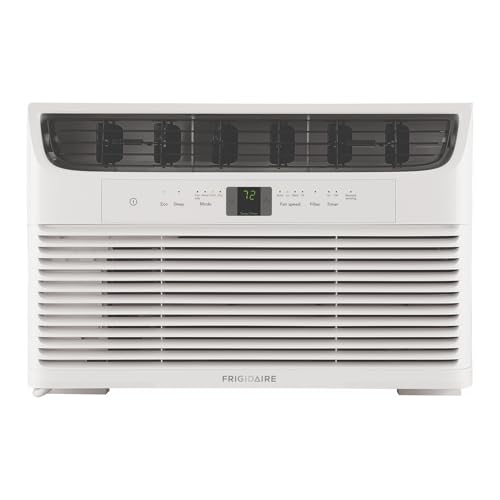
Best for a main bedroom or medium living room
- 8,000 BTU cools rooms up to about 350 sq ft
- Three fan speeds plus an Eco energy mode
- Remote control with a 24-hour timer
- Washable filter with a clean-filter reminder
Why buy it: Owners consistently rate Frigidaire’s mid-size units as the reliable default — enough capacity for a real living space, quiet on the low setting, with controls and an Eco mode people actually use.

Best for a small bedroom on a tight budget
- 5,000 BTU cools rooms up to about 150 sq ft
- Reusable, easy-to-clean filter
- Simple, low-cost entry-level cooling
- Compact and light for solo installation
Why buy it: A common thread in reviews is that it does one job well for very little money — cooling a small bedroom — which is exactly why it is the value pick for anyone who does not need extra features.

Best for large rooms and year-round use
- 12,000 BTU cools rooms up to about 550 sq ft
- Built-in heat mode for shoulder-season warmth
- Remote control with digital thermostat
- Handles larger living rooms and studios
Why buy it: Owners who need to cool a big room or want one unit for both summer and mild winter report this high-capacity model with heat covers both, which is why it earns the premium spot.

Best for a bedroom or office needing digital control
- 6,000 BTU cools rooms up to about 250 sq ft
- Digital controls with a full remote
- Energy Saver mode and 24-hour timer
- Easy-install window kit included
Why buy it: A recurring point in reviews is the precise digital thermostat and remote at this capacity; owners who found 5,000 BTU units too small but 8,000 too big settle here.

Best for humid rooms that need drying as well as cooling
- 6,000 BTU with cool, fan and dehumidify modes
- Removes humidity as a standalone function
- Remote control and adjustable settings
- Suits muggy climates and damp rooms
Why buy it: Owners in humid regions report the standalone dehumidify mode is the feature they did not know they needed, letting one unit both cool and pull moisture out of a sticky room.

Best for those who want plain mechanical dials
- 5,000 BTU cools rooms up to about 150 sq ft
- Manual mechanical controls, no menus
- Two cooling modes and easy-install kit
- Lightweight and simple to maintain
Why buy it: A steady preference among owners who dislike digital menus is a unit with two knobs that just works; this GE is the pick when simplicity and a low price beat features.
How we picked
Energy Efficient HVAC System does not buy, install or physically run the air conditioners we cover. We rank from aggregated owner reviews, manufacturer specifications and the installation and long-term complaint patterns that surface once a model has been in thousands of homes for a season.
Frigidaire, Midea, GE, and LG all compete heavily in this category, and we weigh owner-reported reliability and noise level across all of them rather than favoring one name — a well-reviewed Midea or Frigidaire model can and does outrank a mediocre listing from a bigger brand. We also give weight to ENERGY STAR certification and disclosed EER or CEER figures, since those numbers translate directly into what you'll pay to run the unit all summer. See How We Rank for the full methodology, the window air conditioners hub for what's already published, or the cooling section to compare window units against portables and mini-splits for your situation.