

Affiliate Disclosure
Some links on this page are affiliate links. As an Amazon Associate, we earn from qualifying purchases — at no extra cost to you. We do not buy, test, or physically handle the products we cover; our rankings come from aggregated owner reviews, ratings and expert consensus. Commissions never change our verdicts. How we rank & full disclosure.
Disclosure: Some links below are affiliate links. As an Amazon Associate we earn from qualifying purchases at no extra cost to you — and a commission never changes which products we recommend.
De’Longhi and Honeywell are the two names shoppers weigh most often when buying an oil-filled radiator, and the split is fairly consistent: De’Longhi is the premium choice, known for silent operation, programmable timers, and patented fins that spread radiant heat evenly across a whole room; Honeywell is positioned as the value brand, with simpler dial controls and a lower price. For your indoor climate, the honest bottom line is that if you want scheduling, thermostat precision, and the evenest heat, De’Longhi is worth the premium; if you just want dependable overnight radiator warmth for less, the value tier is the smarter spend. Honeywell’s oil-filled radiators are not among the models we can currently source live pricing for, so the value pick we link below is the closest equivalent we can verify — the PELONIS radiator, which occupies the same simple, affordable slot. Budget oil-filled radiators from brands like Costway follow the same dial-control formula.
| Product | Best for | Buy |
|---|---|---|
| De’Longhi Dragon Digital Oil-Filled Radiator (1500W) | Best Overall | Check Price (paid link) |
| PELONIS Oil-Filled Radiator Heater (1500W, 3 Modes) | Best Value | Check Price (paid link) |
De’Longhi vs Honeywell oil-filled radiator heaters: which is more energy efficient?
Both run at 1500 watts and convert nearly all of that electricity to heat, so neither is meaningfully more energy efficient in raw output. What changes the actual running cost is how precisely the thermostat holds temperature and whether an eco mode cycles power once the room warms up.
An oil-filled radiator's efficiency story is different from a fan-forced heater's. There is no fan pulling extra watts, and the fins keep radiating stored heat for a while after the element switches off, so a well-controlled unit uses less total energy over an evening than a crude on/off dial suggests. This is where De’Longhi's digital thermostat and eco mode pull ahead: they hold a set temperature tightly and cut power the moment the room reaches it. A basic dial radiator, including the PELONIS, tends to overshoot and run longer than needed before you notice and turn it down yourself.
What do you actually get for the premium price? Timer, thermostat and fins compared
Convenience and even heat, not more warmth. Every 1500-watt radiator produces the same heat output. The premium buys a programmable timer, a digital thermostat, and fin geometry designed to spread that heat more evenly and quietly through the whole room.
This is the key thing to understand before paying more. A budget radiator and a premium one will both warm the same space. The difference is whether you can schedule it to be warm before you wake, whether you set a precise thermostat temperature or turn a dial, and how smoothly the fins distribute heat. Owners who value set-and-forget scheduling consistently feel the premium is justified. Owners who just switch a heater on and off do not. Our oil-filled radiator hub breaks down which features change the day-to-day experience.
Which is quieter and more silent for whole-room, overnight heat?
Both are near-silent — silence is built into oil-filled radiators, since neither uses a fan. The overnight edge goes to whichever model has a programmable timer, because scheduling warm-up matters more for sleep than any small difference in noise between the two.
Owners rarely distinguish these radiators on noise, because there is almost none to hear from either one. Where the premium tier pulls ahead for whole-room, overnight comfort is the timer: warming the room before bed and again before the alarm, without leaving it running all night unattended. If that matters to you, it points toward the De’Longhi. If you're happy switching it on manually, the value pick loses nothing in comfort or in how evenly it heats the room.
Tip-over and overheat protection
Both the De’Longhi and the PELONIS include tip-over shut-off, which cuts power if the radiator is knocked over, and overheat protection, which shuts the element down if internal temperatures climb too high. These are standard safety features on modern oil-filled radiators, not premium extras, so don't pay more expecting better protection here — check for them on any budget model too, including Costway's.
Eco mode and thermostat control
De’Longhi's Dragon Digital adds an eco mode that automatically alternates heat settings to hold a target temperature using less electric power overall, plus a true digital thermostat you set in whole degrees. The PELONIS uses a simpler analog thermostat dial with three fixed heat modes — less precise, but still effective for a room you don't need dialed to the degree.
1500 watts, BTU and running cost: how much does each cost to run?
A 1500-watt radiator converts to roughly 5,120 BTU of heat output, and both brands top out there. Run eight hours a day, that's about 12 kWh, which works out to a running cost of roughly $1.50–$2.50 a day at typical U.S. electricity rates, regardless of brand.
Because BTU output is identical between DeLonghi and Honeywell-class radiators, running cost differences come down to how much the thermostat and eco mode reduce actual runtime, not to the wattage on the spec sheet. A digital thermostat that holds temperature tightly, rather than overshooting on a dial, can meaningfully cut real-world kWh use over a heating season even though both units share the same 1500-watt ceiling. The EPA's guidance on space heating backs this up: the biggest energy savings come from zone heating one room and controlling runtime, not from chasing a marginally more efficient watt.
Portable, electric radiant heat: how oil-filled radiators compare to a space heater
An oil-filled radiator is a portable, electric appliance on wheels or a stand, and it warms a room with radiant heat instead of blown air. Compared with a fan-forced space heater, it heats more slowly but holds warmth longer after it switches off, which suits a whole room you occupy for hours rather than a quick blast of heat.
That slower, steadier radiant heat is also why oil-filled radiators are a common bedroom and home-office pick over a fan-forced space heater: no fan noise, no drafty blast, just a gradually warming room. The trade-off is patience — expect a genuinely cold room to take longer to feel warm than it would with a ceramic fan heater, in exchange for the silence and the lingering heat once you turn it off.
What do owners complain about with each brand?
For the premium De’Longhi units, the recurring complaint is simply the price, and occasionally over-complex digital menus. For value radiators like the PELONIS, owners most often mention basic dial controls and no timer — limitations of the tier, not defects. Both share the category's slow warm-up.
Neither brand escapes the fundamental radiator trade-off: they are among the slowest common heaters to reach temperature, in exchange for silence and lingering warmth once the room is up to temperature. Choosing between tiers is really choosing between paying for scheduling and thermostat precision, or saving money and accepting dials. Match that to how you will actually use it, room by room, rather than to the badge on the front.
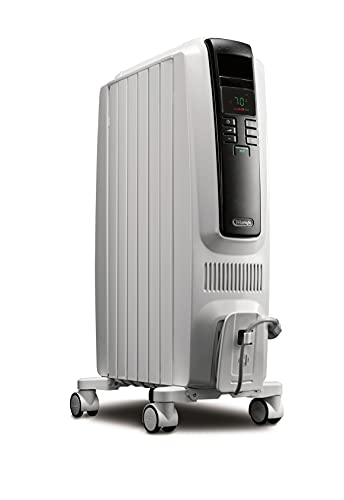
Best for quiet, programmable, set-and-forget heat
- Programmable 24-hour timer
- 1500W across three heat settings
- Patented high-surface-area fins
- Tip-over and overheat protection
Why buy it: De’Longhi’s Dragon line is the model owners recommend most for hands-off overnight heat — the consensus favors it for the timer, the digital control, and how quietly it holds a room.

Best for simple, dependable radiator heat for less
- 1500W with three heat modes
- Dual-knob analog controls
- Fan-free silent operation
- Tip-over protection
Why buy it: A common thread in reviews is that PELONIS delivers the essential radiator experience — quiet, steady, safe — with straightforward dials, at a lower price than the premium brands.
The verdict: De’Longhi vs Honeywell oil-filled radiator heaters
If you want the fullest feature set — a programmable timer, digital thermostat, eco mode, and the evenest, quietest whole-room heat — the De’Longhi Dragon Digital is the stronger buy and the model owners recommend most in this class. If you would rather not pay the premium and simple dial controls suit your overnight routine fine, the value tier delivers the same core radiant warmth at the same 1500 watts; the PELONIS is the closest equivalent we can currently verify and link in place of Honeywell's oil-filled line. Decide by how much you value scheduling, thermostat precision, and running cost, not by brand loyalty. See our full How We Rank methodology for how these picks are researched.