

Affiliate Disclosure
Some links on this page are affiliate links. As an Amazon Associate, we earn from qualifying purchases — at no extra cost to you. We do not buy, test, or physically handle the products we cover; our rankings come from aggregated owner reviews, ratings and expert consensus. Commissions never change our verdicts. How we rank & full disclosure.
Disclosure: Some links below are affiliate links. As an Amazon Associate we earn from qualifying purchases at no extra cost to you — and a commission never changes which products we recommend.
A large patio is the one place where BTU and placement genuinely matter. Extending your indoor climate into a big outdoor space means accepting a hard truth: no single heater warms a large, open patio the way it warms a small balcony, and the honest bottom line is that you should buy the highest output you can, weight the base against wind, and often run two heaters rather than one. If your space is small or sheltered you are overspending on these high-BTU towers — a compact heater is plenty. For a genuinely large patio, the powerful, stable picks below are the ones owners rely on.
How many BTU do you need for a large patio?
For a large open patio, aim for the top of the range — 48,000 to 55,000 BTU per heater — and plan on more than one for a very big space. BTU roughly tracks coverage, but wind and open sides shrink the felt result well below the rated figure.
Output is the honest headline spec for a large patio, which is why the flagship here leads on BTU. But a single 50,000 BTU tower still only comfortably warms a rough 9-to-12-foot circle, so a patio much bigger than that needs two units positioned to overlap. Owners consistently report that two well-placed heaters beat one oversized one. Our patio heaters hub covers how BTU translates to real coverage outdoors.
Why does base stability matter more on a large patio?
Large patios are usually more exposed, and tall standing heaters catch the wind. A fillable sand or water base and a wide footprint are what keep a 7-foot tower upright — the most common cause of patio-heater damage is tipping in a gust.
This is the feature owners most often wish they had prioritized. On a sheltered balcony an empty base is fine; on an open patio it is a liability. Filling the base with sand or water dramatically lowers the center of gravity, and units with a triple-protection or tip-over safety system add an automatic gas cut-off if the heater does go over. Treat a weightable base as essential outdoors, not optional.
Tower or pyramid for a big space?
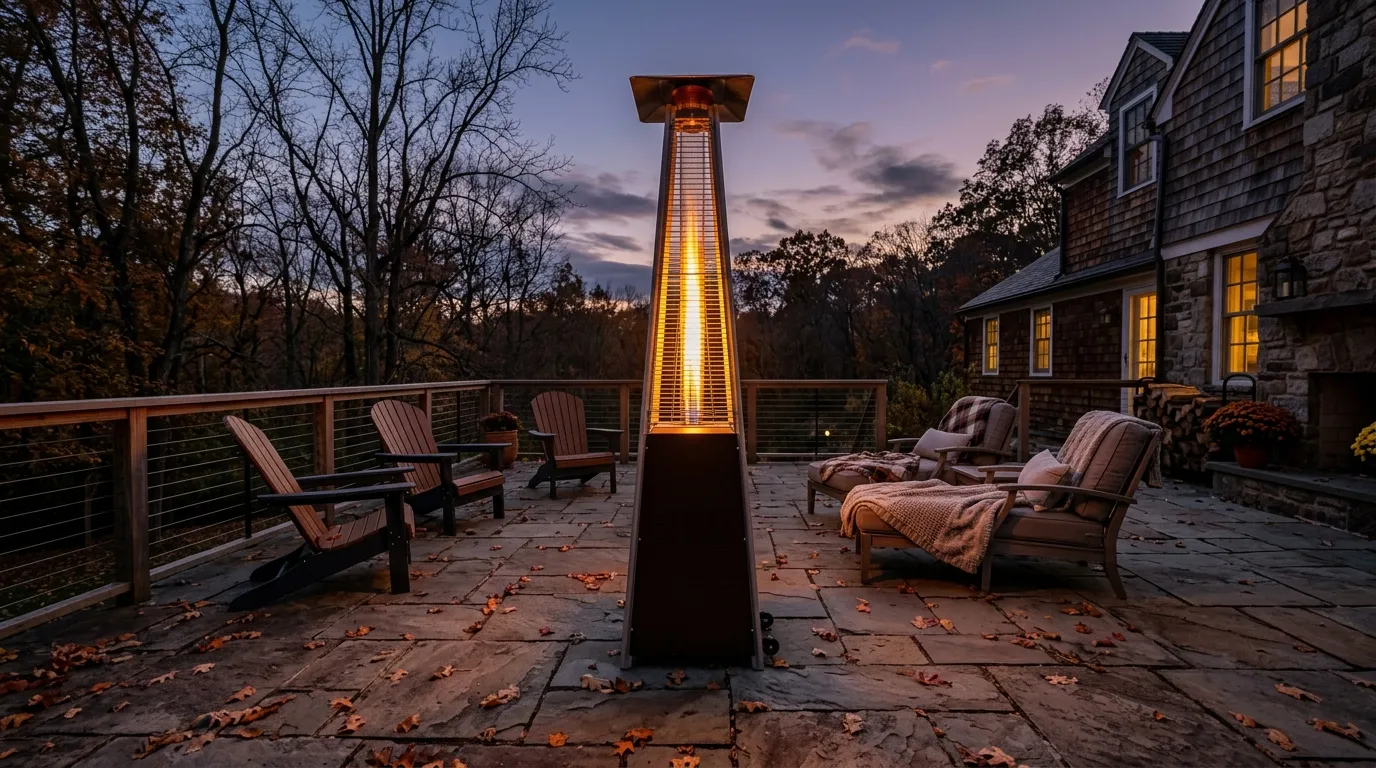
Towers with a reflector cap spread heat in a wide downward circle, best for warming a seating group evenly. Pyramids push a taller, more visible flame and prioritize ambiance. For maximum practical coverage on a large patio, the mushroom-top tower is usually the more efficient choice.
Both formats appear in the picks above because both have a place. The tower is the workhorse for warmth-per-dollar over a table or seating cluster; the pyramid earns its spot where the heater doubles as a focal point on a deck. On a large patio many owners mix them — towers for the main seating area and a pyramid in the corner that people gather near for the look as much as the heat.
What do owners complain about most?
Wind blowing the flame out, propane running down faster on high, and assembly. On a large patio the propane point bites hardest — running a big heater at full output burns through a tank in a handful of hours, so buyers underestimate fuel costs.
None of these are defects; they come with big outdoor propane heaters. A wind guard and a sheltered position reduce flame-out, and keeping a spare tank on hand avoids a cold evening. Owners who plan for the fuel burn and shelter the heaters from wind report far fewer frustrations. See how outdoor heating fits your wider home heating setup for the full picture.
Propane, electric or infrared — which type suits a large patio?
Propane is the standard choice for a large patio because it delivers the most BTU per dollar and needs no wiring, which is why every pick above runs on a propane tank. Electric and infrared heaters can work too, but a freestanding electric outdoor heater usually tops out well below propane's output, and most need a dedicated outlet you may not have near an open patio.
A tabletop or wall-mounted infrared heater is the better fit for a small dining nook, not a large open patio — their radiant heat warms whoever sits directly in front of them rather than filling a wide area. For a big space you want a tall freestanding tower that throws heat outward in a circle. Brands like Hiland, AZ Patio Heaters, Bromic and Fire Sense all build this freestanding format because it is simply the more efficient way to cover a large outdoor footprint. If your patio is small or partly enclosed, though, a compact tabletop or wall-mounted infrared unit is the smarter, cheaper buy — save the big propane towers for genuinely large decks.
What will running a large-patio heater actually cost?
A 48,000-to-55,000 BTU propane heater burns through a standard propane tank in roughly five to ten hours on high, so treat fuel as an ongoing running cost, not a one-time purchase. Running two smaller heaters instead of one oversized unit rarely saves propane, since combined BTU output is what drives consumption either way.
Look for a stainless steel burner and weatherproof housing before you buy — a large patio heater lives outdoors year-round in many households, and cheap-gauge steel rusts through in a season or two of rain and humidity. CSA certification on the gas components is the safety mark worth checking, since it confirms the burner and hose have passed independent testing for outdoor gas appliances. Zone heating still applies outdoors: aiming a tower at your actual seating cluster on the deck, rather than trying to warm the whole patio evenly, gets more comfort out of the same propane tank.
What do first-time large-patio buyers get wrong?
The single biggest mistake is buying one heater sized for a small patio and expecting it to cover a large deck. A 30,000 BTU tabletop unit that would be plenty for a two-person balcony simply cannot compete with wind and open air across a big freestanding gathering space — buy toward the top of the BTU range for a genuinely large patio, not the middle.
The second mistake is treating the base as an afterthought. An empty plastic base on a tall tower is fine indoors and unsafe outside; fill it with sand or water before the first use, not after a gust knocks the heater over. Owners on exposed decks also consistently regret skipping a wind guard around the burner, since even a light breeze can pull a flame sideways and waste propane without adding usable warmth.
Finally, budget for propane as an ongoing cost, not a one-time accessory. A large patio heater run through a full evening of entertaining burns noticeably more fuel than the same unit on a quiet weeknight, so keep a spare tank on hand if you host regularly — running out mid-gathering is the complaint that comes up again and again in owner reviews of every gas patio heater on this list.

Best for the widest heat throw on a big patio
- 55,000 BTU — the highest output here
- Round table built around the pole
- Stainless steel burner
- Wheels for moving across a large space
Why buy it: For a large patio, output is what matters, and this is the most powerful unit in the lineup — owners consistently report it covers a big seating group where lower-BTU heaters leave the edges cold.

Best for strong coverage at a lower price
- 50,000 BTU propane output
- Double-layer stainless steel burner
- Round table design
- Wheels for repositioning
Why buy it: A common thread in reviews is that this model delivers nearly the same reach as the flagship for less — the go-to when you need real large-patio coverage without paying for the top tier.

Best for windy or exposed large patios
- 48,000 BTU output
- Fillable sandbox base for stability
- Wheels once positioned
- Tall tower for wide spread
Why buy it: Owners on open, breezy patios favor a fillable base like this — a recurring note is that the weighted sandbox keeps a tall heater steady where an empty-base unit would tip on a gusty night.

Best for ambiance plus warmth on a large deck
- 48,000 BTU pyramid flame
- Quartz glass tube with visible flame
- Wheels and cover included
- Tall 89-inch profile
Why buy it: For a large deck where the heater is part of the scene, owners favor the pyramid flame — the glass-tube column looks premium and its height helps spread warmth across a wider area.

Best for a dramatic flame with triple safety
- 48,000 BTU pyramid flame
- Warm glass tube flame display
- Triple safety protection system
- Protective cover included
Why buy it: Owners who want the pyramid look with extra safeguards like the PATIOPIA — a frequent note is that the triple-protection system adds peace of mind on a busy patio with people moving around it.

Best for a dependable extra tower for the far end
- 46,000 BTU output
- Wheels and water-fillable base
- Adjustable heat output
- Simple, proven design
Why buy it: A large patio often needs two heaters, and the consensus favors this as the affordable second unit — owners describe it as no-frills but reliable, with a fillable base for stability.
How we picked
These rankings come from aggregated owner reviews, manufacturer specifications, and the recurring complaint patterns across hundreds of listings — never from us buying and running the heaters ourselves. For large patios we weighted BTU output, base stability and anti-tip design, real-world coverage, and the safety systems that matter on an exposed, windy space. Read our full How We Rank methodology for the complete process.