

Affiliate Disclosure
Some links on this page are affiliate links. As an Amazon Associate, we earn from qualifying purchases — at no extra cost to you. We do not buy, test, or physically handle the products we cover; our rankings come from aggregated owner reviews, ratings and expert consensus. Commissions never change our verdicts. How we rank & full disclosure.
Disclosure: Some links below are affiliate links. As an Amazon Associate we earn from qualifying purchases at no extra cost to you — and a commission never changes which products we recommend.
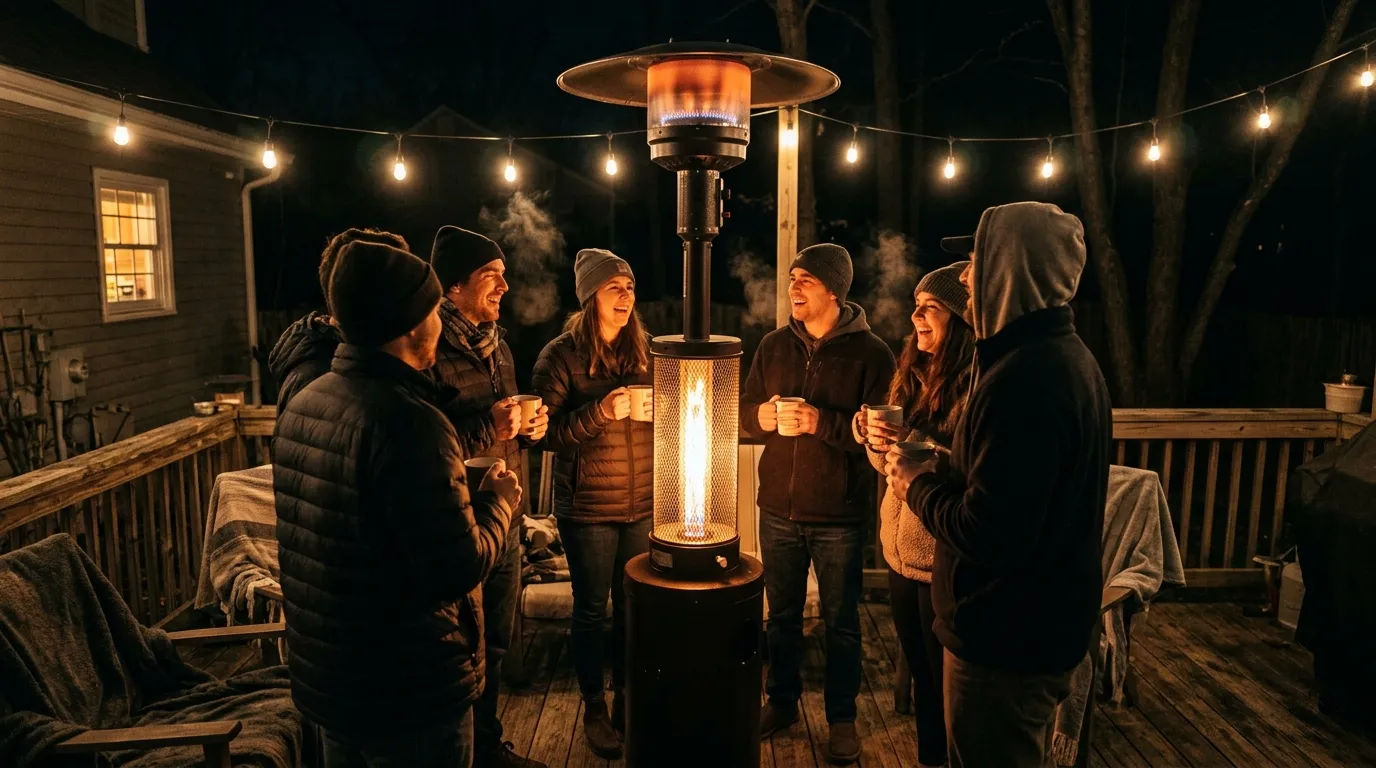
A patio heater extends your indoor climate into the outdoors — but only within limits worth being honest about. A good freestanding propane heater warms a seating group on a cool evening. It does not conquer a windy, wide-open yard. The bottom line: match the BTU and format to your deck or patio, weight the base if you get wind, and expect to refill the propane tank faster than you think. If you have a small, sheltered balcony, a tabletop or wall-mounted outdoor heater can cost far less than these towers. For a typical patio or deck where you want people comfortable after sunset, the picks below are the ones owners consistently trust.
How much area does a patio heater actually cover?
A typical 46,000 to 50,000 BTU tower comfortably warms a rough 9-to-12-foot circle — enough for a small seating group. Wind and open sides cut that sharply, so real outdoor coverage is always less than the BTU number implies.
BTU output and zone heating for a deck
This is the expectation to set before buying. BTU roughly tracks coverage, but outdoors there is no ceiling or walls to hold heat, so placement matters as much as output. Owners consistently report that positioning the heater close to where people sit, against a wall, and out of the wind does more than a few thousand extra BTU. For a large deck or patio, two heaters beat one — each handling its own zone heating job, rather than one unit straining to cover the whole space. Our patio heaters hub goes deeper on sizing.
What types of patio heaters are there?
Outdoor heaters split into freestanding towers, tabletop units, wall-mounted infrared panels, and pyramid-style heaters — and the right one depends on the space, not just the budget.
Freestanding propane towers and radiant heat
A freestanding tower is the default for a dining patio: a mushroom-top or pyramid head on a pole, spreading radiant heat in a wide circle. Pyramid heaters trade some coverage for a taller, more visible glass-tube flame that doubles as ambiance.
Tabletop patio heaters
A tabletop patio heater is a scaled-down version that sits on the table itself. It's useful for a small balcony where a full-size tower would be overkill.
Wall-mounted infrared heaters
Wall-mounted infrared heaters bolt to a covered porch ceiling or wall and throw radiant heat down, without taking up floor space at all. That's a good fit for a fixed outdoor kitchen or covered deck.
Propane tanks, gas and electric power
Most standing models run on propane from a refillable propane tank. Electric infrared wall-mounted units are common on covered patios instead, where running a gas line or swapping tanks isn't practical.
What safety and stability features matter outdoors?
A fillable sand or water base, a wide footprint, and a tip-over auto shut-off. Tall standing heaters catch the wind, and tipping is the most common cause of damage and hazard. A weighted base and automatic gas cut-off address both.
Tip-over protection and weatherproof, stainless steel build
Owners rarely regret prioritizing stability. Filling the base lowers the center of gravity dramatically, and a triple-protection or tip-over shut-off cuts the gas if the unit goes over. Keep the heater at least a couple of feet from walls and well clear of anything flammable overhead. Look for a weatherproof housing and a stainless steel burner assembly, since an outdoor heater lives outside year-round, and cheaper coated steel rusts within a season or two of rain exposure. These habits are the difference between years of use and an early accident.
How much does it cost to run a patio heater?
Running cost for a propane patio heater comes down almost entirely to tank refills, not the heater itself. A 20-lb propane tank typically runs a 45,000–50,000 BTU heater for roughly 8 to 10 hours on high, so an evening or two of entertaining burns through a meaningful chunk of a tank.
Running cost: propane tank versus electric
Compare that to an electric infrared wall-mounted unit, which draws a fixed wattage from the outlet instead of gas. It's cheaper per hour in most areas, but limited to wherever there's a nearby circuit. Neither format is dramatically more efficient outdoors, since there's no wall or ceiling to hold the heat in either way. The practical running cost difference is really about propane tank logistics versus an extension cord.
What do owners complain about most?
The recurring complaints are wind blowing out the flame, propane draining faster than expected on high, and fiddly assembly. None are defects — they come with standing outdoor propane heaters — but they catch first-time buyers off guard.
A wind guard and a sheltered position handle flame-out. Keeping a spare propane tank handy handles the fuel burn, and patience handles assembly. Owners who plan for these report far smoother experiences. If you would rather avoid propane logistics entirely, an electric infrared patio option is a different trade-off worth weighing against your wider home heating choices.
Which patio heater fits your setup?
A dining patio wants a freestanding tower centered near the table. A lounge or fire-pit area does better with two smaller heaters flanking the seating. A covered porch is the one place a wall-mounted infrared unit makes more sense than a standing propane heater.
If you host regularly and the patio sees six or more people most weekends, budget for the highest-BTU freestanding option and a spare propane tank. Running out mid-evening is the single most common regret owners report. If it's mostly two people on a small balcony, a tabletop patio heater or a compact electric unit does the job without the bulk of a full tower, and it's easier to store over summer.
Renters and anyone without a permanent structure should lean toward freestanding and tabletop formats over wall-mounted, since drilling into a rented deck or a shared building wall usually isn't an option. Owners in windier climates consistently favor a heavier, sand-fillable base over a lighter water-fillable one. Sand doesn't freeze or evaporate, and it adds more usable weight per gallon of capacity.
How long does a patio heater last outdoors?
Most owners report three to five years of regular seasonal use from a well-built propane patio heater, longer if it's covered or stored when not in use. A stainless steel burner assembly resists the rust that kills cheaper coated-steel units within a season or two.
The single biggest factor in lifespan isn't the brand — it's whether the heater gets a weatherproof cover between uses. Left uncovered through repeated rain and humidity, even a well-reviewed patio heater's igniter and gas valve start failing early. A $20 cover is cheap insurance against replacing a $200 heater a year sooner than necessary. Wipe down the burner and check the propane tank connection for corrosion at the start of each season, before the first cold evening you actually want the heat.

Best for all-round standing warmth for a dining set
- 50,000 BTU propane output
- Round table built around the pole
- Double-layer stainless steel burner
- Wheels for easy repositioning
Why buy it: This classic mushroom-top tower is the model owners recommend most — the consensus favors it for wide, even warmth over a table, solid build, and the handy integrated tabletop.

Best for dependable warmth on a budget
- 46,000 BTU output
- Wheels and water-fillable base
- Adjustable heat output
- Simple, proven design
Why buy it: A common thread in reviews is that this no-frills tower does the core job reliably for less — owners describe it as the safe budget default, with a fillable base for stability.

Best for a standout flame look on a deck
- 48,000 BTU pyramid flame
- Quartz glass tube with visible flame
- Wheels and cover included
- Tall 89-inch profile
Why buy it: Owners who want the heater to be part of the ambiance favor the pyramid style — a frequent note is that the glass-tube flame looks far more upscale than a standard tower while still delivering real warmth.

Best for the widest coverage for a larger patio
- 55,000 BTU — highest output here
- Round table design
- Stainless steel burner
- Wheels for moving across a space
Why buy it: For a bigger patio, owners consistently reach for the highest-BTU option — reviewers report it covers a larger seating group where lower-output heaters leave the edges cold.

Best for a dramatic flame with extra safeguards
- 48,000 BTU pyramid flame
- Warm glass tube flame display
- Triple safety protection system
- Protective cover included
Why buy it: Owners who want the pyramid look with more built-in safety favor the PATIOPIA — a recurring note is that the triple-protection system reassures on a patio with people moving around it.

Best for exposed spots where stability matters
- 48,000 BTU output
- Fillable sandbox base for stability
- Wheels once positioned
- Tall tower for wide spread
Why buy it: On breezy patios owners favor a weightable base like this — a frequent note is that the sandbox keeps a tall heater steady where an empty-base unit would tip in a gust.
How we picked
These rankings come from aggregated owner reviews, manufacturer specifications, and the recurring complaint patterns across hundreds of listings — never from us buying and running the heaters ourselves. We weighted BTU output and real-world coverage, base stability and tip-over safety, weatherproof build quality, and value. Those are what separate a patio heater owners keep for years from one that rusts or tips after a season.
Names like Hiland, AZ Patio Heaters, Bromic, and Fire Sense show up constantly in this category alongside the models above. Many outdoor heaters carry a CSA safety certification worth checking for on any model you're considering, ours or otherwise. None of those brands are automatically ranked above a lesser-known name. A heater with strong, consistent owner reviews and a stainless steel build outranks a bigger name with a spottier track record on flame stability or tip-over protection.
We also cross-check listed BTU output against owner-reported real-world coverage, since manufacturer numbers are measured in ideal, windless conditions that a real patio rarely offers. Read our full How We Rank methodology for the complete process.