


Affiliate Disclosure
Some links on this page are affiliate links. As an Amazon Associate, we earn from qualifying purchases — at no extra cost to you. We do not buy, test, or physically handle the products we cover; our rankings come from aggregated owner reviews, ratings and expert consensus. Commissions never change our verdicts. How we rank & full disclosure.
A large bedroom is where cheap humidifiers quietly fail. A 1-litre tank that dries out by 2 a.m. does nothing for the indoor climate you're actually trying to fix. For a big room, two things matter: tank capacity and honest coverage across the square footage.
You need enough water to run all night, and enough output to lift humidity across the whole floor, not just the corner the unit sits in. The picks below are the cool-mist models owners of larger bedrooms keep recommending. If your room is small, or you mainly want a diffuser, a smaller unit will suit you better and save money.
Ultrasonic vs evaporative cool mist humidifiers — which is better for a large bedroom?
Ultrasonic cool mist humidifiers use a vibrating plate to atomize water into a fine mist. They run essentially silent, which is why they dominate this list. Evaporative models use a wicking filter and a fan to pull moisture into the air instead. That trades some quiet for water output that self-regulates and never overshoots.
An ultrasonic unit is the better fit for most large bedrooms. It's quiet enough to sleep next to, and pushes mist output far enough to reach across a big room. An evaporative humidifier's wicking filter naturally limits how much moisture it releases as the air gets more humid. That makes it harder to accidentally over-humidify, but it needs regular filter changes and is rarely as silent.
If quiet, all-night operation is the priority, ultrasonic wins. If hands-off self-regulation matters more, evaporative is worth a look.
Wicking filter maintenance vs mist output
An evaporative model's wicking filter needs regular changes, but it naturally caps mist output as the air gets humid. Ultrasonic units skip the filter and push mist output straight into the room.
What tank capacity, runtime and humidistat features matter for a large bedroom?
For a large bedroom, look for tank capacity of roughly a gallon (around 3.8 litres) or more. Pair it with a built-in humidistat that reads relative humidity and stops adding mist once you hit your target. Auto shut-off when the tank runs dry protects the motor and prevents dry air from a unit running empty overnight.
Runtime is really just tank capacity divided by mist output. A bigger tank buys a longer stretch between refills at the same output setting — useful for a big room you want to run on a higher setting all night, without waking up to check it.
A humidistat also protects against the opposite problem. Dry air creeping back once the humidifier switches off is normal, so don't chase a number so precisely that the unit cycles on and off constantly. If sinus dryness or a stuffy nursery is the reason you're shopping, a model with an accurate humidistat is worth paying more for than one with a bigger tank alone.
All of the models here run on low, energy efficient power draws, well under what a space heater or air conditioner uses. Running one all night costs very little.
Square footage, relative humidity and auto shut-off
Match tank capacity to your room's square footage, then let the humidistat hold relative humidity steady. Auto shut-off protects the motor once the tank runs dry.
How big a humidifier does a large bedroom actually need?
For a large bedroom, look for a tank of roughly 3 litres or more and a coverage rating that comfortably exceeds your room's square footage. Tank size sets runtime; coverage sets whether humidity actually reaches the far wall.
Manufacturers rate coverage generously, so buying a unit rated for a room bigger than yours is the safe move. It reaches your target humidity faster and then idles, rather than running flat-out all night and still falling short. A 4-litre-class tank is the sweet spot most large-bedroom owners land on. It's enough for an uninterrupted night, without being so heavy it's a chore to refill.
Nursery and large-bedroom coverage
The same sizing math for a large bedroom works for a nursery: buy for a room bigger than the one you have, so the unit idles instead of straining.
Is cool mist the right choice for a bedroom?
Cool mist is the usual bedroom pick. There's no hot water to spill and no heating element drawing extra power overnight. The trade-off: cool-mist units rely on a clean tank rather than heat to stay hygienic, so regular rinsing matters.
Warm-mist units boil the water first, which some people prefer in winter. But that adds a burn risk and a noticeable power draw. For a room you sleep in with the door closed, the consensus favors cool mist paired with a simple cleaning habit. Empty and wipe the tank every few days, rather than topping it up on old water.
Quiet operation and energy efficient overnight use
Cool mist skips the heating element, so it's quiet and energy efficient overnight. No boiling water means no burn risk and a lower power draw while you sleep.
Will a large humidifier make the room too damp?
It can if you run it wide open and never check the level. The goal is roughly 40–50% relative humidity; above that you invite condensation on windows and, over time, mould. A cheap hygrometer or a model with a built-in humidity readout keeps you honest.
This is the flip side of buying a bigger unit. More output means it's easier to overshoot in a well-sealed room. Owners who are happiest with high-capacity humidifiers almost always mention running them on a lower setting, or an auto mode once the room is comfortable, rather than leaving them on maximum.
Dry air, sinus relief and the right target
Dry air is the whole reason to run a humidifier, and sinus relief is the usual goal. Aim for 40-50% relative humidity, not higher, so you don't trade dry air for damp windows.
What do owners complain about most?
White dust and cleaning. Ultrasonic cool-mist units atomise whatever is in the water, so hard tap water leaves a fine mineral film on nearby surfaces. Distilled or filtered water largely solves it. The second recurring gripe is mould in a neglected tank.
Neither is a fault so much as a maintenance reality of the category. A common complaint is a musty smell after a week of topping-up without emptying. The fix is the same cleaning routine that keeps any humidifier safe. Buy for tank size and quiet, then plan on a rinse every few days, and distilled water if your area is hard.
Filter care and essential oil use
An evaporative filter needs regular rinsing or replacement. If you want essential oil aromatherapy, pick a model with a built-in diffuser tray rather than adding oil straight to the tank.
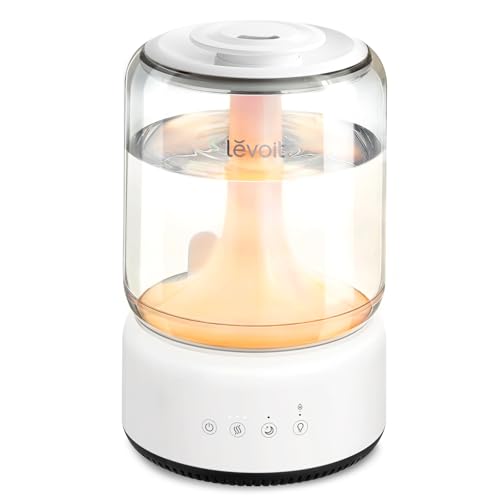
Best for large bedrooms that need all-night runtime
- 4.2 L top-fill tank
- Sized for large rooms
- Ultrasonic cool mist
- Quiet near-sleep operation
Why buy it: Owners consistently report the large tank runs through a full night without a refill, and the pour-in top-fill design is the detail repeat buyers mention most.

Best for long unattended runtime at a mid-range price
- 4 L tank
- Up to 36-hour runtime
- Rated around 28 dB
- Cool-mist output
Why buy it: The long runtime and low noise rating come up again and again in owner feedback as the reason this one gets left running for days at a time.

Best for people who hate wrestling a tank to the sink
- 3.6 L top-fill tank
- Pour-in refilling
- Cool-mist output
- Large-room coverage
Why buy it: A common theme in reviews is how much easier pour-in refilling is than the flip-and-carry tanks on cheaper units — a real difference when the humidifier lives across a big room.

Best for a large bedroom where the unit sits beside the bed
- 2.5 L top-fill tank
- Rated around 28 dB
- Large-room rating
- Compact footprint
Why buy it: Owners point to the small footprint paired with large-room output as the reason it fits a nightstand without dominating it.

Best for light sleepers sensitive to any hum
- 3 L tank
- Rated around 26 dB
- Up to 30-hour runtime
- Cool-mist output
Why buy it: At its low rated noise level it is one of the quietest in this group, and owners who wake at the slightest sound single it out for exactly that.

Best for adding light aromatherapy to the bedroom
- 3 L tank
- Built-in oil diffuser tray
- Quiet operation
- Cool-mist output
Why buy it: The built-in diffuser tray is the feature owners buy this for, letting one unit handle humidity and a faint scent without a second gadget on the dresser.
How we picked
These rankings come from aggregated owner reviews, manufacturer specifications and recurring complaint patterns — not first-hand testing. We don't buy, run or physically handle the units. Instead we read where the consensus lands across large numbers of verified-purchase reviews, and weigh it against what each maker claims.
Levoit and DREO dominate this specific list. Honeywell, Pure Enrichment and Vicks are long-running names worth knowing in the wider cool mist humidifier category, particularly for nursery-focused models. Neither the EPA nor any other US agency certifies humidifiers for efficiency the way ENERGY STAR does for appliances, so "energy efficient" here is a function of low wattage, rather than a formal rating.
That approach favors units owners actually keep using over ones that only look good on a spec sheet. See How We Rank for the full methodology. Browse the cool-mist humidifiers hub or the wider humidity control section for related guides.
If cool mist alone isn't solving genuinely dry winter air across the whole house, rather than just the bedroom, a whole-house humidifier tied into your HVAC system may matter more than any single room unit, however large its tank capacity.