


Affiliate Disclosure
Some links on this page are affiliate links. As an Amazon Associate, we earn from qualifying purchases — at no extra cost to you. We do not buy, test, or physically handle the products we cover; our rankings come from aggregated owner reviews, ratings and expert consensus. Commissions never change our verdicts. How we rank & full disclosure.
The product links below are affiliate links. As an Amazon Associate we earn from qualifying purchases at no extra cost to you, and a commission never changes which products we recommend or where they rank.
Whole-home air quality tracking is really a question of coverage, not a single super-monitor. Any monitor only reads the air in its own room. So "whole-home" means either several sensors reporting to one app, or one portable unit you carry between rooms.
This category suits anyone whose indoor climate varies by room — a stuffy upstairs bedroom, a smoky kitchen, a damp basement — and who wants to see all of it in one place. If you only ever worry about one room, a single monitor is enough, and you can skip the multi-unit approach. The bottom line: decide whether you want many fixed sensors or one you move, then buy for that plan.
The payoff of whole-home tracking isn't just curiosity. It's catching problems that are otherwise invisible, until they've been affecting sleep, allergies, or general health for months. A slow CO2 buildup in a sealed bedroom, a formaldehyde source off-gassing from new furniture, a humidity creep in a basement still below the point where you'd notice a musty smell — all of these show up on a monitor's real-time readout long before a person would notice anything by feel.
That's the actual case for spending on more than one sensor. Air quality problems are usually room-specific and slow-building. That's exactly the kind of thing continuous data logging catches, and a once-a-week walk-through misses entirely.
What should an air quality monitor measure, and how good is sensor accuracy?
Look for real-time PM2.5 (particulate matter), CO2, VOC, and humidity at minimum. Formaldehyde and a rolled-up AQI figure are useful extras. Accuracy depends heavily on sensor type and calibration. A true NDIR CO2 sensor reads truer than an estimated eCO2 figure derived from VOC levels.
Not all sensors measuring "CO2" actually measure CO2 directly. Budget monitors often estimate it (eCO2) from VOC readings, which drifts over time without calibration. A dedicated NDIR sensor, like the one in the Aranet4, measures the gas itself and holds accuracy for years with little to no recalibration needed.
PM2.5 particulate matter sensors use a laser to count particles directly. That's generally reliable across price tiers. Formaldehyde and full VOC breakdowns are the specs where cheaper multi-in-one monitors cut the most corners.
An AQI number is a convenient single-glance summary. But it's a calculated blend of the underlying particulate matter and gas readings. The per-parameter data is what actually tells you which room has a problem, and why.
PM2.5, VOC, CO2 and particulate matter sensors
PM2.5 and particulate matter sensors use a laser to count particles directly. VOC and CO2 sensors vary more in quality — a true NDIR CO2 sensor beats an estimated VOC-derived figure.
AQI, calibration and real-time readings
An AQI number blends several readings into one glance-friendly score. Real-time per-parameter data, kept accurate through regular calibration, tells you more than the blended AQI alone.
How many air quality monitors does a whole home actually need?
Most homes need one monitor per problem area rather than one per room — typically the main bedroom, the kitchen or living area, and any basement or space with a specific concern. Two or three well-placed units give a realistic whole-home picture without over-buying.
Air quality is intensely local. PM2.5 spikes at the stove, CO2 climbs in a closed bedroom overnight, humidity pools in a basement. A single hallway sensor would miss all three.
Owners who track whole-home successfully describe placing units where behaviour and air actually change. That's why a two-pack plus a later single often covers a house better than trying to buy one monitor for every room.
Indoor air quality by room, not by house
Indoor air quality is intensely local — one hallway sensor can't represent a bedroom, kitchen and basement at once. Place sensors where the air actually changes, not just anywhere central.
Should whole-home monitors be networked to one app, or is a portable unit fine?
Networked app-based monitors are better for continuous, simultaneous tracking and data logging across several rooms. A single portable unit is better if you'd rather spot-check rooms one at a time, without any accounts or Wi-Fi. Mixed setups — one hub plus roving sensors — are common and work well.
The Amazon Smart monitors report every unit into one app view with historical data logging. That's what most people picture when they say "whole-home." A portable like the Aranet4 trades simultaneity for accuracy and simplicity. You can't watch four rooms at once, but you get a trustworthy reading anywhere, with zero setup and no app dependency.
A recurring complaint with all-Wi-Fi setups is a dropped unit going unnoticed. Many owners keep at least one self-contained monitor as a reliable check. Check calibration settings periodically on any sensor that's been running continuously for a year or more.
App-based data logging vs a self-contained sensor
An app-based setup gives continuous data logging across every room at once. A self-contained sensor skips the app and Wi-Fi entirely, trading that history for simplicity.
What should you actually track across a whole home for health reasons?
Prioritise PM2.5, CO2, VOCs and humidity, because those are the readings that genuinely differ room to room and drive comfort and health outcomes. A single blended AQI or "air score" is far less useful across a house than seeing which specific value is off in which room.
Different rooms fail in different ways, so per-parameter data is what makes multi-room tracking worth it. High CO2 in a bedroom points to ventilation, and can affect sleep and cognition at sustained high levels. A PM2.5 particulate matter spike in the kitchen points to cooking and range-hood use. Rising humidity in a basement points to a dehumidifier. Formaldehyde, when a monitor tracks it, often points to new furniture or flooring off-gassing.
Monitors that separate these values let you match the fix to the room and the health concern, instead of reacting to one house-wide number that averages the problem away.
Humidity, temperature and formaldehyde by room
Humidity and temperature swings point to ventilation problems. Formaldehyde, when a monitor tracks it, usually points to new furniture or flooring off-gassing nearby.
How do these picks compare to Airthings, Temtop, IQAir, and Awair?
Airthings and IQAir lead the premium, health-focused segment with stronger calibration and longer sensor life; Temtop and Awair sit closer to the budget and mid-range multi-in-one monitors that compete directly with the Sainlogic and ZEMEOLLO picks above.
Airthings built its name on radon and CO2 accuracy for whole-home health monitoring, often at a premium over the multi-in-one displays here. IQAir carries similar premium positioning, with a strong reputation for PM2.5 particulate matter accuracy. Temtop and Awair compete more directly on price, with broad sensor suites similar to the picks above. Owners comparing them report similar accuracy trade-offs — good enough for spotting a problem room, not lab-grade instrumentation.
Whichever brand you choose, EPA guidance on PM2.5 and CO2 thresholds is the reference point worth checking your readings against. A monitor's own color-coded "good/moderate/poor" labeling doesn't always map cleanly to it. None of these brands, including the budget multi-in-one displays, require a subscription to keep reading. That's a distinction worth checking before buying, since a small number of smart home sensors on the market do gate historical data logging behind a paid app tier.
Alerts and accuracy across brands
Alerts matter as much as raw accuracy — a monitor that reads well but never pings your phone misses the point. Compare both before choosing a brand.
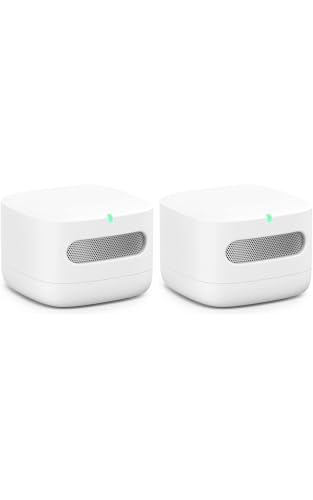
Best for Watching two rooms from a single purchase
- Two identical smart monitors in one box
- Independent PM2.5, VOC, humidity and CO alerts per room
- Works with Alexa for whole-home routines
- Cheaper per unit than buying two singly
Why buy it: Owners consistently report the two-pack is the cleanest way to start whole-home tracking, because a monitor only reports its own room — covering a bedroom and a living area at once beats one unit you keep relocating.

Best for Adding one more room to an Alexa setup
- Single unit that drops into an existing Alexa home
- Tracks PM2.5, VOCs, humidity, temperature and CO
- Phone alert the moment a room’s air drops
- Screen-free — all readings live in the app
Why buy it: A common approach owners describe is buying the two-pack first, then adding singles like this one room by room, since every unit reports to the same app for one whole-home view.

Best for Carrying accurate CO2 readings between rooms
- True NDIR CO2 sensor plus temperature and humidity
- Multi-year battery — no wiring, no Wi-Fi, no app
- E-ink display readable at a glance
- Small enough to move room to room
Why buy it: For homes that care most about CO2, the consensus favors carrying one trustworthy Aranet4 between rooms over blanketing the house with cheaper estimated-CO2 sensors — owners praise its accuracy and set-and-forget battery.

Best for A hub screen in the room you use most
- Reads CO2, HCHO, TVOC, PM2.5, PM1.0 and PM10
- Large 7.2-inch colour display
- Shows humidity and temperature together
- Colour-coded status for fast interpretation
Why buy it: Buyers who want one detailed anchor point for the house pick this for its big screen — owners like putting it in the main living space and using smaller sensors elsewhere for the outlying rooms.

Best for Adding rooms without repaying premium prices
- Tracks ten parameters including CO2 and PM2.5
- Colour touchscreen display
- Rechargeable, so it can rove between rooms
- Reads temperature and humidity
Why buy it: When the goal is covering more of the house cheaply, owners consistently report this hits the readings that matter for a fraction of a name-brand price, making it the natural pick for secondary rooms.

Best for A big, glance-friendly readout in a busy room
- Real-time CO2 plus nine air-quality indicators
- Seven-inch screen readable across the room
- Seven configurable alert thresholds
- Colour status changes as air quality shifts
Why buy it: A frequent complaint about small sensors is unreadable displays; owners choose this one for shared spaces like a kitchen or family room where everyone should be able to see the number without picking it up.
How we picked
These picks come from aggregated owner reviews, manufacturer specifications and recurring complaint patterns — never from us buying or physically handling the units. We don't run first-hand tests. We synthesise what the whole ownership base reports, so you don't have to, weighting sensor accuracy and calibration stability, real-time responsiveness, alert reliability, and app-based data logging where applicable.
See how we rank for the full method. To pair monitoring with the devices that actually change your air, browse the air quality monitors hub and the broader smart climate control section.