

Affiliate Disclosure
Some links on this page are affiliate links. As an Amazon Associate, we earn from qualifying purchases — at no extra cost to you. We do not buy, test, or physically handle the products we cover; our rankings come from aggregated owner reviews, ratings and expert consensus. Commissions never change our verdicts. How we rank & full disclosure.
The product links below are affiliate links. As an Amazon Associate we earn from qualifying purchases at no extra cost to you, and a commission never changes which products we recommend or where they rank.
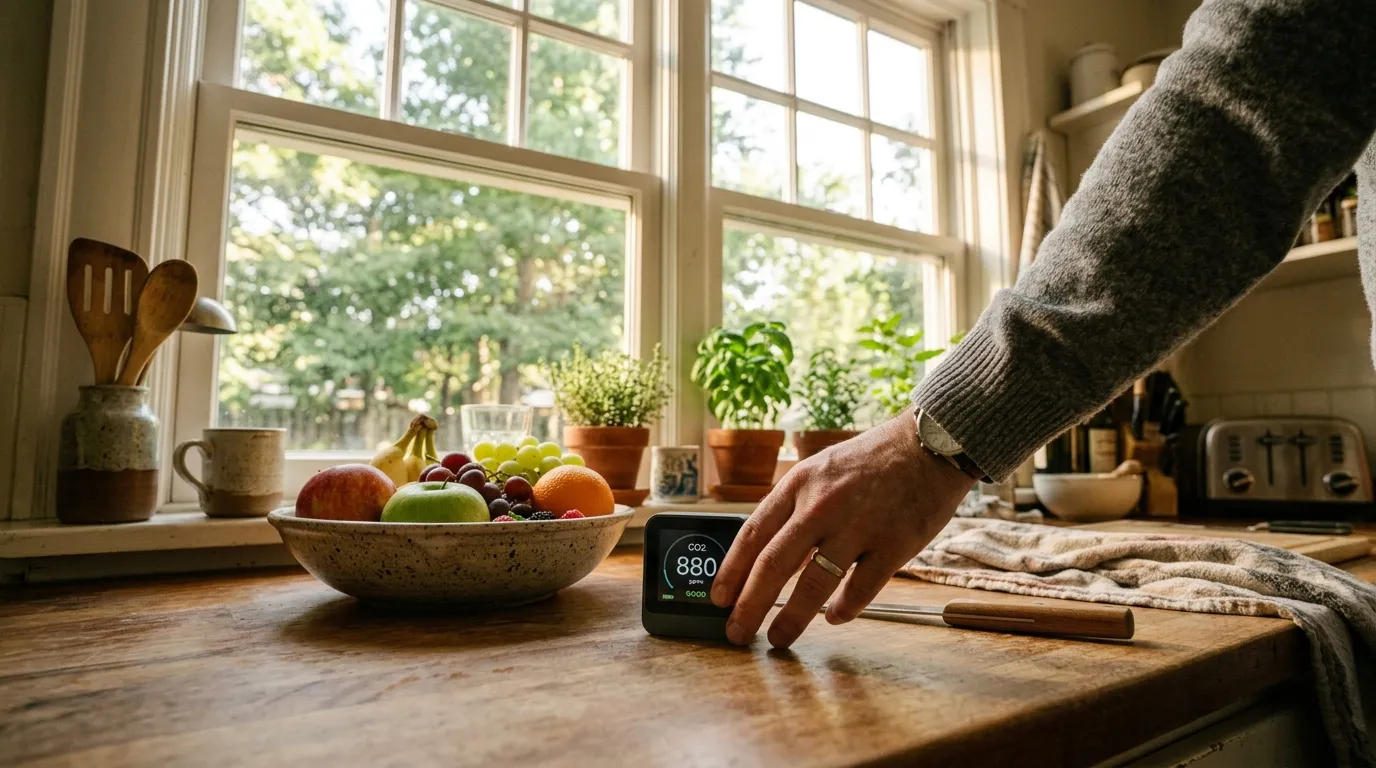
A CO2 monitor measures carbon dioxide — the gas that builds up in closed, occupied rooms and correlates with that stuffy, foggy-headed, hard-to-concentrate feeling. It's the single most useful reading for judging whether your indoor air quality has enough fresh air moving through it. This category suits anyone in a sealed bedroom, a home office, a classroom or a small meeting room who wants to know when it's time to crack a window. If your rooms are already well ventilated and you feel fine, you can skip it. The bottom line: buy for CO2 sensor accuracy first, because a monitor is only as good as the number it reports.
What CO2 level should a monitor tell you to act on?
Outdoor air sits around 400–420 ppm; below about 800 ppm indoors is comfortable, 1,000 ppm is the common "ventilate now" threshold, and above 1,400 ppm is where people widely report drowsiness and poor focus. A good monitor makes crossing those lines obvious.
The value of a CO2 reading is behavioural: it tells you exactly when to open a window, run a fan or step out. That's why colour-coded displays and adjustable alerts matter more than a long list of extra sensors — you want the "getting stuffy" moment flagged before you feel it. Owners repeatedly say a visible threshold alert is what changed their ventilation habits, not the raw number itself.
Why does CO2 sensor type matter so much?
True NDIR (non-dispersive infrared) sensors measure CO2 directly and hold calibration for years; cheaper "eCO2" chips estimate CO2 from VOC readings and can drift or misreport. For a monitor whose whole job is CO2, an NDIR sensor is the feature worth paying for.
This is the biggest quality divide in the category. NDIR units like the Aranet4 give numbers you can act on with confidence, while estimated-CO2 sensors can swing when someone sprays cleaner nearby or opens a bottle of alcohol. A common complaint about the cheapest all-in-one monitors is exactly this drift, so if CO2 accuracy is the point, confirm the sensor is NDIR before buying, and check that its calibration is either factory-set for years or user-adjustable against known outdoor air.
Does a CO2 monitor also track temperature, humidity, and data logging over time?
Most true NDIR monitors bundle temperature and humidity alongside the CO2 reading, since the same board can host all three sensors cheaply. Some models add data logging, storing hours or days of history so you can see trends rather than just a single real-time number.
The real-time reading is what you act on in the moment, but data logging is what tells you whether a room has a chronic ventilation problem or just an occasional bad afternoon. A bedroom that quietly climbs above 1,000 ppm every night while you sleep is a pattern you'd only catch with logged history, not a one-off glance at the display. Temperature and humidity riding along on the same screen is a genuine convenience too — high CO2, high humidity, and a warm room often show up together in a poorly ventilated space, and seeing all three at once makes the diagnosis faster than checking three separate gadgets.
Is a CO2 monitor the same as a carbon monoxide alarm?
No — and it's a critical difference. A CO2 monitor tracks carbon dioxide for ventilation and comfort; a carbon monoxide (CO) alarm detects a deadly, odourless gas from combustion. A CO2 monitor is not a safety device and will not warn you about carbon monoxide.
The names look almost identical, but they protect against completely different things. Every home with gas appliances, a fireplace or an attached garage needs a proper carbon monoxide alarm regardless of whether it owns a CO2 monitor. Treat the CO2 monitors on this page as indoor air quality and ventilation tools, and keep a dedicated, listed CO alarm for safety — they are not interchangeable.
Where should you place a CO2 monitor for an accurate reading?
Somewhere at roughly breathing height, a few feet from any door or window, and away from a direct draft, a vent, or a corner where air doesn't circulate. Placed correctly, a good NDIR monitor gives an accurate real-time picture of the air you're actually breathing in that room.
A monitor stuck right next to an open window reads artificially low, since it's sampling fresh outdoor air rather than the room's real average. One tucked in a dead corner behind furniture can read high because stale air pools there before it circulates. Desk height or a shelf a few feet off the floor, away from the direct path of an HVAC vent, tends to give the most representative number for a bedroom, office, or classroom. If you're portable-monitor shopping specifically to compare rooms, keep the placement consistent between checks so you're comparing like with like.
Why do classrooms and offices care about CO2 monitoring specifically?
A classroom or office packs more people into a fixed volume of air than a home, so CO2 climbs faster and the link between rising ppm and reduced focus becomes noticeable within a single class period or meeting. A visible monitor prompts someone to open a door or window before the room gets uncomfortably stuffy.
Schools and workplaces have increasingly adopted CO2 monitors as a simple, low-cost proxy for ventilation quality, since a rising number is an early, objective signal that a room needs fresh air — well before people consciously notice feeling foggy-headed. A classroom running a portable CO2 monitor can spot-check different rooms through the day, which is exactly the use case a battery-powered, multi-parameter unit is built for. For a fixed office or meeting room, a plug-in desktop model with a clear color-coded alert is usually the simpler, cheaper choice, since it never needs to move.
How accurate do CO2 monitors need to be to be useful?
Within roughly 50 to 75 ppm of the true reading is typical for a good consumer NDIR monitor, which is more than accurate enough to catch the trend that matters: whether a room is climbing toward the 1,000 ppm ventilate-now threshold, not the exact number to the single digit.
Chasing lab-grade accuracy is unnecessary for home, office, or classroom use — what matters is that the monitor is consistent and repeatable so you can trust the trend line and the alerts, not just a single snapshot reading. A monitor's accuracy also depends on periodic calibration; many NDIR units self-calibrate automatically by assuming outdoor-level fresh air occurs at some point over a stretch of days, which is why occasionally opening windows fully actually helps the monitor stay accurate over its lifespan. If a unit's readings start drifting noticeably from what you'd expect in a well-ventilated room, that's the sign it needs a manual recalibration or has reached the end of its useful sensor life.

Best for Anyone who wants a CO2 number they can trust
- True NDIR CO2 sensor for accurate readings
- Also tracks temperature and humidity
- E-ink display with green / amber / red status
- Multi-year battery — no wiring or app required
Why buy it: The Aranet4 is the CO2 monitor owners recommend first — a recurring theme in reviews is that its NDIR accuracy and years-long battery make it the reference other units get measured against.

Best for A reliable desktop CO2 reader on a budget
- Measures CO2 alongside temperature and humidity
- Clear desktop display for home, office or classroom
- Adjustable high-CO2 alert
- Simple plug-in-and-read operation
Why buy it: Owners consistently report Temtop delivers the core CO2, temperature and humidity readings most rooms need at a friendlier price, which makes it the easy value recommendation.

Best for Carrying CO2 tracking between rooms
- 8-in-1 readout including CO2, temperature and humidity
- 1600mAh rechargeable battery for cord-free use
- Compact enough to move room to room
- On-screen air-quality indicators
Why buy it: A common request in reviews is a CO2 monitor you can pick up and carry; owners point to this one’s rechargeable battery and multi-parameter screen as the reasons it works for spot-checking different rooms.
How we picked
These rankings come from aggregated owner reviews, manufacturer specifications and recurring complaint patterns — not from us buying or physically handling the units. We don't run first-hand tests; we synthesise what the whole ownership base reports so you don't have to. Aranet and Temtop lead this list on NDIR accuracy and value respectively, and Vitalight and INKBIRD are other names worth comparing if you want more display or connectivity options. See how we rank for the full method. For how CO2 tracking fits with purifiers, thermostats and humidity, start at the CO2 monitors hub or the wider smart climate control section.