
Affiliate Disclosure
Some links on this page are affiliate links. As an Amazon Associate, we earn from qualifying purchases — at no extra cost to you. We do not buy, test, or physically handle the products we cover; our rankings come from aggregated owner reviews, ratings and expert consensus. Commissions never change our verdicts. How we rank & full disclosure.
Affiliate disclosure: Some links below are affiliate links. As an Amazon Associate we earn from qualifying purchases, at no extra cost to you. Commissions never change which products we recommend or how we rank them.
Both of these thermostats will manage your home's indoor climate well, so the honest answer to which one wins is: it depends on your rooms and your ecosystem. Choose the ecobee Enhanced if your home runs hot in some rooms and cold in others, or if you want the widest smart-home compatibility — its room sensors are the deciding feature. Choose the Google Nest if you value a simpler, better-looking device, already live in the Google ecosystem, and want the best odds of installing without a C-wire. Neither is a wrong buy; they simply suit different homes. A smart thermostat is one of the few upgrades that touches your indoor climate every single day, so getting the fit right matters more here than it does for a one-off accessory purchase.
| Product | Best for | Buy |
|---|---|---|
| ecobee Smart Thermostat Enhanced | Best for Room Sensors | Check Price (paid link) |
| Google Nest Thermostat | Best for Simplicity & Design | Check Price (paid link) |
ecobee vs Nest: which installation is easier — C-wire and HVAC compatibility
Nest has a slight edge, because it more often works without a common (C) wire, which many homes lack. ecobee counters by including a PEK adapter to supply power where there is no C-wire. Either way, run the brand's compatibility checker with a photo of your wiring first.
Older homes with a heat-only or heat-pump-only HVAC system are the most likely to lack a C-wire. This is exactly where the two approaches diverge: ecobee's PEK adapter taps power from the equipment itself. Nest's own power-stealing design works in many but not all setups. If your system is unusual — a heat pump with auxiliary strips, a boiler, or a multi-stage furnace — check the specific compatibility list for both brands before you buy.
Which one balances an uneven home better — remote sensor and zoning
ecobee, clearly. Its SmartSensors act as a remote sensor and let the system prioritize whichever room you are in. A far bedroom or a cold home office is not left to the whim of a hallway thermostat. The Nest reads only where it is mounted.
This matters most in homes with a single thermostat serving multiple floors, where the room the thermostat happens to be mounted in rarely matches the room people actually spend time in. ecobee's included sensor and the option to add more let the system approximate real zoning, prioritizing occupied rooms — a structural advantage Nest's single fixed sensor cannot match. Neither brand sells true multi-zone HVAC control the way a ducted zoning system does; both are single-system thermostats that use sensors to approximate the effect.
Which fits your smart-home ecosystem — WiFi, Alexa, Google Home, and app control
Both connect over home WiFi and offer app control from a phone. ecobee is the broader of the two, working across Alexa, Google Home, Apple Home and SmartThings. Nest fits most naturally in a Google household and pairs seamlessly with Google speakers and the Home app.
If your household already has a mix of devices — an Alexa speaker from Amazon, an iPhone, a SmartThings hub — ecobee's wider compatibility avoids the awkwardness of a thermostat that only half-integrates with what you already own. A household fully committed to Google speakers and Android phones will find Nest the more native fit, with app control that ties tightly into routines already built around Google Home.
Which is simpler to live with day to day — scheduling, programmable, and learning
Nest. Its touch-strip and mirror display keep things minimal, and owners who want to set a schedule and forget it tend to prefer it. ecobee gives more granular, programmable control and richer on-device scheduling, which power users value but casual owners can find is more than they need.
The trade-off is genuinely about how involved you want to be. Nest's learning algorithm builds a schedule from how you actually adjust the temperature over the first week or two, which suits someone who would rather not open an app and configure anything. ecobee expects a bit more setup up front — naming sensors, building a programmable schedule — but rewards that effort with finer control once it is dialed in.
Geofencing and heat pump support: which handles advanced HVAC setups?
Both offer geofencing, using your phone's location to switch to an away setting automatically when everyone leaves and back to a comfort setting as you return. Both also support heat pump systems, including multi-stage and dual-fuel configurations, though ecobee's setup exposes more heat pump-specific options during installation.
For a straightforward single-stage furnace or standard heat pump, either brand's geofencing and HVAC support works reliably. For an unusual system — a heat pump with electric auxiliary heat, or a boiler paired with a heat pump — ecobee's more detailed installation wizard tends to surface the right settings more directly than Nest's simpler setup flow.
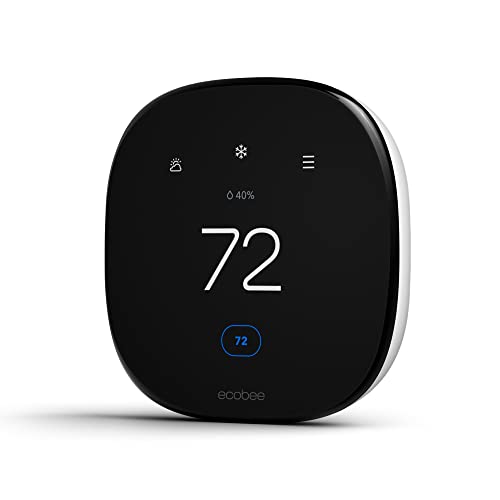
Best for homes with rooms that run hot and cold
- Supports ecobee SmartSensors to balance far-off rooms
- Works with Alexa, Google Home, Apple Home and SmartThings
- Full-color touchscreen with detailed on-device scheduling
- Ships with a PEK adapter to help no-C-wire installs
Why buy it: Owners with an uneven home consistently favor ecobee, because the room sensors let the system follow the bedroom or office you actually occupy rather than the hallway. Its broad ecosystem support is the other reason reviewers reach for it over Nest.
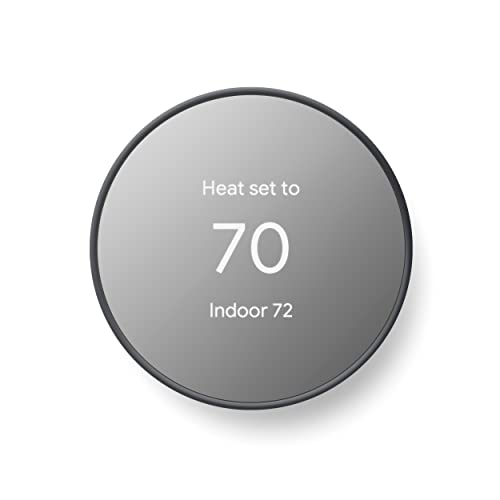
Best for Google-home users who want clean, simple control
- Mirror-finish display with touch-strip control
- Schedules and Home/Away routines via the Google Home app
- Energy-history suggestions to trim runtime
- Often installs without a C-wire — compatibility check advised
Why buy it: The consensus pick for looks and ease. Owners in the Google ecosystem like how naturally it fits, and a recurring plus is that it frequently installs without a C-wire — the trade-off being fewer power-user controls than ecobee offers.
Does either one actually save on heating and cooling costs — energy savings and energy report
Both can, mainly through scheduling and away detection rather than any single magic feature. Nest leans on its learning algorithm to build a schedule automatically. ecobee leans on room sensors and occupancy detection to avoid conditioning rooms nobody is in. Both brands are ENERGY STAR certified and publish an energy report in their apps.
The bigger the gap between your old routine — a thermostat left on one setting all day — and either smart thermostat's scheduling, the more you stand to save. Someone who already runs a disciplined manual schedule will see a smaller jump in energy savings than someone who previously left the system running flat regardless of occupancy. Either brand's energy report shows usage history, which is the honest way to check whether it is actually helping in your specific home.
Where does Honeywell fit next to ecobee and Nest?
Honeywell is the third major name in smart thermostats, and its WiFi-connected line sits closer to Nest than ecobee on features — solid scheduling and app control, without ecobee's remote sensor ecosystem. It is worth cross-shopping if neither ecobee nor Nest's design or ecosystem fits your home.
Honeywell's advantage is often price and broad HVAC compatibility, since the company has decades of experience with both smart and non-smart thermostat installation across every kind of system. If your home has an unusual HVAC setup that neither ecobee nor Nest's compatibility checker loves, it is worth running the same wiring photo through Honeywell's checker before ruling out a smart thermostat entirely.
What does a smart thermostat installation actually involve?
Turning off power at the breaker, removing the old thermostat, labeling and connecting wires to the new base plate, then mounting the display and pairing it to WiFi through the app. Most owners complete installation themselves in under an hour once compatibility is confirmed.
The step that trips people up is not the physical mounting — it is correctly identifying which wire is which on the old thermostat, especially in a home with unusual heat pump or multi-stage wiring. Both ecobee and Nest walk through this in their apps with photos and prompts, but taking a clear photo of the old wiring before disconnecting anything is the single habit that prevents a stalled installation. If your system involves anything beyond a standard single-stage furnace or heat pump, professional installation removes the guesswork.
The verdict
There is no single winner — there is a right pick for your home. Go ecobee if uneven room temperatures or wide ecosystem support matter to you; the room sensors solve a problem the Nest cannot. Go Nest if you want the simpler, cleaner device, live in a Google home, or need the better shot at a no-C-wire install. Whichever you choose, check your system's wiring and compatibility list before buying rather than after, since a return over a wiring mismatch is the single most avoidable smart-thermostat headache. Energy Efficient HVAC System does not buy or physically handle these units; this comparison reflects aggregated owner reviews, manufacturer specifications and recurring complaint patterns — see our How We Rank methodology. For the wider field, see the smart thermostats hub, and our smart climate control pillar for how a thermostat fits with the rest of a connected home.