
Affiliate Disclosure
Some links on this page are affiliate links. As an Amazon Associate, we earn from qualifying purchases — at no extra cost to you. We do not buy, test, or physically handle the products we cover; our rankings come from aggregated owner reviews, ratings and expert consensus. Commissions never change our verdicts. How we rank & full disclosure.
Some links below are affiliate links. As an Amazon Associate we earn a commission from qualifying purchases at no extra cost to you — it never changes which products we recommend or how we rank them.
Dust is the most visible indoor climate problem — and one of the easiest for a purifier to help with, because household dust is mostly particles big enough for any True-HEPA filter to trap. The catch is that dust clogs filters fast, so the smartest dust buys are units with a washable pre-filter and enough coverage to run gently. A purifier reduces airborne dust and slows how quickly it resettles on surfaces; it will not eliminate dusting, but it makes the job far less frequent.
What makes an air purifier good for dust specifically?
A washable pre-filter plus True HEPA, sized generously for the room. The pre-filter catches large, fast-clogging dust so the HEPA lasts; True HEPA then removes the fine dust that stays airborne. Coverage matters because more air changes per hour means dust resettles more slowly.
Household dust is a mix of skin, fiber, soil and dander — most of it well within HEPA's range, so filtration is rarely the limiting factor. What separates a good dust purifier from an average one is how it manages the sheer volume: a washable pre-filter you rinse instead of replace, and enough clean-air delivery to keep the room turning over without running flat-out.
Will an air purifier stop me having to dust?
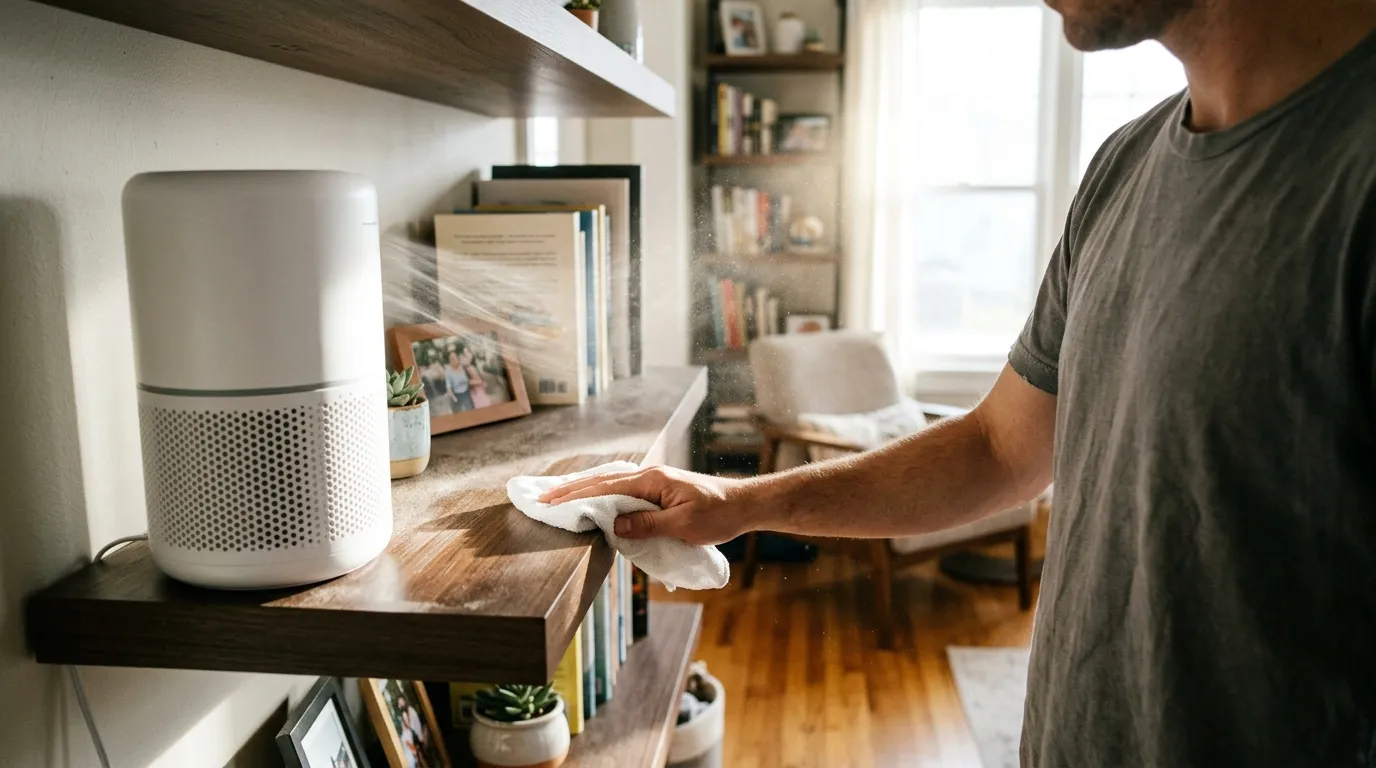
No, but it noticeably slows it down. A purifier captures dust while it is airborne, so less of it lands on shelves and floors — owners consistently report longer gaps between dustings. Dust that has already settled, or that you stir up walking around, still needs a cloth and a vacuum.
Think of it as reducing the supply of airborne dust rather than removing dust entirely. Running it continuously matters here: dust is generated constantly by daily activity, so a purifier switched on only occasionally never gets ahead of it. Pair it with a sealed HEPA vacuum and the two together keep a room far cleaner than either alone.
How big a unit do I need for a dusty room?
Size up. Pick a purifier rated for a larger room than yours so it can hit four to five air changes per hour on a quieter, lower speed. Dusty rooms benefit from constant running, so an over-sized unit on medium beats a small one straining at maximum.
What do owners complain about most?
How fast filters clog, and noise at high speed. Both trace back to dust volume. The recurring advice in reviews is to buy a unit with a rinseable pre-filter and more coverage than you think you need, so it runs gently and the expensive HEPA is not doing all the heavy lifting.
What's the difference between HEPA, activated carbon and CADR for dust?
True HEPA and CADR are the two numbers that matter for dust — HEPA describes filter quality (how small a particle it traps), while CADR (Clean Air Delivery Rate) describes speed: how much clean air the unit actually pushes out per minute. A purifier can have excellent HEPA media and still feel weak in a real room if its CADR, and the fan behind it, is too small for your square footage. AHAM independently certifies CADR figures, so look for that certification on brands like LEVOIT, Coway, Winix and Honeywell rather than trusting an uncertified number.
Activated carbon is a secondary stage that most dust-focused purifiers include almost as an afterthought — dust itself is a solid particulate, not a gas, so HEPA does the real work, and carbon mainly helps with any musty or construction dust smell that tags along with a renovation. If your main complaint is genuinely fine dust and particulates rather than odor, prioritize HEPA grade and CADR over how thick the carbon layer is.
How do PM2.5, allergens and filter replacement connect for dusty homes?
PM2.5 is the fine-particle reading — the portion of dust small enough to stay airborne and reach deep into lungs — that many purifiers display in real time, and it is a genuinely useful way to see whether an auto mode unit is responding to a fresh cloud of dust from vacuuming or construction work nearby. Allergens like dust-mite debris ride along on the same fine particles, so a unit that handles PM2.5 well is also easing allergies.
Filter replacement is the ongoing cost dust owners underestimate: a heavy dust load can cut a HEPA filter's rated life significantly if there is no pre-filter catching the coarse material first. Budget to check the pre-filter monthly in a dusty home — after a renovation or new construction dust settles, more often — and replace the True HEPA cartridge on the manufacturer's schedule rather than waiting for a performance drop you can feel.
What do first-time dust-focused buyers get wrong?
The most common mistake is buying a purifier without a washable pre-filter for a genuinely dusty home, then watching the True HEPA stage clog far faster than the manufacturer's estimate. In a construction-adjacent or high-traffic household, a pre-filter you rinse regularly is what keeps the expensive HEPA cartridge lasting anywhere near its rated life.
The second mistake is undersizing. Square footage ratings assume an average particle load, and a room with more dust than average — pets, carpet, an older HVAC system, nearby renovation — needs more CADR than the bare room-size number suggests, or the purifier runs constantly at top speed and still falls behind. The third is expecting a purifier to replace vacuuming and dusting entirely; it only captures dust while it is airborne, so settled dust on shelves and floors still needs a cloth and a vacuum on a normal schedule.
Placement is the quieter fourth mistake. A purifier pushed into a corner behind furniture, or set up right next to an open doorway with constant foot traffic, pulls in less of the room's actual air than one given a clear space to draw from. Give it room on at least two sides, keep it away from a wall it can recirculate the same stale air against, and change the pre-filter on a set schedule rather than waiting until it visibly looks gray — by the time dust is visible on the pre-filter, the True HEPA stage behind it has already been working harder than it should.

Best for Whole-room dust control with lower long-term filter costs
- Rated for very large rooms up to about 2,200 sq ft
- Washable filter component handles heavy dust without constant replacements
- Real-time PM2.5 display and air-quality sensor
- High fan speeds for fast air changes in dusty rooms
Why buy it: The best all-round dust fighter here because the washable component tackles what makes dust expensive — filters clogging fast. Owners consistently report visibly less settled dust within days, and the PM2.5 readout confirms the load dropping.
Best for Bedrooms and mid-size rooms where dust is the main issue
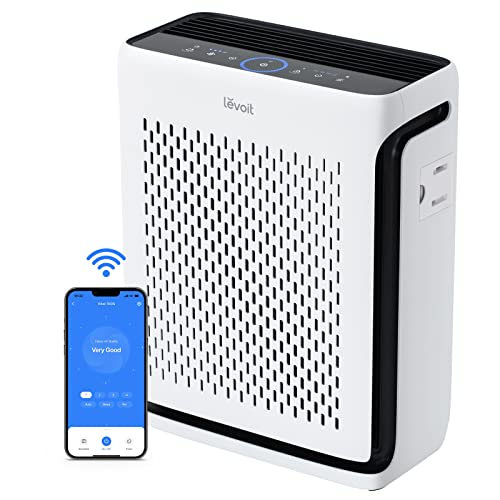
- Washable pre-filter captures large dust and hair up front
- True HEPA and carbon behind it for fine dust and odor
- Reusable pre-filter cuts replacement frequency
- Sized for a single bedroom or living room
Why buy it: A cost-smart pick for dust because the washable pre-filter takes the brunt, so the pricier HEPA lasts longer. Owners consistently report it keeps surfaces cleaner between dustings, especially in bedrooms.

Best for Quiet overnight dust filtration in a single room
- H13 True HEPA captures fine dust down to 0.3 microns
- Activated-carbon layer for accompanying odors
- Quiet sleep mode for running through the night
- Compact footprint for nightstands and desks
Why buy it: The quiet-room specialist. Owners consistently report waking up to less dust on the nightstand, and its near-silent low setting makes it easy to leave running all night where dust settles most.

Best for Large rooms wanting maximum coverage and turnover
- True HEPA rated for rooms up to about 2,200 sq ft
- Multi-stage filtration for fine and coarse dust
- Strong airflow for rapid whole-room cleaning
- Simple controls with a large clean-air delivery
Why buy it: A high-coverage HEPA option for big, dusty rooms. Owners consistently report it clears the air quickly after activities that kick up dust, though a common complaint is that top speed is audible.

Best for Great-rooms and basements that need reach without breaking the bank
- Cleans rooms up to about 1,695 sq ft in an hour
- Multi-stage filter including True HEPA for fine dust
- Higher airflow aimed at larger open spaces
- Straightforward controls, no app needed
Why buy it: A lot of coverage for the money. Owners consistently report it handles bigger dusty rooms other mid-size units struggle with, making it a sensible large-area pick when budget still matters.

Best for A simple, quiet unit for steady background dust control
- High-efficiency filtration for rooms up to about 1,076 sq ft
- Multi-stage filter targeting dust, pollen and smoke
- Runs quietly enough for all-day operation
- No-app controls that are easy to set and forget
Why buy it: A no-fuss budget option for keeping dust down in a medium room. Owners consistently report it runs quietly all day, which is what steady dust control actually needs.
How we picked
We do not buy or run these units ourselves. Energy Efficient HVAC System ranks air purifiers from aggregated owner reviews, manufacturer filtration specs and the complaint patterns that only surface across many buyers. For dust the consensus favors washable pre-filters and generous coverage over headline features, because dust volume — not filtration efficiency — is what usually limits performance. See how we rank for the full method.
Want the background first? Read the air purifiers for dust hub, step back to the air purification pillar, or see how to improve indoor air quality for the habits that keep dust down.