
Affiliate Disclosure
Some links on this page are affiliate links. As an Amazon Associate, we earn from qualifying purchases — at no extra cost to you. We do not buy, test, or physically handle the products we cover; our rankings come from aggregated owner reviews, ratings and expert consensus. Commissions never change our verdicts. How we rank & full disclosure.
Some links below are affiliate links: if you buy through one we earn a small commission at no extra cost to you. We never buy or physically handle these fans, and a commission never changes where a product lands in this ranking.
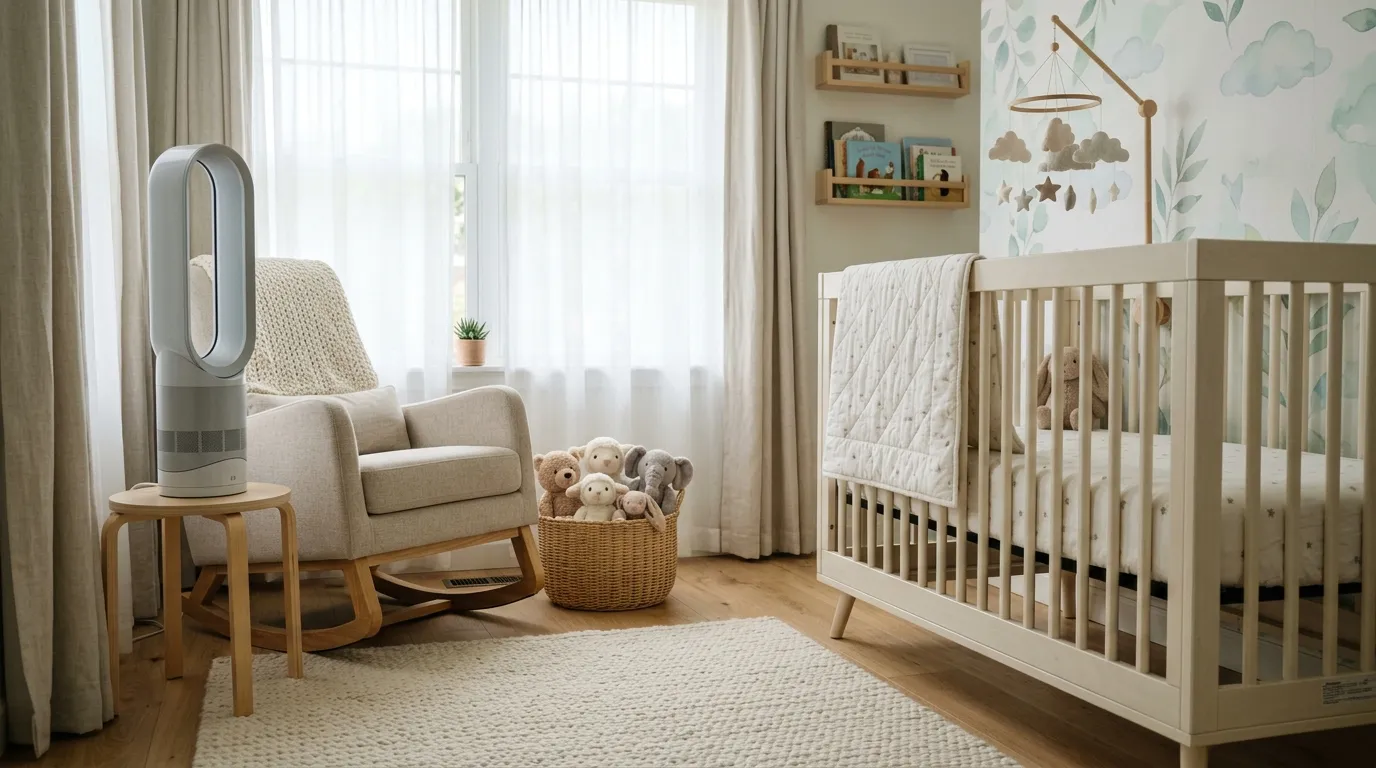
For a nursery, a bladeless fan is less about cooling and more about a safe, quiet indoor climate. It's gentle air circulation with no exposed blades within a curious child's reach. That safety-plus-quiet combination is exactly what bladeless fans do best, which is why this category suits nurseries better than most.
If your baby's room genuinely overheats, though, a fan alone won't fix it. Circulation makes a room feel more comfortable. It does not lower the temperature.
Is a bladeless fan safe for kids in a nursery?
Yes, and circulating air is generally encouraged for infant sleep. Research has linked moving air in a nursery to a lower risk of overheating. A bladeless design adds a second layer of safety by removing the spinning blades a toddler could reach.
The two things that matter most: don't aim airflow directly at the baby, and keep the fan and its cord well out of reach. Every pick above is bladeless specifically so there's nothing to poke a finger into. Models with a pivoting arm or oscillation let you circulate air near the ceiling, instead of blowing it onto the crib.
Air circulation and airflow near the crib
Air circulation is the actual job here, not a direct draft. Point airflow at the ceiling or a wall, not straight at the crib. Gentle, indirect airflow is what pediatric guidance generally favors.
How quiet does a nursery fan really need to be?
Quiet enough that its low speed doesn't intrude. But many parents actually want a steady, soft sound. A DC-motor fan around the low-20s in decibels gives you both options — near-silent, or a consistent white-noise-style hum with no clicks or rattles.
The consensus favors DC-motor models here. The noise they make is smooth and even, easier for a baby to sleep through than the uneven whir of a cheap AC motor. A common complaint about budget fans is a faint tick or wobble that becomes obvious in a quiet room at 2am — worth avoiding when sleep is at stake.
Tower design and running cost at low speed
A tower fan on its lowest speed barely touches your running cost. The DC motor style favored here draws little power, whether it runs quiet all night or just a nap.
Should the fan blow directly on the baby?
No. Aim it to circulate the room's air, rather than blowing straight onto an infant. Point it toward a wall, the ceiling or across the room, so the whole space stays evenly comfortable without a direct draft on the crib.
This is where an aimable fan with wide oscillation earns its place. Owners consistently report using the Shark's pivoting arm, or a tower fan's oscillation setting, to keep air moving for gentle cooling without a targeted breeze. A timer or sleep mode also helps, easing the fan off once the room has settled.
Oscillation and remote control for gentle cooling
Oscillation spreads gentle cooling across the whole room instead of one spot. A remote control lets you adjust the angle or speed without opening the nursery door.
What makes a fan "bladeless," and why does that matter in a nursery?
A bladeless fan, sometimes called an air multiplier — the term Dyson popularized — draws air in through a base. It accelerates that air out through a narrow ring-shaped slot. There's no spinning blade behind the grille for small fingers to reach. It still moves real air — the "bladeless" part refers to what you can touch, not the airflow itself.
Because there's nothing exposed to spin, a bladeless tower is inherently safe for kids, in a way a caged box fan is not. The smooth housing makes for genuinely easy clean wipe-downs, compared with picking hair and dust out of blade guards.
Brands like Dyson, DREO, LEVOIT and Kohler all sell bladeless towers built around this same idea. A few premium Dyson models double as a bladeless air purifier, adding HEPA filtration to the airflow for a nursery with allergy concerns.
Easy clean housing, no blade guard
A bladeless housing wipes clean in seconds. There's no blade guard to pick hair and dust out of, which matters in a room you clean often.
What specs and features matter for a nursery fan?
CFM (airflow output) matters less here than speed settings and controls, since a nursery fan usually runs on its lowest one or two speeds. Look for a wide range of speed settings, so you can find a genuinely gentle one. Add a timer so the fan can ease off once a baby is asleep, rather than running at full airflow all night.
Remote control matters more in a nursery than almost any other room. You want to adjust the fan without opening a door and waking a light sleeper. A few newer models add smart, app-connected control for the same reason — you can nudge the speed from the hallway on your phone.
None of this changes the running cost much. A bladeless fan on low draws only a little power, so energy efficient operation is rarely a concern next to a heater or an air conditioner. ENERGY STAR-style low-wattage ratings are common across this category for exactly that reason.
CFM, speed settings and smart control
CFM output matters less than fine speed settings for a nursery fan, since it mostly runs on the lowest one or two. Some newer models add smart, app-based control for the same reason.
Timer and energy efficient overnight use
A timer eases the fan off once a baby is asleep instead of running it all night. It's already an energy efficient appliance on low, so the timer is about routine, not power savings.
What do first-time nursery-fan buyers get wrong?
The most common mistake is buying a caged box fan because it's cheaper. A year or two later, parents discover the guard's gaps are still wide enough for a curious toddler's finger. A genuinely bladeless design solves that problem permanently, not just for the crib-only newborn stage. That's why it's worth the modest price premium over a standard room fan, for a room a child will use for years.
The second mistake is buying on top-speed airflow instead of low-speed quiet. A nursery fan spends almost all its life on its lowest one or two speed settings. A unit that only shines at full power — loud, strong, impressive on a spec sheet — is the wrong pick for a room where the whole goal is not waking anyone up. Test-listen to owner videos of the lowest setting before buying, if you can — marketing copy rarely mentions how a fan actually sounds at 2am.
Cord and placement safety round out the common regrets. Keep the fan and its cord well out of a crib's reach. Use a tower or wall-adjacent placement, rather than a low tabletop unit near where a baby will eventually stand. Never run a fan pointed directly at a sleeping infant, regardless of how gentle the airflow feels to an adult hand. None of the models above are marketed as safe for kids to touch while running, bladeless or not — treat "no blades" as removing one risk, not every risk.
Do you need a separate air purifier alongside a nursery fan?
A fan and an air purifier solve different problems. A bladeless fan alone won't fix a genuinely dusty or allergy-prone nursery. Circulating air makes a stuffy room feel fresher and helps a baby sleep, but it doesn't remove dust, pollen or pet dander the way a true HEPA air purifier does.
Some premium bladeless models fold both functions into one housing, filtering the air it moves rather than just pushing it around. That's worth considering if allergies already run in the family, or the home has shedding pets.
For most nurseries, though, a dedicated bladeless fan for gentle circulation and cooling is the more cost-effective setup. Pair it with a separate air purifier only if you have an actual dust or allergy concern, rather than paying a premium for a combination unit you may not need.

Best for a near-silent breeze that will not wake a sleeping baby
- DC motor rated near 22 dB on the lowest speed
- No exposed blades to reach into
- Eight speeds plus a 12-hour timer
- Remote so you adjust it without opening the door
Why buy it: The consensus favors this as the best nursery match: owners consistently report the low speeds are quiet enough to run through a nap, and the remote means you can nudge the speed from the doorway without disturbing the room.

Best for a quiet, gradual sleep mode for overnight use
- Ultra-quiet DC motor around 22 dB on low
- Sleep mode steps the speed down over the night
- 90-degree oscillation with a 7-hour timer
- Slim 40-inch tower that tucks into a corner
Why buy it: Owners consistently report the sleep mode is the standout for a nursery, easing airflow down as the room settles. A common complaint is the price, which is why it sits as the premium pick rather than the value one.

Best for covering a nursery on a smaller budget
- Bladeless 40-inch tower, nothing to poke fingers into
- Wide oscillation for even, gentle coverage
- 9-hour timer and a full remote
- Turbo speed for warming afternoons
Why buy it: Owners consistently report this is the most fan-for-the-money option that is still safe around a crib. Keep it on a low speed for a nursery — the consensus is that the turbo setting is too loud for a sleeping baby.

Best for directing a gentle breeze away from the crib
- Pivoting arm aims air up, down or across the room
- Bladeless design with no blade guard to clean around
- Quiet variable-speed motor
- Remote control and timer
Why buy it: The adjustable arm is genuinely useful in a nursery: owners consistently report using it to circulate air near the ceiling rather than blowing directly onto the baby, which pediatric guidance generally prefers.

Best for a small, wipe-clean fan on a shelf or dresser
- Compact 11.8-inch bladeless desk fan
- Touch controls and three quiet speeds
- Smooth housing that wipes clean quickly
- Small footprint for a nursery shelf
Why buy it: A handy second fan for the changing area. A common complaint is that it is a personal-sized fan, not a room cooler, so use it for close, gentle air rather than cooling the whole nursery.

Best for small nurseries where floor space is tight
- Compact 34-inch bladeless tower
- 70-degree oscillation
- Quiet DC motor
- Light enough to move between rooms
Why buy it: A good fit for a smaller nursery. Owners consistently report it is easy to reposition and simple to clean, though its shorter body suits compact rooms more than large ones.
How we picked
We do not buy, test or physically handle these fans. For a nursery roundup we weighted three things owners talk about most — genuinely low noise on the lowest speed, a fully bladeless housing that's easy to keep clean, and controls (remote, timer, sleep mode) that let you adjust the fan without opening the door. Those judgments come from aggregated owner reviews and manufacturer specifications, not first-hand testing.
See how we rank, browse the full bladeless fans hub, or read how cooling affects your home's indoor climate to understand where a fan helps and where a nursery needs real cooling instead.