



Affiliate Disclosure
Some links on this page are affiliate links. As an Amazon Associate, we earn from qualifying purchases — at no extra cost to you. We do not buy, test, or physically handle the products we cover; our rankings come from aggregated owner reviews, ratings and expert consensus. Commissions never change our verdicts. How we rank & full disclosure.
A bladeless fan is not bladeless — it simply hides its impeller in the base. A small, fast turbine draws air in through vents near the floor and forces it out through a narrow slot around the inside of the loop, and that fast-moving sheet of air drags a much larger volume of surrounding room air along with it. The result is a smooth, wide airflow with no exposed spinning parts at hand height. What you pay for is that safety and the smoothness, not raw airflow per dollar.
How does a bladeless fan actually move air?
A motor in the base pushes air up into the hollow ring and out through a thin slot. That jet passes over a curved lip, which draws in surrounding air alongside it — a process called entrainment — so the volume of air leaving the front is several times what the impeller itself moves.
The practical effect is an airstream with unusually little turbulence and no blade chop, which is why owners frequently describe it as feeling like natural airflow rather than a fan. It also means the airflow arrives as a broad column rather than a concentrated jet, so it covers a person at a distance more evenly than a small desk fan does.
The engineering cost of all this is that the impeller has to spin fast in a small housing to generate the pressure the slot requires. That is why bladeless designs are typically no more efficient than a large conventional fan and often less so, and why the sound they make sits higher in pitch. Marketing that presents entrainment as free extra airflow is describing how the mechanism works, not a violation of the trade-off between air moved and energy used.
Are bladeless fans genuinely safer around children and pets?
Yes, in the specific way that matters: there is no exposed rotating blade at the height a toddler or a curious pet can reach. The impeller is behind narrow intake vents in the base, and fingers cannot reach it. That is the category's clearest and most defensible advantage.
This is the reason bladeless fans dominate nursery and playroom recommendations. A conventional fan's guard is designed to prevent adult fingers reaching the blade, and small fingers, pencils and toys are a different problem. Removing the hazard entirely rather than guarding it is a materially better answer in a room where an unsupervised child spends time.
Two caveats are worth keeping in view. A tall bladeless fan on a narrow base is a tip-over risk in exactly the same household, so base weight and stability deserve as much attention as the blade question. And the intake vents at the bottom still draw air — and dust, hair and small objects — so keeping the floor around the base clear matters more than with a fan whose intake is at waist height.
Are bladeless fans quieter than regular fans?
Not necessarily quieter in decibels, but different in character. There is no blade chop, so the sound is smoother, but the high-speed impeller and the air passing through a narrow slot can produce a hiss or higher-pitched tone that some people find more noticeable than a conventional fan's rush.
Owner feedback on this splits sharply, and it splits on sound character rather than volume. People who dislike the rhythmic pulse of a bladed fan often prefer a bladeless one at the same measured level; people sensitive to higher frequencies report the opposite. The quality of the motor and the precision of the slot make a large difference here, and it is one of the clearest areas where the expensive models justify their price against the budget imitations.
On low settings, well-made bladeless fans are genuinely quiet and suit bedrooms and nurseries. On high, the same hiss becomes prominent. If you mainly want a large volume of quiet air rather than a safe one, a large-diameter conventional fan achieves that more cheaply — tower fans occupy a similar footprint and price band with a different set of compromises.
Are they easier to clean?
Much easier, and it is an underrated part of the appeal. The loop is a smooth surface you can wipe in seconds, with no blades to disassemble and no cage to unclip. The maintenance that does remain is the intake vents in the base, which collect dust and hair.
Compared with a tower fan's inaccessible internal drum or a pedestal fan's blade set behind a guard, this is a real practical advantage in a home with pets or in a dusty room. It also means the fan keeps performing as it did when new for longer, because dust accumulation on a blade is what quietly degrades a conventional fan's airflow over seasons.
Blocked intake vents are the failure mode to watch for. Restricted intake reduces output and makes the motor work harder, and because the vents are at floor level they clog faster than most people expect. A vacuum brush over the base every few weeks handles it.
The loop shape itself also affects how the fan behaves in a room. Tall oval loops throw a broad vertical curtain of air that reaches a standing adult; smaller round loops concentrate the airflow into a narrower column better suited to a desk or a bedside table. Some models use a partially open loop that directs air forward rather than allowing it to spread, which increases the distance the airstream travels at the cost of covering less of the room. None of this is usually described on the box, so it is worth matching the shape to how you will actually sit or stand relative to the fan.
Is a combined bladeless fan and purifier worth buying?
It can be, if you genuinely want both in one appliance and the room is small enough for the purifier side to be adequate. The compromise is that combining functions usually means less airflow than a dedicated fan and less clean-air delivery than a dedicated purifier of the same price.
Many premium bladeless models add sealed filtration, and some add heating so the same unit works year-round. That consolidation is genuinely attractive in a nursery or a small bedroom where one appliance replacing three is worth a performance compromise. Filter cost is the ongoing consideration, and it is often significant relative to the purchase price over several years, and proprietary filter formats mean there is rarely a cheaper third-party option.
There is also a functional tension between the two jobs. A fan wants to move as much air as possible with as little resistance as possible; a purifier deliberately places a dense filter in the airflow path. Combining them means the fan side is always working against a restriction, which is why a combined unit generally produces less airflow than a plain fan of the same size and power. Manufacturers manage this with more powerful motors, which brings the noise back up. It is a reasonable compromise for a small room and a poor one for a large, hot space.
Before paying for the filtration, check what standard it actually meets — the term HEPA is used loosely in product marketing, and our explainer on what a true HEPA filter is covers the difference and why room size matters as much as filter grade. As with every fan in the cooling pillar, the filtration does not make the appliance an air conditioner: it still cools people rather than rooms.
What types of bladeless fans are there?
Format decides footprint, coverage and what extra features are worth paying for.
Tower bladeless fans
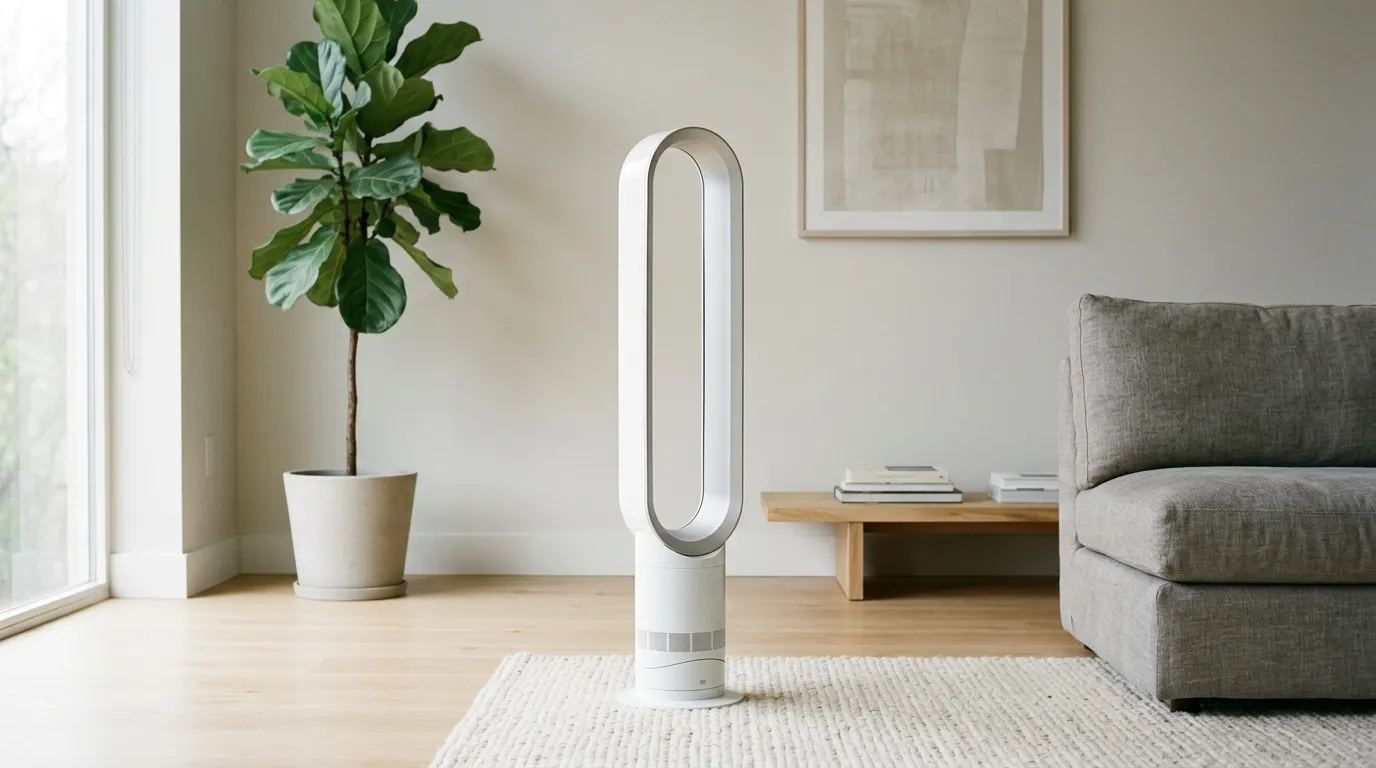
A tower bladeless fan stands tall and narrow, throwing a wide vertical curtain of air that reaches a standing adult. Dyson popularized the format, and DREO now competes directly on price with similar output.
Smart bladeless fans with app control
Smart bladeless fans add app control, voice-assistant support and scheduling on top of the usual remote. DREO's smart line leans hardest into this; Dyson's app also layers in air quality data on combo models.
Bladeless fan and air purifier combos
Some bladeless fans add a sealed HEPA stage, turning the loop into an air purifier as well as a fan. LEVOIT and Dyson both sell combo models. The compromise is less raw airflow than a dedicated fan of the same size.
Desk and personal bladeless fans
Smaller bladeless models sized for a desk or bedside table trade coverage for a compact footprint. Kohler has moved into this space with bathroom and countertop-oriented models, a less common maker in the category.
What specs actually matter for cooling and comfort?
Past format, a short list of specs decides how much genuine cooling you get and how easy the fan is to live with.
Airflow, CFM and air multiplier technology
Airflow is rated in CFM, the same measure used across the cooling category. Air multiplier technology — the entrainment effect that pulls extra room air along with the jet — is what lets a small impeller move a much larger volume than its size suggests.
Oscillation, speed settings and remote control
Oscillation spreads the airflow across a room instead of a single fixed column, and most models offer several speed settings from a whisper-low overnight setting to full cooling power. A remote control makes adjusting both from across the room easy.
Timer, easy clean design and safe for kids
A built-in timer switches the unit off automatically, useful overnight or before you leave the house. The loop's easy clean surface wipes down in seconds, and the enclosed impeller makes the whole category safe for kids and pets by design.
Energy efficient running cost and air circulation
An energy efficient bladeless fan typically draws well under 50 watts on a normal setting, keeping running cost low even used all summer. ENERGY STAR-rated models move the most air circulation through a room per watt used.
Every product recommendation below is ranked from aggregated real owner reviews and manufacturer specifications, never from us buying and running a unit ourselves — see How We Rank for the full methodology.


