

Affiliate Disclosure
Some links on this page are affiliate links. As an Amazon Associate, we earn from qualifying purchases — at no extra cost to you. We do not buy, test, or physically handle the products we cover; our rankings come from aggregated owner reviews, ratings and expert consensus. Commissions never change our verdicts. How we rank & full disclosure.
Some links below are affiliate links: if you buy through one we earn a small commission at no extra cost to you. We never buy or physically handle these fans, and a commission never changes where a product lands in this ranking.
A bladeless fan won't lower the temperature of a room — it moves air so your indoor climate feels cooler, calmer, and safe for kids and pets to be around. If you want a fan that's easy to clean, pleasant to sleep next to, and free of exposed blades, this category earns its keep. If you're chasing the absolute highest airflow-per-dollar, a plain box or tower fan still wins on raw output, and that's a fair reason to skip bladeless entirely.
Do bladeless fans actually cool a room?
No fan lowers air temperature, bladeless included. A bladeless fan moves air across your skin so sweat evaporates faster, which makes you feel cooler up into the mid-80s Fahrenheit. Above that, you need an air conditioner, not a fan.
This is the single biggest misunderstanding owners run into, and it's worth being clear about before you spend anything: a fan is a comfort tool for air circulation, not a cooling appliance. If your room genuinely gets hot, read how airflow, temperature and humidity work together in how cooling affects your home's indoor climate before deciding whether a fan is enough or whether you need a cooler.
How does "air multiplier" technology actually work?
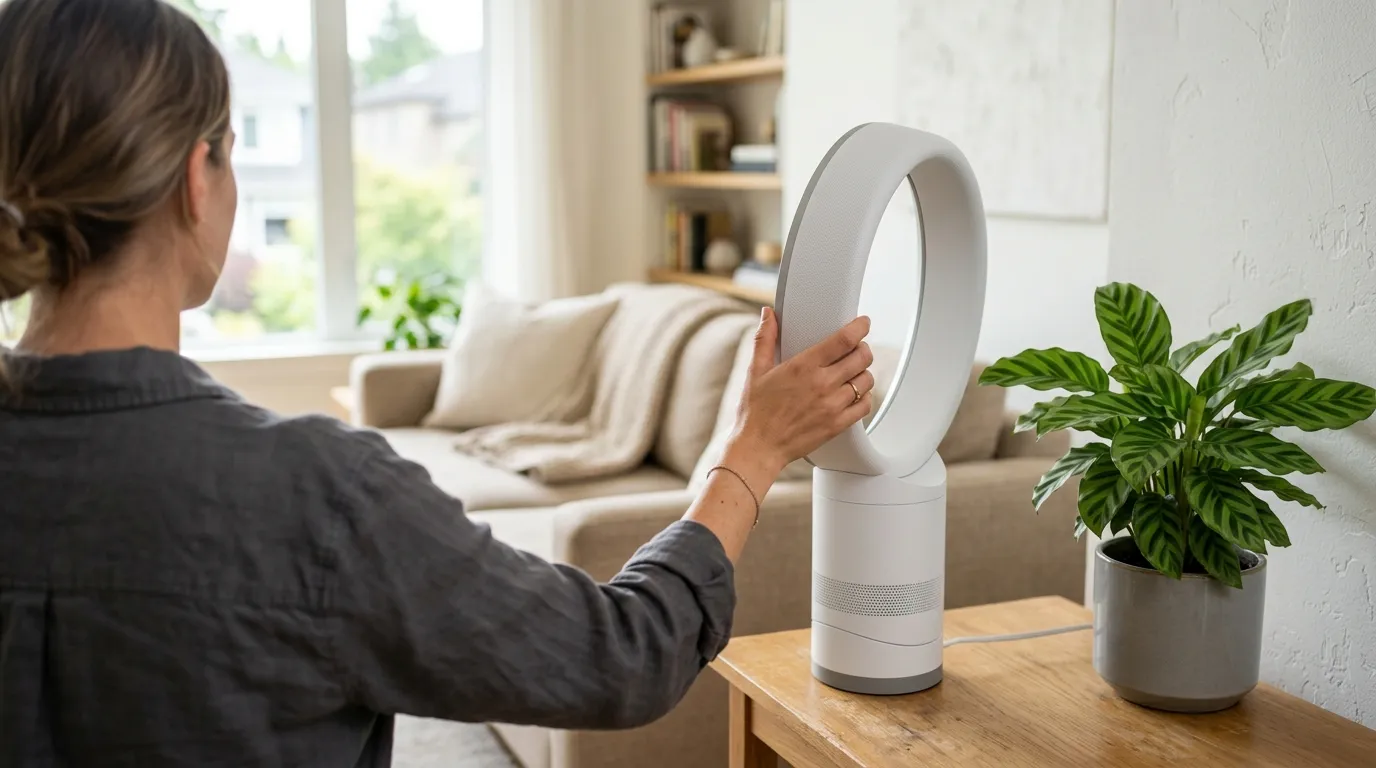
A bladeless fan pulls air in through a base using a small internal impeller, then accelerates and amplifies it through a narrow slot in the ring — an air multiplier effect that pushes out far more airflow than the motor alone draws in.
Dyson popularized this design and the "air multiplier" term, and most bladeless towers now use some version of the same principle: a hidden motor in the base instead of exposed blades in the loop you see. Manufacturers rarely publish a directly comparable CFM figure for bladeless models the way they do for box fans, since the smooth, amplified airflow is measured and marketed differently — which is exactly why owner-reported "how far does the air actually reach" feedback matters more than the spec sheet here.
Are bladeless fans worth the extra money over a normal fan?
For most buyers, yes — but for airflow reasons second, not first. Bladeless fans cost more per unit of airflow, so you're paying for safety, easy cleaning and a quieter, more diffuse breeze rather than raw output.
The strongest case for a bladeless fan is a home with young kids or pets, where being safe for kids by design removes an obvious hazard, and a nightstand or nursery where a smooth, wipe-clean housing beats reaching between guard bars with a cloth. The consensus favors bladeless designs on those counts. If none of that applies to you, an ordinary tower or box fan will push more air for less money.
What should you look for in a bladeless fan?
Prioritise a DC motor (quieter and more energy efficient), real oscillation for whole-room coverage, fine speed settings, a sleep mode or timer for overnight use, and a remote control. Match the fan's size to the room — a slim tower for a bedroom, a wider or pivoting model for open-plan spaces.
DC-motor models like the Pelonis and the 22 dB tower above are the ones owners consistently single out for near-silent low-speed running and lower running cost over a full summer of daily use. Bladeless fans aren't ENERGY STAR certified the way an air conditioner or dehumidifier is, but a DC motor uses the same lower-power-draw principle that earns bigger appliances that badge — a meaningful, if uncertified, energy efficient upgrade over an old-style AC motor. A common complaint across cheaper AC-motor units is a low hum you notice at night. Oscillation range matters too: 70 to 90 degrees covers a bedroom, but a large living room benefits from a pivoting-arm design that can also aim air up or down. Eight or nine distinct speed settings, rather than three, let you dial in exactly the right amount of airflow without jumping straight to "too loud."
Do any bladeless fans double as an air purifier or add smart features?
A handful of premium bladeless towers combine fan and air purifier functions in one housing, and some add smart, app-connected control alongside the standard remote — but treat both as bonuses, not the reason to buy.
A combined fan-and-air-purifier unit is convenient if you're short on space, but a dedicated air purifier with real HEPA filtration generally outperforms a hybrid model built primarily to move air. Smart, app-based scheduling is a genuine convenience — start the fan from bed or before you get home — but it's not something owners rank above quiet low-speed running or build quality when picking a favorite.
Are bladeless fans quieter than bladed fans?
On low and medium speeds, generally yes — the airflow is smoother and there's no blade chop. But on their highest speeds bladeless fans are not silent; pushing more air always makes more noise, whatever the design.
Treat any "whisper quiet" marketing as describing the lowest speed only. Owners consistently report the quiet claims hold up at settings 1 to 3 and break down at the top of the range. If overnight quiet is your priority, choose a DC-motor model and plan to run it low.
Are bladeless fans actually safer around kids and pets?
Yes, meaningfully — there's no exposed spinning blade or grille gap small fingers or a curious cat can reach through, which is the main reason parents and pet owners choose bladeless over a traditional box or pedestal fan.
That said, safe for kids doesn't mean maintenance-free: the base still houses a motor and a narrow intake that can pull in loose hair, strings, or small toys if a child pushes something into it. Keep the fan on a stable, non-tippable surface, and treat "bladeless" as removing one specific hazard — the blades — not as a reason to skip normal supervision around any electrical appliance. A wipe-clean housing also means less dust buildup for anyone with allergies or asthma in the household, which pairs well with a dedicated air purifier if allergens are a bigger concern than just moving air around.

Best for whole-room airflow you can aim exactly where you want it
- Bladeless design with no exposed spinning blades
- Pivoting arm aims airflow up, down or across a room
- Quiet variable-speed motor with multiple settings
- Remote control and timer for hands-off running
Why buy it: The consensus favors the TurboBlade as the most versatile bladeless fan you can buy: the adjustable arm lets you push air across a whole room or straight down a hallway, and owners consistently report it moves noticeably more air than the slim single-tower bladeless models.

Best for a quiet bedroom fan without paying a premium price
- 40-inch bladeless tower fits into narrow spaces
- Wide-area oscillation for whole-room coverage
- 9-hour timer and a full-function remote
- Turbo speed for the hottest afternoons
Why buy it: Owners consistently report this delivers the most airflow-per-dollar in the bladeless category. A common complaint is that the turbo setting is clearly audible, so most people run it a notch or two lower overnight.

Best for large rooms that need steady, low-noise airflow
- Ultra-quiet DC motor rated around 22 dB on low
- Six speeds and four modes, including a sleep mode
- 90-degree oscillation with a 7-hour timer
- Slim 40-inch profile with remote control
Why buy it: The DC motor is the real draw: owners consistently report it is quiet enough to sleep beside on the lower speeds, and the sleep mode steps the fan down gradually through the night so it does not wake you.

Best for light sleepers who want near-silent airflow
- DC motor rated near 22 dB on the lowest speed
- Eight speed levels and four running modes
- 90-degree oscillation and a 12-hour timer
- Remote control for adjustments from bed
Why buy it: A strong pick for anyone sensitive to fan noise. The consensus favors it for near-silent low-speed running, though owners note the top speeds are much louder — true of any fan actually moving a lot of air.

Best for tight corners, small bedrooms and home offices
- Compact 34-inch bladeless tower
- 70-degree oscillation for focused coverage
- Quiet DC motor
- Lightweight and easy to carry room to room
Why buy it: A sensible choice when floor space is tight. Owners consistently report it is easy to move and simple to wipe clean, though its smaller size suits bedrooms and offices better than large open-plan spaces.

Best for a desk, nightstand or office shelf
- 11.8-inch bladeless desk fan
- Three speeds with simple touch controls
- Quiet enough to run beside a keyboard
- Smooth housing that wipes clean in seconds
Why buy it: For a desk or nightstand this is the easy pick. A common complaint is that it is a personal-sized fan, not a room cooler, so treat it as close-range airflow rather than whole-room cooling.
How we picked
We do not buy, test or physically handle the fans on this page. These picks come from reading aggregated owner reviews, manufacturer specifications and the recurring praise-and-complaint patterns that show up once a product has been in enough homes — the same honest-research method we apply across the site. When owners repeatedly report the same strength or the same flaw, that consensus drives the ranking, not marketing copy.
Names like Dyson, DREO, and LEVOIT dominate the bladeless-fan conversation, and adjacent brands like Kohler show up in the bladeless bathroom-ventilation corner of the category — none of them get an automatic ranking boost here. See how we rank for the full methodology, browse the rest of the bladeless fans hub, or step up to the wider cooling guides to compare bladeless against tower, box and pedestal fans.