

Affiliate Disclosure
Some links on this page are affiliate links. As an Amazon Associate, we earn from qualifying purchases — at no extra cost to you. We do not buy, test, or physically handle the products we cover; our rankings come from aggregated owner reviews, ratings and expert consensus. Commissions never change our verdicts. How we rank & full disclosure.
Affiliate disclosure: Some links below are affiliate links. As an Amazon Associate we earn from qualifying purchases at no extra cost to you. We do not physically handle the products we cover, and commissions never change our verdicts.
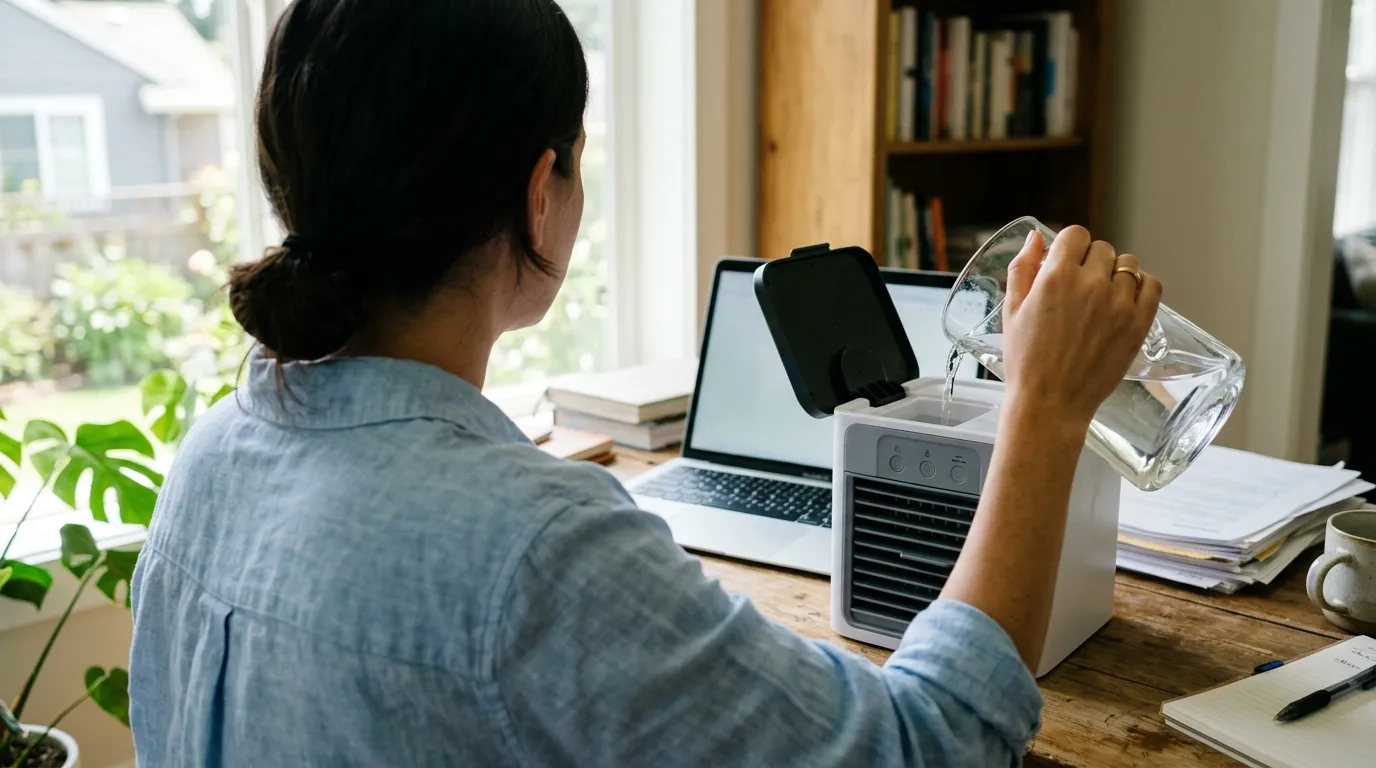
A desk is the one place a personal air cooler genuinely makes sense, because it is built to cool exactly the small zone you sit in — not the room. These are evaporative units: they pull air through a wet pad, cool it a little, add some humidity, and blow it at you from a foot or two away. For a hot home office or a stuffy corner desk with no AC, that improves your own comfort without changing the room's indoor climate at all. If you were hoping to cool the whole office, this is the wrong tool — but if you just want the air at your seat to feel cooler, the picks below are chosen for a small footprint, low noise, and enough runtime to get through a work block.
What makes a good desk air cooler?
A small footprint, quiet operation, and airflow you can aim straight at yourself. On a desk you sit close, so raw power matters less than fitting beside a monitor, staying quiet enough for calls, and pointing the air where you actually are.
Desk duty rewards different traits than a floor cooler. You don't need long reach because you're right in front of it; you do need it to be compact, quiet and easy to aim. Many of these run off USB or a small rechargeable battery, which keeps a tidy desk free of another bulky power brick. Some models add basic oscillation to sweep air gently side to side instead of blasting one fixed spot — useful if two people share a desk. A common owner tip is to place the unit slightly to the side and angled at you, rather than dead ahead where it dries your eyes.
Will a desk cooler cool the whole room?
No — and it's not meant to. A desk personal cooler conditions the small pocket of air around you, not the room. That's a feature, not a flaw: it puts the cooling where you are instead of wasting energy trying to chill an entire small room it never could.
This is the expectation to get right before buying. As an evaporative device, it can only cool the air passing over its wet pad, and that cooled air disperses within a few feet. Owners who treat it as a personal comfort device at their seat are consistently satisfied; those who expected it to cool the office are not. If room cooling is the goal, a portable air conditioner is the honest answer.
How long do they run before a refill, and what does misting add?
It depends on water tank size. Mini coolers with 300–450 ml tanks run for a short stint, while 1200 ml water tanks last through most of a work block. For a desk you occupy all day, the larger tank saves you from constant trips to the sink.
Evaporative coolers drain their water tank steadily because they're continuously turning water into vapor. On a desk you use all day, that makes tank size the practical spec: a tiny cooler becomes a refill chore, while a 1200 ml model runs long enough to forget about for a while. Some models add a misting mode on top of plain evaporative airflow, spraying a finer, more visible fog for a stronger cooling sensation — it drains the tank faster, so treat misting as an occasional boost rather than the setting you run all day. Whatever size you choose, empty and dry it at the end of the day — leaving water standing in a warm unit is what causes a musty smell.
How much does it cost to run a personal air cooler?
Running cost is close to nothing. Most personal air coolers draw well under 10 watts on USB power, so even running one for a full eight-hour workday uses a fraction of a kWh — pennies compared with a space heater or a window AC.
That low running cost is part of the appeal: because these units plug into a laptop's USB port or a phone charger, there's no meaningful energy efficient calculation to make the way there is with a full-size appliance. The real ongoing cost is water for the tank, not electricity. If you're weighing a desk cooler against running a whole-room air conditioner just to cool one seat, the desk cooler wins on running cost every time — it just can't do the same job.
Do they help in a humid office?
Much less. Evaporative cooling needs dry air to work, so in a humid office the cooling effect shrinks and you mostly get moving, slightly damper air. In a dry office or a dry climate, the same unit feels noticeably more refreshing.
Because the whole mechanism relies on water evaporating into the air, the drier the office, the better it works — and the more humid it is, the less you feel. A common complaint from owners in muggy climates is that the cooler just adds to the stuffiness. If your workspace is already humid, a small desk fan or a portable AC will serve you better than an evaporative cooler.
Does adding ice actually make it colder?
Briefly, yes — dropping ice cubes or a frozen pack into the water tank drops the output temperature noticeably for the first 20 to 30 minutes, then it fades back to standard evaporative cooling once the ice melts.
Owners who add ice regularly describe it as a short, strong boost rather than an all-day upgrade — worth doing right before an important call or a particularly hot afternoon, not something to rely on for sustained performance. It also means refilling more often, since melted ice adds to the water the unit works through. If consistent, all-day cooling matters more to you than an occasional cold blast, prioritize water tank size over ice compatibility when comparing models.
How do you keep a desk air cooler clean?
Empty and air-dry the water tank daily, and rinse the wet pad or filter every one to two weeks, since standing water in a warm, humid housing is exactly the environment mold and bacteria need to grow.
This matters more on a personal cooler than a room unit because it runs a foot or two from your face — anything growing in the tank ends up in the air you're breathing directly. Use distilled or filtered water where possible; hard tap water leaves mineral buildup on the pad faster and shortens how long a wick or filter stays effective. A quick weekly wipe of the housing and vents keeps dust from building up in the airflow path, which is the same maintenance habit that keeps any small fan or cooler running quietly.

Best for a small desk where footprint matters most
- Compact 450 ml design
- 3 speeds
- 7-color ambient light
- Cooler, fan and humidifier in one
Why buy it: Owners consistently report this is the right shape for a desk — small enough to sit beside a monitor, quiet enough for calls, and aimed directly at you, which is where a personal cooler actually helps.

Best for longer desk sessions without refilling
- 1200 ml tank for longer runtime
- 3 speeds and 3 mist modes
- Remote control
- Night light
Why buy it: A common value pick for a desk, owners like that the larger tank runs through a work block, and the remote saves reaching around a cluttered desk to change speed.

Best for a quieter, better-built desk cooler in dry heat
- Hydro-Chill evaporative cooling
- Quiet operation
- Compact, tidy design
- Adds moisture to dry office air
Why buy it: The consensus favors the Arctic Air for build quality and low noise. Owners note it is a personal cooler, so it earns its place on a desk you sit at rather than as a room cooler.

Best for the lowest-cost desk cooler
- 3 wind speeds
- Compact personal size
- Evaporative cooling
- Simple controls
Why buy it: Owners on a tight budget pick this for a desk and accept the basics — short runtime and modest airflow — in exchange for the low price.

Best for moving between desk, commute and outdoors
- Handheld, rechargeable
- Personal airflow
- Travel-friendly weight
- Simple speed control
Why buy it: A common second pick, owners like carrying it from the desk to a commute. It is a personal fan first, so treat any cooling as a bonus.

Best for adding ice for a stronger desk-side chill
- 1200 ml tank
- Ice-compatible cooling mist
- Personal airflow
- Multiple speeds
Why buy it: Owners who add ice packs report a stronger cool blast for a while. Once the ice melts it behaves like any evaporative cooler, so it suits a desk in dry heat.
How we picked
We do not buy or physically handle these units; the rankings above come from aggregated owner reviews, recurring complaint patterns and manufacturer specifications, weighted toward what a desk specifically needs — a small footprint, quiet running and usable runtime, rather than room-cooling power these units cannot deliver.
Names like Evapolar, DREO, Ontel, and Comfort Zone all show up repeatedly in this category, and we weigh their owner feedback the same way we weigh a lesser-known brand — CFM output and tank-size claims get checked against real reviews rather than taken at face value. See our full How We Rank methodology for the sources behind every pick.
For the wider view of the category and how it compares, browse the Personal Air Coolers hub, or step up to the full Cooling section to weigh a desk cooler against a real air conditioner.