



Affiliate Disclosure
Some links on this page are affiliate links. As an Amazon Associate, we earn from qualifying purchases — at no extra cost to you. We do not buy, test, or physically handle the products we cover; our rankings come from aggregated owner reviews, ratings and expert consensus. Commissions never change our verdicts. How we rank & full disclosure.
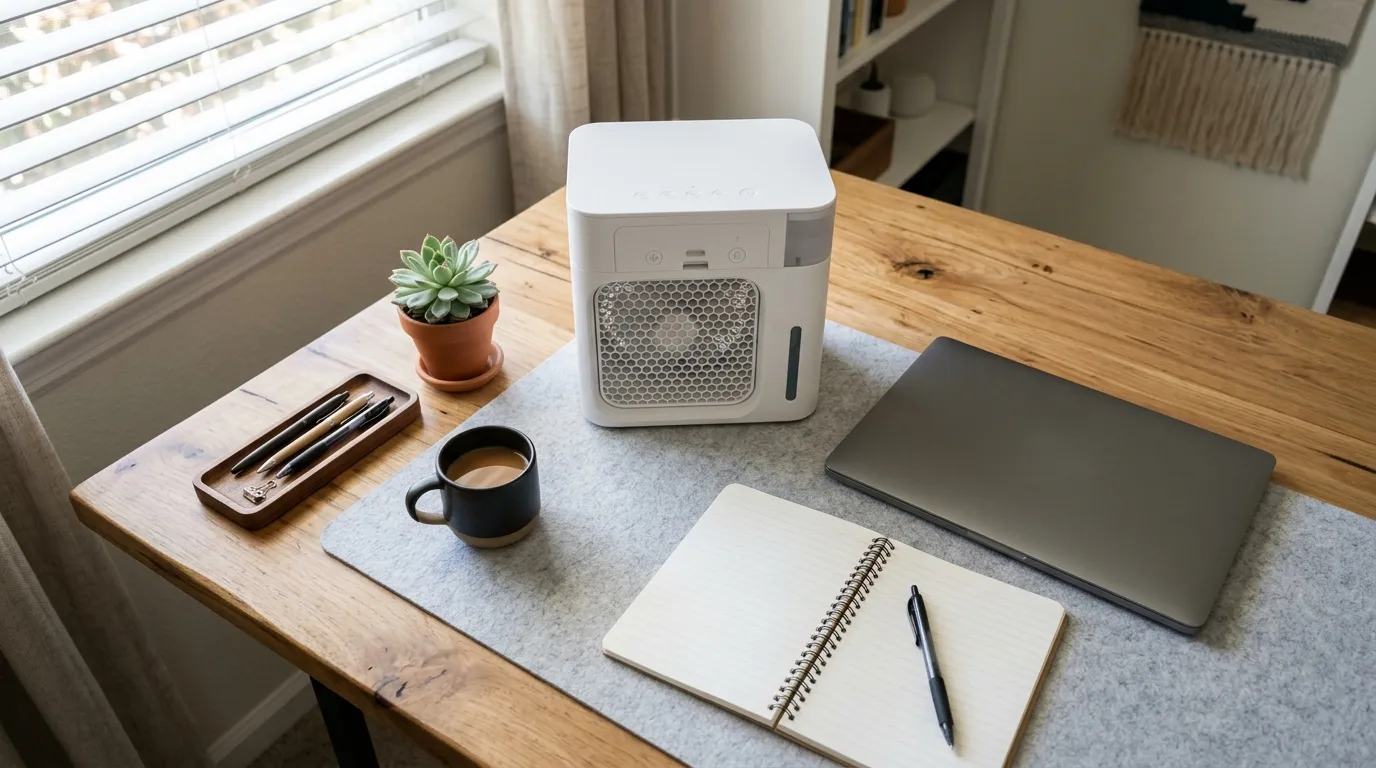
Personal air coolers are the most oversold category in this pillar, and also the most misunderstood. A small fan draws air through a water-soaked wick, evaporation pulls heat out of that air, and the result is a stream of cooler, more humid air aimed at whoever sits directly in front of it. Evapolar, DREO, Ontel and Comfort Zone all sell desk-scale evaporative coolers built around this same basic mechanism, usually at very different price points for broadly similar hardware. Used with realistic expectations at a desk in dry air, that is a genuinely pleasant and very cheap thing to have. Bought as a substitute for a real air conditioner, it causes more disappointment than any other appliance here. Knowing which job you are actually buying it for is most of what separates a happy owner from a disappointed one.
Can a personal air cooler actually cool a small room?
No. These units move a small volume of air and hold a small amount of water, so their effect is limited to the airstream right in front of them, usually a couple of feet. They cannot lower the temperature of a small room, and marketing that implies otherwise is describing a different class of appliance.
The scale gap is easy to see in principle. A room air conditioner is rated in thousands of BTU and draws hundreds of watts. A desktop cooler runs on a USB port or a small adapter and moves a fraction of the airflow a box fan moves. There is no way to configure that hardware to change a room's temperature — the energy simply is not there.
What it does do is real, though. Air a few degrees cooler than ambient, arriving right at your face and forearms while you work, changes how comfortable you feel in a warm room more than the temperature drop alone suggests, because the airflow also speeds up evaporation from your skin. That is a legitimate personal-comfort benefit, not a room-cooling one.
Does evaporative cooling work in humid weather or a dry climate?
Barely, in humid weather. Like every evaporative device, a personal cooler depends on the air's capacity to absorb more water. In a dry climate it produces a noticeably cool stream. Above roughly 60 percent relative humidity there is very little evaporation left to use, and what you get is a small fan blowing damp air.
Humidity limits and misting output
The same physics governs full-size units, and our evaporative coolers hub covers it in more depth. At desktop scale the disappointment lands faster, because the misting and cooling claims on the packaging usually set a higher bar than the unit can clear once local humidity climbs. A unit that performs well in an arid climate can feel underwhelming in a humid one, and neither result says anything about build quality.
How big is the water tank, and how often do you refill it?
Frequently. Desktop units commonly hold somewhere between a few hundred millilitres and about a litre, and on a high setting in dry air that is a matter of hours, not a full day. A larger water tank is the single most useful spec to compare in this category.
Refill frequency is the practical difference between a unit that stays on a desk and one that ends up in a drawer. It's also why many owners run these on a low setting most of the time — lower airflow means slower evaporation, less cooling, and a tank that lasts a full working day instead of a morning.
Check how the tank is filled as well as how big it is. Units that need lifting the whole appliance to a sink, or that fill through a small, awkward port, get refilled less often than ones with a removable tank or a wide top opening. It's a small detail that shows up repeatedly in the gap between well-reviewed and poorly reviewed models.
Ice, USB power and rechargeable batteries
Adding ice to the tank is the standard owner workaround, and it does help, briefly. Chilled water lowers the temperature of the wick and the air passing through it, but a small amount of ice in a warm room melts fast, so the effect lasts tens of minutes rather than hours. Owners who rely on it usually keep a second frozen ice pack in the freezer. Power source shapes the experience just as much as tank size. USB-powered units are limited by how much current a port can supply, which caps both fan speed and pump strength — they're quiet and portable, and they're the weakest performers. Units built around a rechargeable battery pack or a mains adapter can drive a larger fan and a proper pump, and they produce airflow you can actually feel from more than arm's length.
CFM, airflow and running cost
Few personal air coolers publish a CFM rating, but where one is listed it is a fair way to compare two units' raw airflow before comparing price. Running cost is trivial either way — a desktop unit draws a small fraction of a kWh over a full day, nothing like a room air conditioner — so the real comparison is airflow and refill frequency, not electricity. A pump that strains to draw water up through a clogged wick also draws more current than a clean one, which is one more reason regular cleaning matters more than the spec sheet suggests.
How do you keep a desk cooler quiet and mould-free?
Empty the tank at the end of the day and run the fan alone for a while so the wick dries out. A permanently damp filter in a warm room is an ideal growth environment, and the musty smell owners report is almost always the result of leaving water sitting in the unit.
Because these units are cheap, owners tend to treat them as disposable and skip maintenance — which is exactly why hygiene complaints are common. The routine that prevents it is short: empty, dry, and replace the wick or filter on the schedule the manufacturer lists. Hard water speeds up the problem by leaving mineral deposits that hold moisture and trap dust. Filtered or distilled water slows scale build-up and keeps a wick effective longer, worth doing if the unit runs daily.
Oscillation and portable desk placement
Most personal air coolers skip oscillation entirely and just aim a fixed stream at wherever you point them, which keeps the unit small and portable enough to move between a desk and a nightstand. A few higher-end models add a slow oscillation sweep to spread the airstream across a wider desk, at some cost to the direct cooling effect right in front of you.
There is also a humidity consideration worth noting even at this scale. In a small, closed room, running an evaporative device all day does raise the room's moisture level, and in an already damp room that is not a neutral side effect — our page on the ideal indoor humidity level covers the range worth staying inside and why the upper end matters.
Would a small, energy efficient fan be the better buy?
In humid climates, almost certainly. A plain desk or tower fan at the same price moves more air, needs no water, has nothing to grow mould in, and delivers most of the comfort benefit — because the cooling sensation you feel is mainly evaporation from your own skin, not the air's temperature.
This is the honest comparison the category deserves. The evaporative element earns its keep in dry air, where it adds a measurable temperature drop on top of the airflow effect, and where the extra humidity it introduces is welcome rather than a problem. Everywhere else, the water tank is added maintenance for a marginal gain, and a straightforward, energy efficient tower fan is the better appliance.
The case where a personal cooler clearly wins is a hot, dry workspace with no cooling at all — a garage bench, a warehouse desk, a sunroom in an arid climate — where a few degrees at close range is a genuine improvement and running an air conditioner isn't an option. Bought for that job, with the tank routine understood in advance, owners are consistently satisfied. Bought as a cheap air conditioner, they aren't.
Every product recommendation below is ranked from aggregated real owner reviews and manufacturer specifications, never from us buying and running a unit ourselves — see How We Rank for the full methodology.


