


Affiliate Disclosure
Some links on this page are affiliate links. As an Amazon Associate, we earn from qualifying purchases — at no extra cost to you. We do not buy, test, or physically handle the products we cover; our rankings come from aggregated owner reviews, ratings and expert consensus. Commissions never change our verdicts. How we rank & full disclosure.
Some links below are affiliate links. As an Amazon Associate we earn a commission from qualifying purchases at no extra cost to you — and it never changes which products we recommend or where they rank.
Infrared heaters warm people and objects directly through line of sight, so they feel warm faster than a space heater that first has to heat the room's air — which makes them the right lever when your indoor climate problem is one cold spot rather than a whole cold house. Buy an infrared heater if you want quick, felt warmth at a desk, a reading chair, a workshop bench, or a garage. Skip it if you need even, whole-room air temperature (a ceramic heater does that better) or silent overnight heat from an oil-filled radiator. Electric infrared heaters from brands like Dr Infrared, Duraflame, Heat Storm and LifeSmart dominate the category, and for most people the Dr Infrared DR-968 below is the pick that satisfies the widest range of rooms.
What types of infrared heaters are there — quartz vs carbon element vs far infrared?
Infrared heaters split into three common designs: quartz tube heaters, carbon element panels, and far infrared panels. Quartz is the most common and cheapest; carbon element runs cooler to the touch; far infrared is usually the quietest, fan-free option.
A quartz infrared heater glows visibly and delivers instant heat the moment you switch it on — the tube itself gets hot and radiates immediately, which is why quartz cabinets like the Dr Infrared and EdenPURE models above respond so fast. Carbon element heaters use a carbon-fiber panel instead of a glass tube; owners report the surface runs cooler and the light is dimmer, which suits a bedroom where a bright orange glow is unwelcome. Far infrared panels — often wall-mounted — skip the fan entirely and radiate silent, gentle heat with no moving parts, trading some raw BTU output for near-silent operation. None of the three heat the room's air the way a fan-forced space heater does; all three warm what is directly in front of them.
Cabinet shape matters too, separate from the element inside. A tower-style infrared heater like the BLACK+DECKER radiant quartz tower fits a narrow bedroom corner but throws heat in one direction; a boxier console like the Dr Infrared or EdenPURE units spreads slightly wider and usually adds caster wheels so you can roll it between rooms. If you already own a ceramic space heater and are wondering whether to add an infrared one, the honest answer is that they solve different problems — a ceramic unit is still the better electric heater for warming an entire small room evenly, while infrared is the better choice for a single fixed spot.
Do infrared heaters actually save money on running cost?
They can, but only because of how you use them, not because infrared is inherently more energy efficient per watt. Warming the person directly means you feel comfortable sooner and can lower the thermostat elsewhere — the saving comes from zone heating one occupied spot instead of the whole house.
Every 1,500 watts heater draws the same power from the wall regardless of type, and the EPA does not rate infrared heaters as more efficient than any other resistive electric heater — a watt is a watt. Infrared feels faster because it skips the step of heating air, so people often run it for shorter bursts. Run one on top of an unchanged central setting and it adds to your kWh bill; use it for zone heating — warming only where you are while the rest of the house runs cooler — and it pays off. A typical 1,500-watt unit run for eight hours draws roughly 12 kWh; check your utility's rate per kWh to work out the real running cost in your home.
Is infrared heat safe, with tip-over and overheat protection?
Yes — quality infrared cabinet heaters run with a cool-touch housing plus tip-over and overheat auto shut-off, and many owners prefer the warmth because it does not dry out a room the way a bare-coil electric heater can. Keep three feet of clearance from anything flammable as with any heater.
The directness is the appeal and the catch: infrared warms what it can see, so anyone sitting outside the beam feels less of it. A recurring complaint is that people expect whole-room comfort and instead get a warm zone — which is precisely what infrared is designed to deliver. Point it at the seating, confirm the model has both tip-over and overheat cutoffs (every heater in this roundup does), and never run one on an extension cord rated below its draw.
Infrared vs ceramic: which makes the better garage heater?
Choose infrared for fast, felt warmth on a person at a fixed spot — a workbench or a single garage stall; choose ceramic for more even warmth across a room where people move around. Infrared wins as a garage heater or at a desk; ceramic wins for a general bedroom or living room.
They are complementary, not competing. If your need is truly whole-room and even, our ceramic heaters hub is the better starting point. If it is a cold garage or a single occupied seat, infrared is the answer — and our best infrared heaters for garages covers the higher-output end built specifically as a garage heater. Shoppers comparing brand names run into the same question a different way: Dr Infrared and Heat Storm both sell true infrared cabinets, while some Duraflame and LifeSmart models blend an infrared element with a ceramic or fan-forced stage for a middle-ground result. Read the spec sheet rather than the marketing copy to know which you are actually buying.
How many watts do infrared heaters use, and what's the real running cost?
Nearly every plug-in infrared heater sold in the US is capped at 1500 watts on a standard 120V outlet — that ceiling is set by the circuit, not the heater. Manufacturers describe output in BTU as well as watts; 1,500 watts converts to roughly 5,100 BTU.
Because wattage is fixed, the differences between models are about how efficiently that wattage becomes felt warmth, not raw output. A silent far infrared panel with no fan uses the same 1,500 watts as a loud fan-forced cabinet, so if silent operation matters more than fast heat, that is the trade to make. To estimate cost, multiply the wattage by the hours run to get watt-hours, divide by 1,000 for kWh, then multiply by your utility's per-kWh rate — a 1,500-watt heater run four hours a night is about 6 kWh a day. None of the heaters here carry a formal EPA efficiency rating, because that program does not currently cover portable space heaters — staying energy efficient is about how you run them, not a label on the box.
Placement affects both cost and safety. Put the heater on a hard, level floor at least three feet from curtains, bedding or furniture, and plug it directly into a wall outlet rather than a power strip — a 1,500-watt draw is close to the limit of what many extension cords and multi-outlet strips are rated for, and a warm cord is a warning sign to unplug and stop using it. Running an infrared heater in a garage adds a wrinkle: a garage heater sees dust and cold-start humidity a bedroom unit never does, so wipe the reflector and grille periodically and confirm the model is rated for that kind of duty before you leave it unattended overnight.
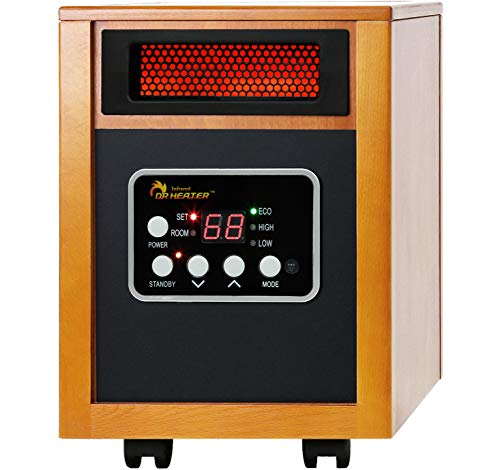
Best for a main room where you want fast, felt warmth all season
- Infrared quartz + PTC heating, up to 1,500W
- Auto energy-saving mode with thermostat
- Tip-over and overheat auto shut-off
- Caster wheels and remote-friendly cabinet design
Why buy it: The DR-968 is the model that comes up most often as the reference infrared heater — owners consistently report even, comfortable warmth without the dry, roasted feeling of a bare coil. It is the safe default if you are not sure which infrared unit to buy.

Best for a larger room that needs both quick and sustained heat
- Dual infrared + convection hybrid heating
- Up to 1,500W with remote control
- Thermostat with energy-saving operation
- Overheat and tip-over protection
Why buy it: Owners consistently report the hybrid design warms a room faster and holds it more evenly than infrared alone, which is why it earns the premium slot. A common note is that it costs more than a basic quartz tower — you are paying for the second heating mode.

Best for a bedroom or narrow corner where floor space is tight
- Slim radiant quartz tower footprint
- Line-of-sight infrared warmth
- Adjustable heat settings
- Tip-over safety cut-off
Why buy it: The tower shape is why owners pick this for a bedroom — it slots against a wall and warms whoever is in front of it. A recurring complaint about any radiant tower is that heat is directional, so aim it at the seating rather than expecting whole-room coverage.

Best for an open-plan living area on the larger side
- Rated for spaces up to about 1,000 sq ft
- Copper infrared heating elements
- Portable cabinet with safety cut-offs
- Gentle, even radiant warmth
Why buy it: The consensus favors EdenPURE when the room is bigger than a typical infrared unit is built for. Owners report steady, comfortable heat over a large area, though a common note is that no plug-in heater truly heats 1,000 square feet in a poorly insulated or drafty room.

Best for a first infrared heater without overspending
- Infrared cabinet heater with remote control
- Adjustable thermostat and energy-saving mode
- LED display for temperature
- Overheat and tip-over protection
Why buy it: Owners consistently report this delivers the core infrared experience — even, non-drying warmth with a remote and thermostat — for noticeably less than the name-brand cabinets. A common complaint is that the wood-look finish is plainer in person, which does not affect how it heats.

Best for a household that shifts one heater between rooms
- Dual heating, up to 1,500W
- Four caster wheels for easy rolling
- Programmable timer and remote
- Tip-over and overheat protection
Why buy it: The four wheels and timer are why owners choose this as the one heater that follows them around the house. It is heavier than a personal unit, but that weight buys the dual-heating output the lighter models lack.
How we picked
We do not buy, test, or physically handle the heaters we cover. These rankings come from aggregated owner reviews, manufacturer specifications, and the recurring complaint patterns across hundreds of infrared listings — spanning familiar names like Dr Infrared, Duraflame, Heat Storm and LifeSmart — the consensus view, not one reviewer's opinion. Each model links to its live Amazon listing so you can check the current price and read the reviews yourself. See How We Rank for the full methodology, the infrared heaters hub for buying context, and the heating pillar for how infrared fits your wider indoor climate.