

Affiliate Disclosure
Some links on this page are affiliate links. As an Amazon Associate, we earn from qualifying purchases — at no extra cost to you. We do not buy, test, or physically handle the products we cover; our rankings come from aggregated owner reviews, ratings and expert consensus. Commissions never change our verdicts. How we rank & full disclosure.
Some links below are affiliate links: if you buy through one we may earn a commission at no extra cost to you. That never changes our verdict — this comparison is drawn from aggregated owner reviews and manufacturer specifications, not from who pays the most.
Short version: Lasko wins on value and coverage — its slim, portable 5586 ceramic tower heater spreads heat across a wide room for the lowest price, so it's the default budget pick. DREO wins on quiet, even warmth — its taller, thermostat-controlled tower is the one owners reach for in a bedroom or office where low noise and a steady temperature matter more than saving a few dollars. Both are electric ceramic units capped at the same 1500 watts, so this isn't a power contest. It's a choice between lowest-price oscillation coverage and quieter, more precise comfort.
| Product | Best for | Buy |
|---|---|---|
| Lasko 5586 Oscillating Ceramic Tower Heater | Best for value and wide coverage | Check Price (paid link) |
| DREO 30-Inch Oscillating Tower Heater with Remote | Best for quiet, even room heat | Check Price (paid link) |
Lasko vs Dreo tower heaters: which oscillation covers a wider room?
It's close. Both are tall, tower-profile ceramic heaters built to sweep warmth side to side with oscillation, so both handle an open room far better than a compact heater. DREO's 120-degree oscillation covers a slightly wider arc. Lasko's steady fan-forced output does the job dependably across most living-room-sized spaces.
Because both units run at 1500 watts, neither can out-muscle the other on raw heat output, measured loosely in BTU. What owners report is that the tower format itself — not the brand — makes the difference here. The tall profile and the oscillation are what carry heat across a room, rather than dumping it all in one spot. For a big open space, either tower heater reaches further than a compact space heater would, so coverage rarely decides this matchup alone. The tie-breakers tend to be noise, price and the small controls each one offers.
Lasko vs Dreo: which ceramic tower heater is quieter?
DREO is the quieter choice, and that's the main reason people pay more for it. Lasko towers aren't loud, but a faint fan-forced hum is a common note. DREO tunes its models specifically to stay quiet for sleeping and working spaces.
Noise is often the deciding factor once coverage is a wash between the two. If the tower heater lives beside a bed or a desk where a hum is distracting, the consensus favors DREO. If it lives in a living room where a faint hum disappears into background sound — a TV on, people talking — the difference stops mattering, and Lasko's lower price becomes the stronger argument. Run either unit on low before judging noise, since most of what you hear from a ceramic tower comes from the fan at full output.
Thermostat, remote control and timer — which controls do you get?
Both give you a digital thermostat, the control that matters most for holding a set temperature. Lasko adds a timer. DREO ships with a remote control so you can adjust settings from across the room. Choose by which convenience you'll actually use.
A thermostat separates a tower heater you keep from one you return, because it holds a set temperature instead of overshooting and cycling on and off all evening — and both of these units have one. Beyond that, the extras are small quality-of-life differences: a timer to shut off after you fall asleep, or a remote control to change the setting without leaving a warm seat on a cold night. Neither is a deal-breaker. But the remote is the convenience owners mention most when explaining why they paid more for the DREO.
1500 watts, BTU output and running cost — which costs less to run?
Both heaters draw the same 1500 watts, so the running cost per hour is essentially identical between them. Neither is more energy efficient than the other on paper — a 1500W electric heater converts virtually all its power into heat output, regardless of brand.
What changes the real-world running cost is how much you actually run the unit. DREO's quieter operation means owners tend to leave it on longer in a bedroom overnight, while Lasko's lower purchase price offsets a similar kWh draw over its lifespan. Neither the EPA nor ENERGY STAR rates electric resistance space heaters, since the technology has a fixed efficiency ceiling near 100 percent. The only lever left is how many hours the thermostat lets the element sit idle.
Tip-over and overheat safety: are both tower heaters protected?
Yes. Both the Lasko 5586 and the DREO 30-inch tower ship with tip-over and overheat safety switches as standard. A tip-over switch cuts power instantly if the unit is knocked over, and an overheat sensor shuts the element down if internal temperatures climb too high.
This matters more with a tall, top-heavy tower heater than with a squat ceramic cube, since a tall profile is easier to knock over near a pet or a child. Neither brand cuts corners here, and both switches are standard across the Honeywell and Dyson tower lines too, so safety isn't a real differentiator in this matchup.
Tall profile vs portable footprint — which fits a tighter space?
Both are slim and portable by design, since the tall-profile tower format exists precisely to fit beside furniture without taking up floor space. Lasko's 29-inch profile is marginally more compact. DREO's 30-inch body is close enough that the difference won't decide the purchase for most rooms.
Where the footprint question actually matters is height versus a room's furniture layout. A tall tower next to a low couch throws heat over the top of the seating rather than into it, while one placed beside a chair or standing desk works with the room instead of against it. Either brand's portable tower slots into a corner or against a wall without the bulk of a cabinet-style heater, so this is rarely the deciding factor between the two. It comes back to noise and price.
Which electric tower heater is easier to live with day to day?
Day-to-day, the DREO edges ahead on convenience: the remote control means you can lower the thermostat setting from bed without getting up, and the quiet fan-forced airflow doesn't compete with a TV or a phone call. The Lasko is simpler to operate but no less reliable, and its lower price makes it an easy second unit for a spare room.
Both are portable enough to move room to room in a few seconds — unplug, carry by the built-in handle, plug back in. Neither needs a dedicated 240-volt circuit like a garage heater or a mini-split; both run happily on a standard household outlet at 1500 watts. Cord length is similar on both models, long enough to reach an outlet across a small room without an extension cord, which safety guides generally discourage for any space heater.
If you're replacing an aging tower heater from Honeywell or Dyson, both the Lasko and the DREO are drop-in upgrades: same tall profile, same oscillation sweep, same 1500W ceiling, just newer thermostats and quieter fans than tower heaters built a decade ago.
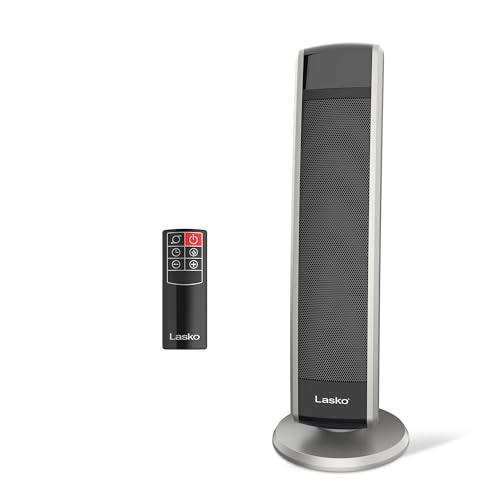
Best for dependable oscillating warmth for the lowest price
- 29-inch slim ceramic tower
- Oscillation spreads heat side to side
- Digital thermostat and timer
- Slim footprint for tight spaces
Why buy it: Lasko is the long-running budget-workhorse name in tower heaters, and the 5586 is the model owners cite most. The tall oscillating body covers a wide arc and the price sits well below the premium brands, which is why the consensus favors it when value is the priority.

Best for quiet, even warmth in a bedroom or office
- 30-inch tower profile for a wide throw
- 120-degree oscillation for broad coverage
- 1500W ceramic heating with thermostat
- Remote control included
Why buy it: DREO built its reputation on quiet, thermostat-controlled warmth, and owners consistently reach for it where noise matters — a bedroom or home office. It settles a room to a set temperature rather than blasting and cycling, which is the difference people notice first coming from a basic tower.
The verdict: energy efficient, electric comfort — Lasko or Dreo?
Buy the Lasko 5586 if you want the widest oscillation coverage for the least money and a faint hum is a non-issue in the room. Buy the DREO if the tower heater will live in a bedroom or office where quiet, steady, thermostat-held warmth is worth paying for. Both are established, widely owned electric ceramic tower heaters, so there's no wrong answer here — only a trade-off between saving money and buying quiet. For sizing and safety, see our tower heaters hub and the best tower heaters roundup. Our method is on the How We Rank page.