
Affiliate Disclosure
Some links on this page are affiliate links. As an Amazon Associate, we earn from qualifying purchases — at no extra cost to you. We do not buy, test, or physically handle the products we cover; our rankings come from aggregated owner reviews, ratings and expert consensus. Commissions never change our verdicts. How we rank & full disclosure.
Some links below are affiliate links: if you buy through one we may earn a commission at no extra cost to you. That never changes our verdict — this comparison is drawn from aggregated owner reviews and manufacturer specifications, not from who pays the most.
Cadet and Fahrenheat are the two names most people weigh up when they want a permanent, hard-wired electric heater rather than something portable, but they are not really built for the same room. The Cadet Com-Pak Twin is a 4000W workhorse meant to carry a whole bedroom or living room, while the Fahrenheat FZL4004F is purpose-built for entryways and vestibules — the narrow transition spaces that lose heat every time a door opens. Both are wired, 240-volt-capable installs, so plan for an electrician either way, but the honest bottom line for your indoor climate is that these two solve different heating problems inside the same house.
| Product | Best for | Buy |
|---|---|---|
| Cadet Com-Pak Twin Electric Wall Heater (4000W, 240V) | Best for a large room | Check Price (paid link) |
| Fahrenheat FZL4004F High-Capacity Fan-Forced Wall Heater | Best for entryways and vestibules | Check Price (paid link) |
Which wall heater is right for a whole room versus a doorway?
The Cadet Com-Pak Twin is sized to be the primary heat source for a bedroom, den or basement room. The Fahrenheat FZL4004F is sized and shaped for a narrow entryway or vestibule. Its goal is a fast blast of warm air, not steady room-wide comfort.
This is the real decision, and it is less about brand than about matching the heater to the space. A room needs even, sustained output and a thermostat that holds a set temperature over hours. That is exactly what the Com-Pak Twin's 4000W and built-in thermostat are designed to do. A vestibule or mudroom has a different job. It just needs to counter cold air every time a door opens, which calls for a high-capacity, fan-forced burst rather than a slow, steady climb. Trying to use one in the other's role usually disappoints.
Recessed, hardwired, 240 volt mounting: which installs more easily?
Neither is a simple plug-in job. Both are hardwired, recessed units that call for cutting into the wall and, in most homes, hiring an electrician. The Cadet's 240 volt requirement is the bigger electrical step. The Fahrenheat's smaller footprint makes it a somewhat simpler physical install.
Install effort for both comes down to the same core steps: run wiring to the location, mount the heater body, and fit the grille flush with the wall. Where they differ is what is on the other end of that wiring.
240 volt circuits and hardwired installation
The Com-Pak Twin's higher wattage means a dedicated 240 volt circuit sized for real room heating. That is a bigger ask of your panel than the FZL4004F's more modest circuit needs. Budget for an electrician either way, and confirm your panel has capacity before buying the higher-output Cadet.
Recessed vs in-wall mounting
Both units use a recessed, in-wall mounting style, so the body sits inside the stud cavity with just the grille visible. That flush mounting is neater than a surface-mount unit, but it also means the wall cavity must be free of plumbing and wiring before you cut the opening.
1500 watts to 4000W: how wall heater wattage scales with room size
Smaller wall heater models start around 1500 watts, roughly 5,100 BTU, enough for a small bathroom or office. The Cadet's 4000W output, closer to 13,600 BTU, is built for a full bedroom or living room. Match the wattage to the square footage, not to whichever unit looks sturdier on the shelf.
Running cost and energy efficient BTU output: which one is cheaper to run day to day?
Running cost tracks wattage and hours of use, not brand. The 4000W Cadet costs more per hour to run than the smaller Fahrenheat, but it is also doing a bigger job. Per hour of comparable heating work, measured in kWh, the two are not far apart.
The honest way to think about running cost here is per task, not per watt. If you are heating a whole room for hours every evening, the Cadet's higher wattage is simply what that job costs. A smaller heater in the same room would run longer and less effectively for the same result. The energy efficient choice is the one sized correctly for the space, not the one with the lowest wattage on paper. The Fahrenheat's lower wattage suits its job too — a vestibule only needs heat in short bursts, not continuous running like a room heater.
Thermostat, fan-forced heat, and safety: are they equally safe to use?
Both include the thermostat and overheat protections expected of a hardwired wall heater, and both are UL listed. The main safety consideration is sizing the circuit correctly and keeping the recommended clearance from anything flammable near the grille.
Because both units are permanently wired rather than plugged in, the electrician doing the install is your main line of defense. A correctly sized breaker and properly terminated wiring matter more here than with any portable heater. The fan-forced element in both models also means moving parts to check periodically — a fan that grinds or rattles is usually dust buildup, not a failing motor. Once installed to spec, owners of both brands report years of trouble-free use, since there is no cord to fray and no tip-over risk with a wall-mounted unit.
Electric baseboard vs hydronic wall heater: what's the difference?
Both the Cadet and the Fahrenheat are fan-forced electric units, not hydronic. A hydronic wall heater circulates heated fluid through a sealed element instead of blowing air, trading fast recovery for quieter, more even warmth.
Electric baseboard heaters, the low-profile strip style that runs along the floor, are the other common alternative to a recessed unit like these two. Baseboard heat is cheaper to install since it usually needs less wall cutting, but a recessed fan-forced heater like the Cadet or Fahrenheat recovers temperature faster after a door opens. Choose fan-forced for speed, hydronic or baseboard for quiet, steady background heat.
Bathroom wall heaters: is either model rated for wet locations?
Neither the Cadet Com-Pak Twin nor the Fahrenheat FZL4004F is marketed specifically as a bathroom unit, though both are UL listed for standard interior use. A dedicated bathroom wall heater needs a wet-location rating that these general-purpose models do not carry.
Brands including Broan, Stiebel Eltron, and King Electric make wall heaters purpose-built and UL listed for bathroom installation, often pairing the heater with a light or fan. If your project is specifically a bathroom, look at that dedicated category rather than repurposing a general room heater like the Cadet or Fahrenheat near a wet zone.
Zone heating or supplemental heat: could you use either one in the other's spot?
Technically yes, but neither is the ideal fit outside its designed role. The Com-Pak Twin would work as supplemental heat in an entryway but is oversized for brief bursts. The FZL4004F could run as zone heating in a bedroom but would struggle to hold the room at temperature.
This is the same principle that runs through most wall-heater shopping mistakes: bigger is not automatically better, and purpose-built beats general-purpose. A vestibule heater is optimized for quick recovery in a high-traffic area with the door opening constantly. A room heater is optimized for sustained, even output over hours. Buying the wrong one for the space usually means paying more for a heater that still does not solve the problem it was bought for.

Best for a large bedroom, living room or basement that needs serious hard-wired heat
- 4000W output on a 240V circuit
- Built-in adjustable thermostat
- Fan-forced heating for fast recovery
- Flush recessed mount, twin-unit design
Why buy it: The Com-Pak Twin is the Cadet owners reach for when a single wall heater has to carry a whole room, not just take the edge off a small space. Reviewers consistently point to the 4000W output and built-in thermostat as the combination that makes it a full-time heat source rather than a supplement.
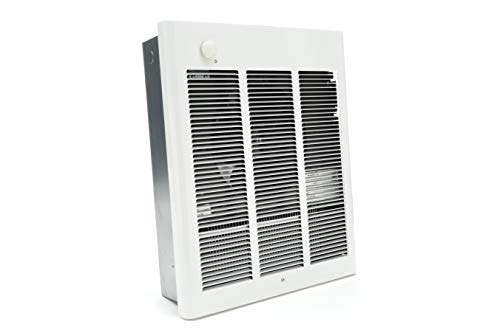
Best for a mudroom, entryway or vestibule that needs a quick blast of heat
- High-capacity fan-forced heating
- Purpose-built for entryways and vestibules
- Wall-mounted, out of foot-traffic areas
- Rugged housing for high-use, high-traffic spots
Why buy it: Fahrenheat designed the FZL4004F specifically for the spot most wall heaters ignore — the entryway or vestibule that gets a blast of cold air every time a door opens. Owners consistently cite it as the fastest way to knock the chill off that transition space instead of trying to heat it from a room away.
The verdict
Buy the Cadet Com-Pak Twin if you need a permanent, hard-wired heater to carry a whole bedroom, living room or basement through the winter. Buy the Fahrenheat FZL4004F if the problem is a specific cold entryway or vestibule that needs a fast blast of heat, not whole-room warmth. Both are established names in hard-wired electric heating with long track records, so the decision is really about matching the unit to the space rather than picking a "better" brand. For sizing and safety, see our wall & baseboard heaters hub and the wider wall heaters buying guide. Our method is on the How We Rank page.