


Affiliate Disclosure
Some links on this page are affiliate links. As an Amazon Associate, we earn from qualifying purchases — at no extra cost to you. We do not buy, test, or physically handle the products we cover; our rankings come from aggregated owner reviews, ratings and expert consensus. Commissions never change our verdicts. How we rank & full disclosure.
Wall and baseboard heaters are what you install when you have stopped treating a cold room as a temporary problem. They are permanent, they are wired into the house rather than plugged in, and they are controlled from a thermostat on the wall like the rest of your heating. That permanence is the whole appeal — and it is also why the decision deserves more care than a portable heater, because getting it wrong means an electrician rather than a return label.
What is the real difference between a wall heater and a baseboard heater?
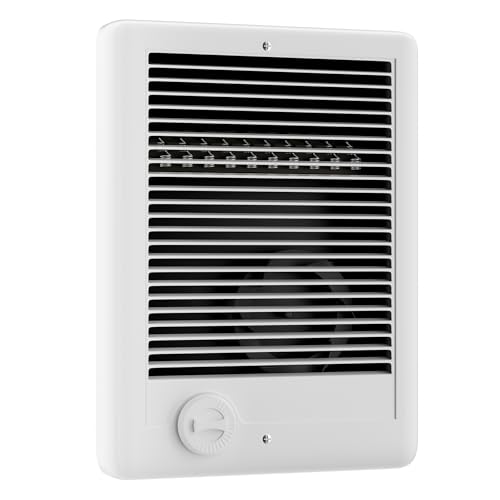
A wall heater is a recessed fan-forced box that heats a small area quickly and audibly. A baseboard heater is a long, fanless convection strip that warms a room slowly, silently and evenly. Speed against silence is the whole trade.
Electric fan-forced wall heaters: recessed and in-wall
Fan-forced wall units push heated air out of a grille, so you feel the effect within a minute or two and the warmth concentrates where the unit is pointing. Most are electric, recessed into a single stud bay so the box sits flush with the wall rather than projecting into the room. An in-wall unit like this needs no floor space at all, which makes it the default choice for bathrooms and entryways — rooms where you want heat now, for twenty minutes, and then do not care. Brands such as Broan, Cadet, Stiebel Eltron and King Electric all make recessed fan-forced units in this size class.
Hydronic and electric baseboard heaters
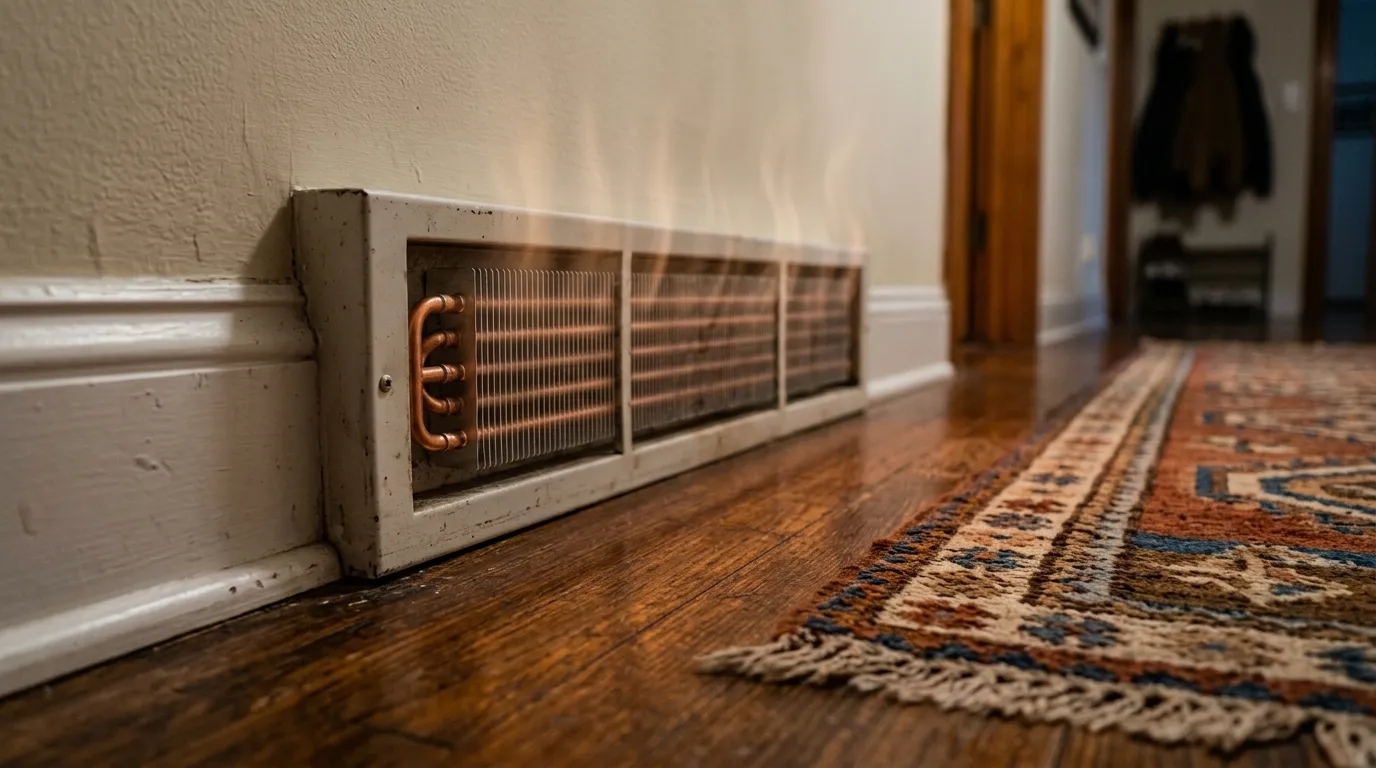
Baseboard heaters work by natural convection: air enters at the bottom, passes over a finned element and rises out the top, circulating the room without a fan. Most household baseboard is electric resistance, but hydronic baseboard exists too — a sealed liquid-filled element heated electrically or by a boiler loop, which holds warmth a little longer between cycles. Either way there is no noise beyond expansion ticking and no draft, which is why baseboard ends up in bedrooms. The cost is wall length — a 1,500-watt unit is roughly six feet long — and a permanent restriction on where furniture and curtains can go.
How many watts, and how many BTU, of fixed heat does a room actually need?
The familiar ten watts per square foot applies, so a 10-by-12 bedroom needs about 1,200 watts. Baseboard is typically rated around 250 watts per linear foot, which makes that a five to six foot run. Add capacity for poor insulation, corner rooms or large windows.
Because these units are the primary heat for the room rather than a supplement, the sizing needs more honesty than a portable heater does. A plug-in unit that comes up a little short just means you are slightly cool for an evening; an undersized baseboard installation means a room that never reaches temperature all winter and a rework that involves opening walls. When in doubt within a room, err upward and let the thermostat manage it.
Placement follows the same physics that dictates the shape. Baseboard traditionally goes under a window, because that is where the coldest air falls, and putting the heater there intercepts the draft before it crosses the room. Wall units go where you stand rather than where you sit — beside a shower, at a door — and want a clear path in front of the grille rather than the back of a towel rail.
1500 watts, BTU and mounting length
A single 1500-watt heater, wall or baseboard, produces roughly 5,100 BTU per hour — the same output regardless of shape, because the arithmetic runs on wattage, not form factor. What differs is how that output is packaged: a recessed wall unit delivers it from one spot on the wall, while baseboard spreads the same wattage along a mounting length of several feet. A room needing more than about 1,500 watts of fixed heat usually means either a longer baseboard run or a second wall unit on its own circuit, not a single larger box.
Do you need an electrician for hardwired 240 volt installation?
In almost every case, yes. Most wall and baseboard heaters are 240 volt appliances that hardwire to a dedicated circuit with a line-voltage wall thermostat. That is a breaker, a cable run and a permit conversation in many jurisdictions, not a weekend swap.
The units themselves are inexpensive relative to the installation, which reverses the usual budgeting instinct. Before choosing anything, check that your panel has spare capacity and a free double-pole slot; a house already at its limit may need panel work that dwarfs the heater cost. Rooms with several heaters may need more than one circuit, since the total load is what the breaker has to carry.
240 volt hardwired circuits and thermostat wiring
Two details worth raising with the electrician up front. First, the thermostat: a wall-mounted, hardwired line-voltage thermostat placed away from drafts and direct sun controls the room far better than the unit-mounted dial some models ship with. Second, bathrooms have their own requirements around ground-fault protection and the 240 volt rating of anything installed near a shower — do not adapt a general-purpose unit for that location.
Are wall and baseboard heaters expensive to run, and does zone heating cut the running cost?
They are electric resistance heaters, so every kilowatt-hour (kWh) becomes a kWh of heat and there is no efficiency multiplier. Against a heat pump they lose clearly on running cost; against portable heaters they are identical per watt, but they let you heat only the rooms you occupy.
The honest framing is that fixed electric heat is not cheap heat, it is controllable heat. Its advantage is zone heating: each room has its own thermostat, so an unused guest room can sit at a low setpoint all winter while the room you live in stays comfortable. Households that use that capability properly often spend less than they did running a central system to keep the whole house at one temperature.
Running cost, energy efficient zoning and supplemental heat
Whether zone heating actually saves money depends on your rates, your insulation and how many rooms are genuinely in use. Rather than trusting a general claim, it is worth spending an evening working out the numbers for your own home's indoor climate. The most energy efficient pattern is usually fixed heat in the rooms you occupy daily, paired with a portable unit as supplemental heat for anywhere used only occasionally — and if that is the whole use case, a unit from the space heaters hub may be the more rational purchase than a hardwired installation at all.
What do owners complain about after living with them?
Thermostat swing, expansion ticking from baseboard units, fan noise from wall units, and dust. The furniture restriction is the complaint that surprises people most: a baseboard heater permanently claims the wall it sits on, and sofas and long curtains cannot cover it.
Line-voltage thermostats are a genuine weak point. Many are simple mechanical devices that let a room drift several degrees either side of the setpoint, which reads as a room that is alternately stuffy and chilly rather than steady. Replacing a basic thermostat with a better electronic line-voltage model is one of the highest-value upgrades in this category, and it is usually far cheaper than replacing the heaters.
Dust is the maintenance item nobody is told about. Baseboard fins collect it, airflow drops, output falls and a scorched smell appears when the heating season restarts. Vacuuming the fins before winter takes minutes and prevents most of it. And if silence in a bedroom is the goal but rewiring is not on the table, a fanless portable from the oil-filled radiator hub delivers a similar quality of heat without the installation.
Are these a good fit for a bathroom?
A fan-forced wall heater is one of the better answers for a bathroom, because it warms a small space quickly and takes no floor area at all. It has to be a unit rated for the location and installed to the electrical requirements that apply near a shower.
Bathrooms are the classic case for fixed heat: small, used in short bursts, frequently the coldest room in the house, and a poor place to leave a portable heater given the combination of water and bare feet. A recessed wall unit with a built-in timer or a short-cycle switch matches that usage pattern well — heat while you are in there, off when you are not, and nothing standing on a wet floor.
Two things need to be right. The unit must be rated for a damp location and positioned away from the shower or tub according to the manufacturer and your local requirements, which is not a detail to improvise around. And the fan will be clearly audible in a small tiled room, which is perfectly acceptable for a fifteen-minute use case and would not be in a bedroom. Baseboard is the quieter technology but generally a poor fit here, since bathrooms rarely have spare wall length and a low, hot strip near hanging towels is not an ideal arrangement.
Every guide below is ranked from aggregated real owner reviews and manufacturer documentation, never from us buying and running a heater ourselves — see How We Rank for the full methodology.