

Affiliate Disclosure
Some links on this page are affiliate links. As an Amazon Associate, we earn from qualifying purchases — at no extra cost to you. We do not buy, test, or physically handle the products we cover; our rankings come from aggregated owner reviews, ratings and expert consensus. Commissions never change our verdicts. How we rank & full disclosure.
This is the one air purification category where the most useful advice is often "probably not, and here is why". UV-C and ozone are real technologies with real industrial applications, but the way they are packaged and marketed for home use frequently outruns both the physics and the safety guidance. Read this section as a caution rather than a shopping list — because for most households, a good HEPA and carbon machine does the job these products claim without the trade-offs.
Are ozone generators safe to use at home?
Not in occupied spaces. Ozone is a lung irritant, and public health guidance is consistent that concentrations high enough to affect odors or microorganisms are well above levels considered safe to breathe. An ozone generator is not an air cleaner you run while people are in the room.
Ozone is a reactive form of oxygen. That reactivity is exactly what makes it useful for treating a sealed, empty space and exactly what makes it a respiratory hazard for people, pets and plants. It can irritate airways, worsen asthma symptoms and reduce lung function, and those effects can occur at concentrations below the level at which many people notice a smell.
The narrow legitimate use case is unoccupied remediation: a vacant property being treated for severe residual odor, with the space sealed, nobody inside, and a substantial airing-out period before reoccupation. That is a professional procedure with a protocol, not a consumer appliance you leave running in a bedroom. Any product marketed for continuous use in an occupied room while producing ozone should be treated with real caution.
What about ionizers that produce ozone as a byproduct?
Many ionizers generate some ozone incidentally, and disclosure varies widely. If a unit has an ionizer function, look for the ability to switch it off — the HEPA and carbon stages do the real work, and the ionizer is usually the part you can lose without missing it.
Ionizers charge airborne particles so they clump together and fall out of the air more readily. This is a real mechanism, but it works by making particles settle onto your surfaces rather than by removing them from your home, and it can leave a visible film of deposited particulate on nearby walls and furniture. It is also a substantially weaker effect than simply forcing air through a filter.
The practical rule is simple: buy a purifier for its filtration, not for its ionizer. If the ionizer can be disabled and the machine still meets its clean-air ratings without it, the feature is at worst harmless. If a device relies on ionization as its primary mechanism and has no meaningful filter behind it, you are paying for a weaker method with an ozone question attached.
Does UV-C inside an air purifier do anything?
Less than the marketing suggests. UV-C can inactivate bacteria, viruses and mold spores, but only with enough intensity and enough contact time. Air moving quickly past a small lamp inside a consumer purifier gets a fraction of a second of exposure — far less than laboratory conditions assume.
The dose that matters is intensity multiplied by time. Industrial and clinical UV systems solve this with powerful lamps and deliberately slow, long exposure chambers. A consumer purifier has neither, because the same airflow that makes it good at filtration is what gives the lamp so little to work with. That does not make UV-C useless, but it does mean it should be treated as a marginal bonus stage rather than a reason to choose one machine over another.
There is also a durability point buyers rarely hear. UV-C lamps lose output over time well before they visibly fail, so a lamp that is still glowing may be delivering considerably less than when it was new. Manufacturers generally specify annual replacement for this reason, which is an ongoing cost worth factoring in against a benefit that is difficult to verify.
None of this makes UV-C a red flag. Where it appears as a switchable extra on a machine that already has certified HEPA media and a real carbon bed, it costs little and does no harm. The problem is only when it is presented as the reason to buy — because then you are paying a premium for the stage doing the least work.
Is photocatalytic oxidation any different?
PCO pairs UV light with a catalyst, usually titanium dioxide, to break down gases rather than trap them. The concept is sound, but consumer implementations can produce byproducts including formaldehyde and ozone when the reaction is incomplete, which is a meaningful caveat.
The appeal is obvious: instead of adsorbing odor molecules onto carbon that eventually saturates, PCO aims to destroy them. In practice, contact time and catalyst surface area limit consumer units the same way they limit UV-C, and partial oxidation of a complex mixture of household volatile organic compounds does not reliably end at harmless products.
For odor control, a deep activated carbon bed remains the more predictable and better-understood approach. It has a clear failure mode — it saturates, and you replace it — which is easier to manage than a reaction whose completeness you cannot observe. That is why odor-focused machines in the air purifiers for smoke category lead with carbon weight rather than with a light source.
When does this category make sense at all?
When UV-C is an optional extra stage on a machine that already has genuine HEPA and carbon filtration, and the price premium is small. It rarely makes sense as the primary mechanism, and ozone generation is not appropriate for a room anyone is living in.
If you have arrived here looking for a solution to mold, odor or airborne pathogens, the honest answer is that certified HEPA filtration plus a real carbon bed plus moisture and ventilation control covers those needs more reliably and with fewer unknowns. Mold in particular is a moisture problem that filtration supports rather than solves, as air purifiers for mold sets out in detail.
The wider point is that air quality is a layered problem, not a single-device one. Source control, ventilation and humidity do most of the work before any filtration technology gets involved — the practical sequence is laid out in how to improve your home's indoor climate.
How do you decode the marketing language in this category?
Look for what physically happens to a particle. "True HEPA" and "activated carbon" describe mechanisms with measurable outcomes. "Plasma", "negative ion", "active oxygen" and "fresh air technology" describe effects, not mechanisms, and often mean ionization or ozone generation.
The most reliable filter for marketing claims is whether a product publishes a CADR figure. CADR is an independently defined measure of how much clean air a unit actually delivers, and devices whose primary mechanism is not filtration usually cannot produce a competitive number — so they lead with adjectives instead. The absence of a CADR rating on a room-sized purifier is informative in itself.
Two other phrases are worth recognizing. "Ozone-free" is a genuinely useful claim when a manufacturer makes it explicitly, because it means they have committed to it rather than left it ambiguous. "Hospital-grade" is not a defined standard for consumer purifiers and carries no certification behind it. When in doubt, the question to ask is simple: what stops the particle, and where does it end up?
What types of UV and ozone air purifiers are there?
The category covers four distinct mechanisms, and they are not interchangeable.
UV-C light air purifiers
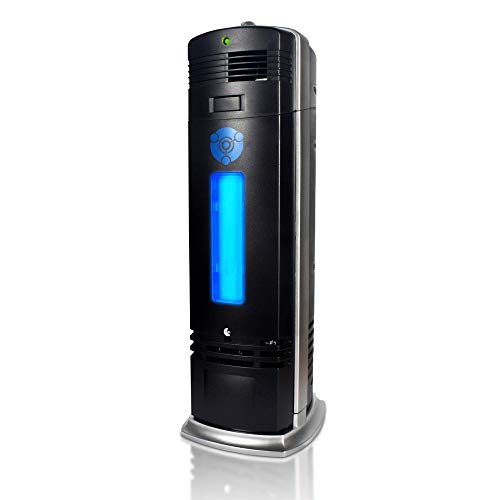
UV-C light air purifiers pass air past a small germicidal lamp inside the housing. Germ Guardian is one of the more established names combining a UV-C stage with a HEPA filter rather than selling UV-C alone.
Ozone generators for unoccupied rooms
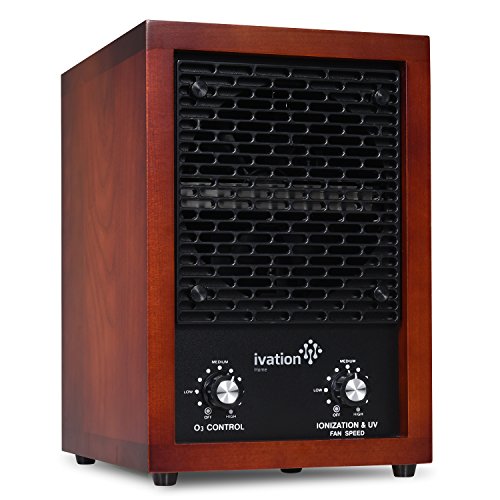
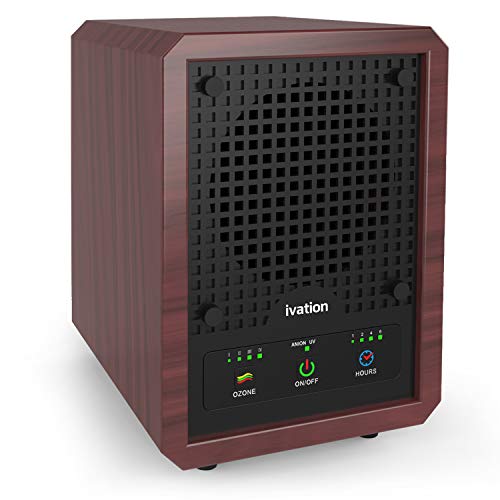
Ozone generators like those sold by Enerzen and Airthereal are marketed for odor and mold, but they are built for an unoccupied room only — sealed, vacated, and aired out before anyone re-enters. CARB restricts the sale of ozone-generating air cleaners in California for exactly this reason.
Ionizers and negative-ion purifiers
Ionizers charge airborne particles so they clump and settle onto surfaces instead of staying suspended. AiroDoctor and similar brands often bundle an ionizer alongside genuine filtration — the ionizer alone is a weak mechanism and can produce ozone as a byproduct.
Photocatalytic (PCO) purifiers
Photocatalytic purifiers pair UV light with a catalyst to break down gases rather than trap them. It's a real mechanism, but incomplete reactions in a consumer unit can produce unwanted byproducts, which the EPA flags as a genuine caveat.
What claims and specs should you actually check?
This category's marketing language runs well ahead of what most units can verify. Check the mechanism, not the adjective.
HEPA, VOC and mold spores
A real HEPA filter stops particles — dust, pollen, mold spores — that UV and ozone technology largely ignore. VOC gases need activated carbon, not light or ozone, to actually leave the air.
Germicidal claims, bacteria and virus inactivation
Germicidal claims about bacteria and virus inactivation depend entirely on dose — intensity multiplied by contact time. A lamp that is technically germicidal in a lab test may do almost nothing in the split second air spends near it inside a consumer purifier.
Odor removal, sanitize claims and square footage
Odor removal and "sanitize" claims are the most exaggerated language in this category. Coverage-area claims in square footage assume ideal conditions that rarely match a real, occupied room.
Air treatment, air quality and UV air purifier marketing
A UV air purifier marketed as complete air treatment is usually overselling a single weak stage. Genuine air quality improvement still comes from HEPA and carbon filtration first, with UV-C or PCO as a minor add-on at best.
Everything in this category is assessed from aggregated real owner reviews, published manufacturer specifications and public health guidance, never from buying and running units ourselves — see How We Rank for the full methodology.