

Affiliate Disclosure
Some links on this page are affiliate links. As an Amazon Associate, we earn from qualifying purchases — at no extra cost to you. We do not buy, test, or physically handle the products we cover; our rankings come from aggregated owner reviews, ratings and expert consensus. Commissions never change our verdicts. How we rank & full disclosure.
Some links below are affiliate links: if you buy through one we earn a small commission at no extra cost to you. We never buy or physically handle these fans, and a commission never changes where a product lands in this ranking.
A box fan is the cheapest way to move a lot of air, and for a hot room it can transform your indoor climate — not by cooling it, but by circulating air, pulling cooler evening air in through a window, or exhausting hot, stuffy air out. It is a genuinely portable room fan: light enough to carry between rooms, with a handle built into the frame for exactly that. If you want maximum airflow per dollar and do not care about remotes or oscillation, a box fan is the right buy. If you want quiet, refined, aim-anywhere airflow for a bedroom, a tower or bladeless fan will suit you better.
Box fan vs window fan vs room fan — which type do you need?
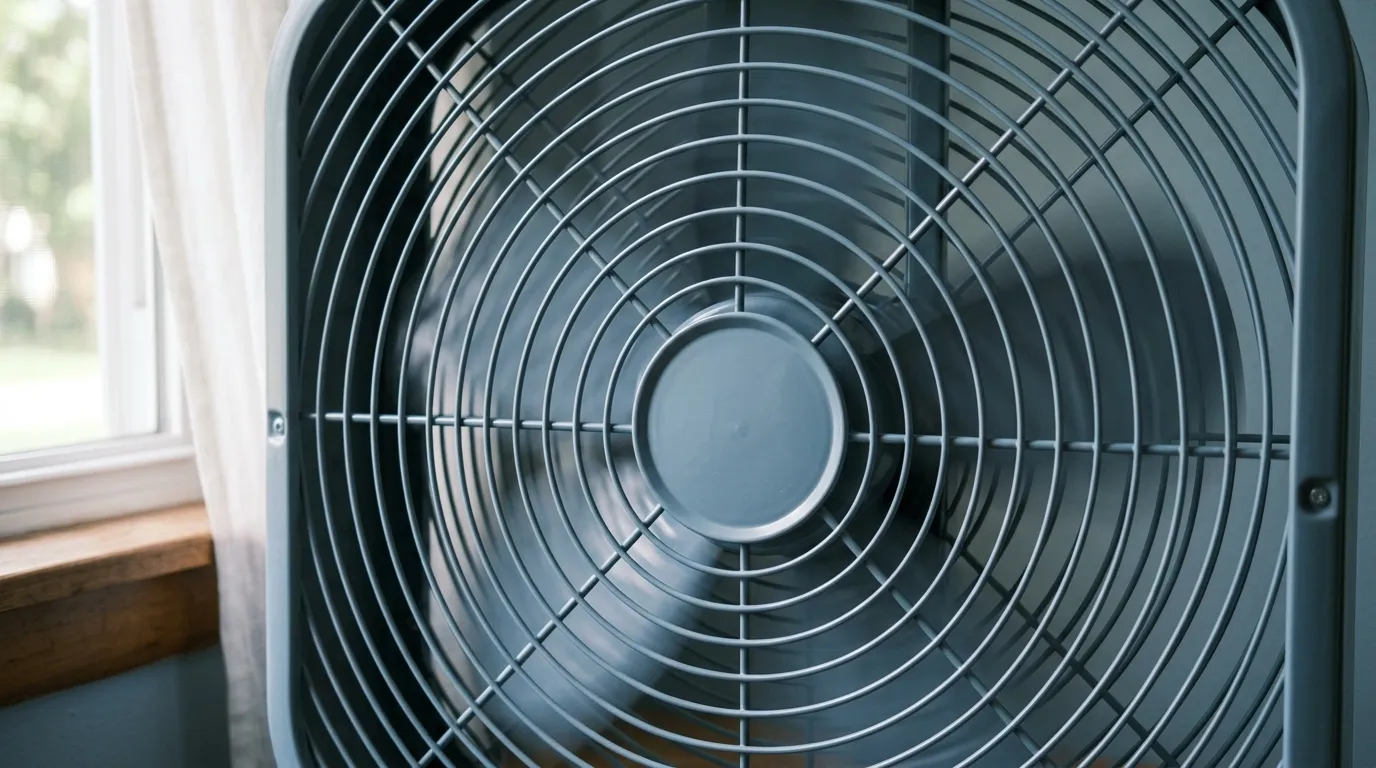
A box fan is a flat, square room fan built to sit on a floor, table or in a window opening for general air circulation. A dedicated window fan adds reversible blades for intake-and-exhaust ventilation; a tower or pedestal fan trades raw airflow for a quieter, more directional breeze.
The box shape is what makes it so flexible: the same fan that circulates a bedroom overnight can be turned sideways into a window for cross-ventilation, something a tall tower fan's cabinet cannot do. If you specifically want to exhaust hot air or draw in cool night air through a window every night, a purpose-built window fan with reversible blades does that job better than a box fan wedged into the frame. For general-purpose room fan duty — bedroom, living room, garage — the box fan's simplicity and price are hard to beat.
What actually makes one box fan better than another?
Airflow (measured in CFM), noise at the speed you will actually use, and build quality. Most 20-inch box fans look identical, but they differ in how much air they move, how loud they are doing it, and whether the motor, blades and housing survive years of use.
CFM is the number worth checking — the Pelonis above is rated around 2,295 CFM, which is strong for the category. But raw airflow is only useful if you can live with the noise, so match the fan to the room: a bedroom rewards a quieter model run on low, while a garage or workshop rewards a rugged, high-velocity fan like the Hurricane. Cheaper fans tend to use thinner blades and a smaller motor, which is usually where the noise and the CFM shortfall both come from.
How much airflow and power does a box fan use — CFM, watts and motor?
Airflow is measured in CFM; a strong 20-inch box fan moves upward of 2,000 CFM on its highest of three-speed settings. Motor size is usually in the 60-to-100-watt range, so even run all day a box fan barely registers on an electric bill.
Because a box fan's motor draws so little power compared with any compressor-based cooling, it is inherently energy efficient — there is no ENERGY STAR certification program for simple fans the way there is for air conditioners, but the low wattage speaks for itself. When comparing CFM between two box fans of the same 20-inch size, the number is a reasonable proxy for how much air circulation you are actually getting, so it is worth checking even though the fans look nearly identical.
Can a box fan cool a room down?
Not on its own — it does not lower air temperature. It cools you by moving air across your skin, and it can genuinely help cooling a room if you use it in a window to bring in cooler outside air or exhaust hot indoor air.
This window trick is where box fans outperform pricier fans: their flat shape fits a double-hung window, so on a cool evening you can pull the day's heat out of the house through ventilation rather than air conditioning. To understand when airflow is enough and when you need real cooling, read how cooling affects your home's indoor climate.
Are box fans loud?
On high, yes — a box fan trades refinement for airflow, so the top speed of any of these will be clearly audible. On low and medium they are much more livable, and many people actually like the steady white noise hum for sleeping.
A common complaint across the whole category is high-speed noise, and it is not a defect — it is physics: more air past the blades means more sound. If quiet matters more than maximum air, plan to run the fan on a lower setting, or step up to a tower fan. If you want the airflow and do not mind the sound, a box fan is unbeatable value.
Where should you place a box fan, and does direction matter?
Facing out of a window in the evening exhausts hot indoor air; facing in during a cool early morning pulls in fresh air. On a floor or table pointed at you, it works purely for personal cooling through moving air rather than any real ventilation effect.
Placement changes what job the fan is actually doing. Set in a window with the blades pushing air outward, a box fan becomes an exhaust fan for a stuffy attic bedroom or a kitchen after cooking. Set on the floor across a room, it is simple air circulation, evening out hot and cool pockets rather than moving air in or out of the house at all. Running two box fans — one exhausting from an upstairs window, one drawing in through a downstairs window or door — creates a cross-breeze that can noticeably drop indoor temperature on a night when it is cooler outside than in, all without touching the thermostat.

Best for strong whole-room airflow with quiet, everyday running
- 20-inch box fan rated around 2,295 CFM
- Three speeds for table, floor or window use
- Slim frame with a built-in carry handle
- Lightweight and easy to reposition
Why buy it: The consensus favors the Pelonis as the best all-round box fan: owners consistently report it pushes more air than most 20-inch rivals while staying reasonably quiet, which is the balance most people actually want from a box fan.

Best for a reliable, no-frills fan at the lowest sensible price
- Classic 20-inch, three-speed box fan
- Five-blade design for steady airflow
- Carry handle and a lightweight 67-watt motor
- Simple top-mounted speed dial
Why buy it: Owners consistently report this does exactly what a box fan should for the least money. A common complaint is that it is basic — no remote, no timer — but for straightforward airflow it is hard to beat on price.

Best for a sturdier fan for a workshop, garage or shop
- Rugged 20-inch box fan built for heavy use
- Three-speed high-velocity motor
- Durable housing that stands up to a garage
- Simple, serviceable design
Why buy it: The consensus favors Hurricane for durability: owners consistently report the housing and motor hold up better than thin-frame budget fans, which is why it is the pick for a garage or workshop rather than a bedroom.

Best for moving the most air in a hot room
- 20-inch box fan with Max Cooling Technology
- Three settings from gentle to full-force
- Carry handle for easy moving
- Fits standard double-hung windows
Why buy it: Owners consistently report the Genesis moves a lot of air on its top setting, making it a good window-exhaust or whole-room fan. A common complaint is that the high speed is loud — expected from any fan pushing this much air.

Best for a second fan for another room without spending much
- 20-inch, three-speed box fan
- Full-force air circulation design
- Lightweight with a carry handle
- Works on a floor, table or in a window
Why buy it: A dependable budget choice when you just need more air in a spare room. Owners consistently report it is a solid basic; the consensus is to treat it as functional rather than refined.

Best for a trusted name with simple three-speed control
- 20-inch box fan with three speed settings
- Lightweight frame with a carry handle
- Straightforward top-mounted controls
- Suits floor, table or window placement
Why buy it: A safe pick for buyers who want a familiar brand. Owners consistently report reliable airflow; a common complaint is that it is functionally similar to cheaper unbranded fans, so you are partly paying for the name.
How we picked
We do not buy, test or physically handle these fans. Box fans are a mature, simple category, so our ranking leans on the patterns that emerge from aggregated owner reviews and manufacturer specifications — rated airflow, the balance of noise versus output, and how well the motor and frame hold up over years of reported use. Across familiar names like Lasko, Hurricane, Genesis and PELONIS, the pattern is consistent: owners forgive plain looks and a lack of extras far more readily than they forgive weak airflow or a motor that fails after one summer. When owners repeatedly praise the same strength or flag the same flaw, that consensus sets the order. See how we rank, browse the rest of the box fans hub, or compare box fans against other options in the wider cooling guides.
Maintenance is minimal but not zero: dust builds up on the blades and front grille over a season, and a caked layer measurably cuts airflow. A quick wipe-down every few weeks keeps a box fan performing closer to its rated CFM, and it is worth doing before the first hot week of the year rather than after you notice it running weaker than you remember.