



Affiliate Disclosure
Some links on this page are affiliate links. As an Amazon Associate, we earn from qualifying purchases — at no extra cost to you. We do not buy, test, or physically handle the products we cover; our rankings come from aggregated owner reviews, ratings and expert consensus. Commissions never change our verdicts. How we rank & full disclosure.
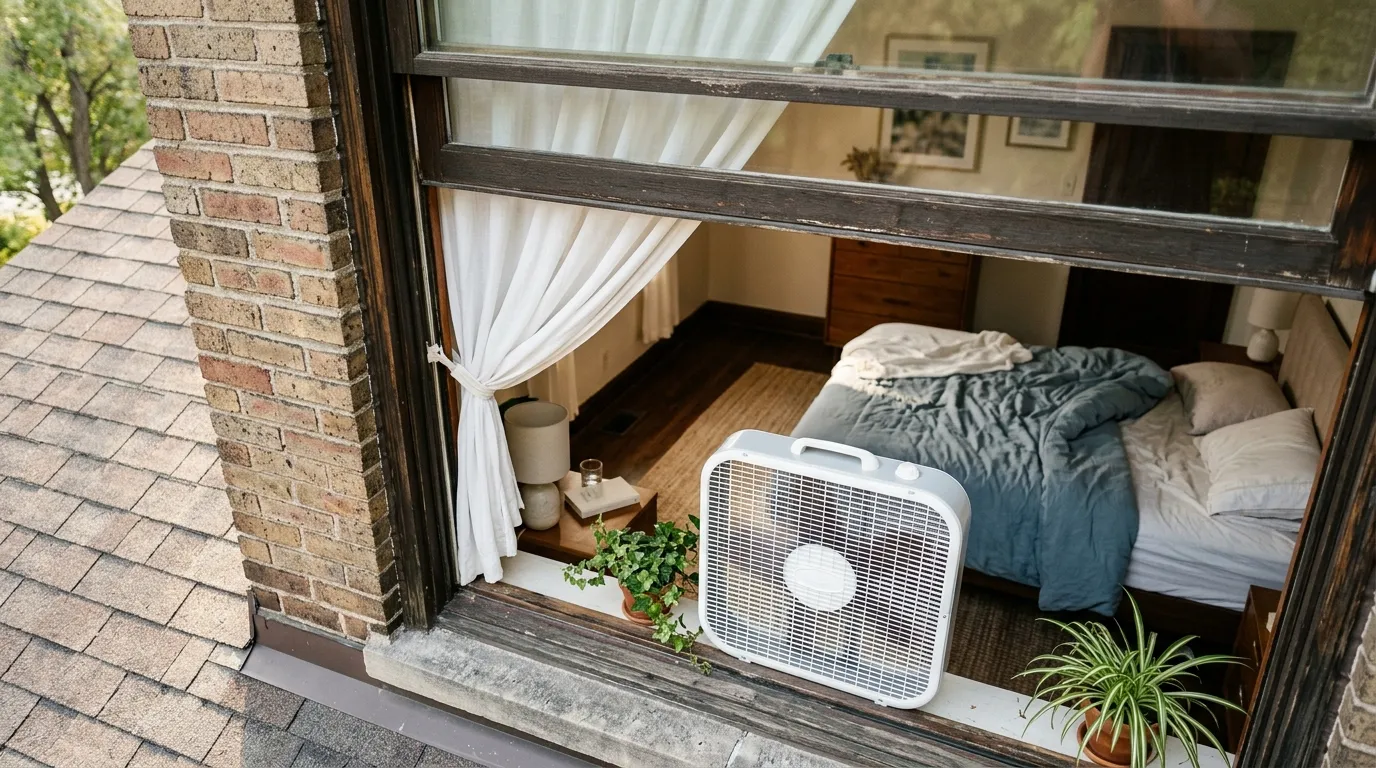
The box fan is the least sophisticated appliance in this pillar and, used correctly, one of the most effective. A 20-inch blade in a square frame moves a large volume of air for a very low price and a very low power draw, with no oscillation, no remote and usually no display. Lasko, Genesis, Hurricane and PELONIS all compete in this exact category, mostly on CFM per dollar rather than features. Its value is almost entirely a function of where you put it. Pointed at a chair it is a personal breeze. Set in a window or doorway it becomes a ventilation device that changes the air in a room rather than merely stirring it.
How much airflow and CFM does a box fan actually move?
A standard 20-inch box fan typically moves somewhere between about 1,500 and 2,500 CFM on its highest speed, while drawing roughly 50 to 100 watts. That is substantially more airflow per watt and per dollar than a tower fan of similar price.
CFM and airflow by blade size
The efficiency comes from the same principle that governs every fan: a large blade turning slowly moves more air than a small blade turning fast. A box fan gives up refinement — oscillation, fine speed control, quiet operation — and spends all of it on frontal area. Where a manufacturer does not publish CFM, blade diameter and motor wattage together give a reasonable indication of real airflow.
20-inch blades and motor watts
20-inch blades remain the category standard for good reason: it is the largest frame that still fits a standard window opening. A bigger motor pulling more watts spins those blades faster, but past a point the extra draw buys noise more than airflow. Reviewers who compare models by CFM per watt, not just top-speed CFM, tend to end up happier with the fan a year later.
Three-speed control and energy efficient settings
Most box fans offer three-speed control — low, medium and high — rather than a stepless dial, which keeps the motor and switch simple and cheap to build. Running on a lower speed most of the time is also the energy efficient choice: airflow drops roughly with the cube of fan speed, so dropping from high to medium can cut power draw by more than half for a small loss in moving air. Few box fans carry ENERGY STAR certification, because the category is simple enough to fall outside the programme's usual scope, but the wattage printed on the label tells you most of what ENERGY STAR would. Airflow this high has a practical consequence worth planning around, too: a box fan on high in a small room is genuinely disruptive, blowing papers around rather than producing an ambient breeze. Many owners run them on low or medium indoors and reserve the top speed for window use, where the airflow is doing structural work rather than aiming at a person.
Should you use a box fan as a window fan for ventilation?
Often yes — used as a window fan, it is the highest-value application of the category. Facing outward, a box fan exhausts hot indoor air and pulls replacement air in through other openings. Facing inward on the cooler, shaded side of a house, it brings cool evening air in.
Exhaust vs intake placement
The technique that produces the biggest effect is deliberate cross-ventilation: one fan on exhaust on the warm or leeward side of the house, and an open window on the opposite, cooler side to supply replacement air. This does far more to change how a house feels on a summer evening than the same fan sitting in the middle of a room, because it replaces the air rather than recirculating it. It only works when the outdoor air is actually cooler than the indoor air — after sunset in most climates, and never during the hottest part of a summer afternoon.
Placement details matter for ventilation to work well. Fill the gaps around the fan in the window opening, or the air you just exhausted flows straight back in around the frame. Secure the fan so it cannot be pushed out or fall, especially above ground level. And be realistic about what comes in with the air: an intake fan brings pollen, dust and outdoor smoke with it, which is covered in more depth in our guide to improving indoor air quality.
How loud is a box fan — white noise, quiet settings and room fan use?
Loud on high, commonly in the 60-decibel range, and moderate and fairly quiet on low. The sound is broad and rushing rather than tonal, which is why many people find a box fan easy to sleep next to on a low setting despite its absolute noise level being higher than a tower fan's.
The character of the noise explains the split in owner opinion. A box fan produces a wide-spectrum airflow sound with very little motor whine, which the brain treats as white noise. A substantial number of people buy one specifically as a bedroom room fan for that reason. What breaks the effect is mechanical noise: a rattling grille, a blade rubbing its housing, or a motor bearing that has started to hum. Those are the complaints that show up in reviews after a season or two of continuous use.
Because box fans are cheap and simple, they also tend to be run harder and longer than more expensive fans, which speeds up exactly those failure modes. Storing one flat under a bed with dust settling on the blades, then running it at full speed next season, is how most of them get noisy.
Build quality within the category varies less than price suggests, because the design is so simple, but a few details separate the better units. A metal or reinforced frame resists the flex that lets a blade contact its housing. A carry handle moulded into the frame rather than glued on survives being moved between rooms and windows, which is what these fans are for. And a cord long enough to reach a window without an extension lead removes the most common improvised hazard in the category. None of these add much to the price, and their absence is what turns a two-season fan into a one-season fan.
Can a box fan improve air circulation and filter the air?
People do tape a filter to a box fan, and the practice is well established as a low-cost way to capture airborne particles while boosting air circulation. Do it with the fan on the pull side of the filter, use several filters in a box arrangement rather than one flat against the intake, and never leave it running unattended.
The reasoning behind the multi-filter box arrangement, rather than a single taped-on filter, is airflow resistance. One filter pressed against the intake restricts airflow substantially, which reduces the amount of air actually cleaned and makes the motor work harder for the same watts. Spreading the same filtration across several panels gives far more filter area, lower resistance, and better throughput. Modern box fans sold in the United States include a fused plug as a safety requirement, but a restricted, hard-working fan motor is still a motor running outside its design intent.
The honest framing is that this is a legitimate, widely used approach where a purpose-built purifier is not available or not affordable, not an equivalent to one. A dedicated purifier has a properly matched fan, a sealed airflow path, and a filter rated to a known standard — see our explainer on what a true HEPA filter is for what that rating actually means and why a furnace filter is not the same thing.
When does a portable box fan stop being the right tool?
When you need airflow aimed at a person at seated or standing height, when you need oscillation to cover a room, or when the outdoor air is hotter than the indoor air. A box fan sits on the floor and blows in one fixed direction, and neither of those is adjustable.
For directed comfort cooling, a raised, oscillating fan does the job better — pedestal fans put similar airflow at the right height and sweep it across a room. Being lightweight and portable is a real advantage for a box fan moved between rooms, but on a genuinely hot day with no cooler outdoor air to draw in, it has nothing to work with. Moving 90-degree air across the room does not make it 80-degree air, and at high enough temperatures moving hot air over skin stops helping altogether. That is the point at which the answer is mechanical cooling rather than a bigger fan.
Every product recommendation below is ranked from aggregated real owner reviews and manufacturer specifications, never from us buying and running a unit ourselves — see How We Rank for the full methodology.


