


Affiliate Disclosure
Some links on this page are affiliate links. As an Amazon Associate, we earn from qualifying purchases — at no extra cost to you. We do not buy, test, or physically handle the products we cover; our rankings come from aggregated owner reviews, ratings and expert consensus. Commissions never change our verdicts. How we rank & full disclosure.
A whole-house fan is the only appliance in this pillar that cools an entire home without a compressor. Mounted in the ceiling of a central hallway, it pulls air out of the living space and pushes it into the attic, where it escapes through the roof vents — and that outflow drags cool outdoor air in through every window you have opened. In a climate with cool evenings it can replace hours of air conditioning for a fraction of the electricity. In a climate where the night stays hot and humid, it has nothing useful to pull in.
How much CFM does a whole-house fan need?
A common sizing approach is two to three CFM per square foot of living space, which puts a 2,000 square footage home in the region of 4,000 to 6,000 CFM, brands like QuietCool and Tamarack both rate their fans this way. Higher figures give faster air changes; lower figures are quieter and cheaper to vent.
Square footage and two-speed sizing
The underlying goal is air exchange rather than airflow for its own sake. The point of the appliance is to replace the entire volume of hot air in the house with cooler outdoor air several times an hour, so a larger fan cools a house down faster after sunset and lets you shut it off sooner. That is why owners in hot-summer regions usually recommend sizing at the upper end of the range rather than the lower. A two-speed or multi-speed fan lets you run near the top CFM figure at dusk, then step down once the house has cooled.
Cubic feet, attic ventilation and gable vents
What sets the practical ceiling is not the fan but the attic. Every cubic foot the fan pushes upward has to get out through gable vents, roof vents or other attic ventilation, and the standard guidance from HVI is roughly one square foot of net free vent area per 750 CFM of fan capacity. Net free area is smaller than the physical opening because screens and louvers restrict it — often by half or more. An oversized fan in an under-vented attic pressurises the attic, pushes hot air back into the house through ceiling gaps, and performs far below its rating. This is the most common installation mistake in the category.
When does a whole-house fan actually work?
Only when the outdoor air is cooler than the indoor air — typically evening, overnight and early morning. It works brilliantly in climates with a large day-to-night temperature swing, and poorly where summer nights stay warm and humid, because it brings that humidity indoors.
Summer air exchange and cooling season
The usage pattern that produces the results owners rave about is deliberate. Keep the house closed and shaded through the heat of the day, then open windows and run the fan once outdoor temperature drops below indoor temperature. Within an hour or two the house has flushed its stored heat through a fast air exchange, the attic has cooled along with it, and the following day starts from a lower baseline. Running it during a hot afternoon does the exact opposite, which is why some owners' first summer experience is disappointing.
The regional split is stark. Inland and mountain West climates, with hot days and genuinely cool nights, are the natural home of this appliance. Humid southeastern climates, where a summer night may only fall to the high seventies with high moisture content, get very little from it and may find the humidity it imports makes rooms feel worse. It is the same climate logic that governs evaporative coolers, applied at the scale of a whole building.
How loud is a whole-house fan?
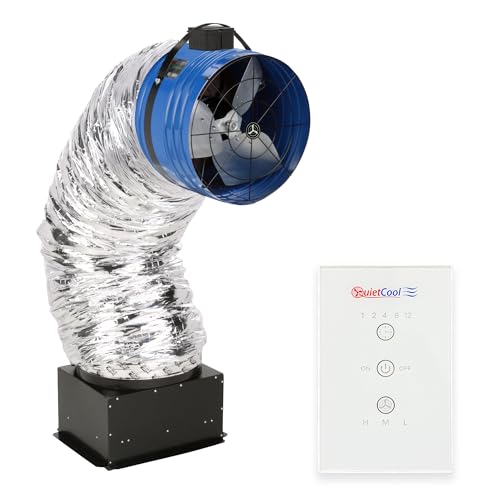
Traditional direct-drive units mounted straight into the ceiling are loud — a large blade and motor immediately above your head, often described as sounding like an aircraft. Modern ducted models from brands like QuietCool place the fan away from the grille and connect it with insulated flexible duct, which cuts perceived noise dramatically.
Ducted vs ceiling mount installation
Noise is the single biggest reason older whole-house fans get abandoned, and it is the area where the category has changed most. A ducted design sets the motor several feet away in the attic and lets the duct absorb both the mechanical noise and the airflow rush, instead of a direct ceiling mount installation right above the room. Multi-speed models help further, since a lower speed run for longer is often quieter and just as effective once the house has begun to cool.
The other noise consideration is airflow through the windows themselves. Pulling several thousand CFM through a house means air is moving fast past partly open sashes, and owners routinely report whistling until they learn to open windows wider and spread the intake across several rooms. That distribution also improves cooling, because it draws air through the rooms you actually want cooled rather than short-circuiting through the nearest opening.
Grille design contributes as well. A large grille with a low face velocity is quieter than a small one passing the same volume of air, which is why better units use a wider ceiling opening than the fan itself requires. Owners retrofitting a modern ducted fan into an existing older opening sometimes keep the original small grille and then wonder why the promised quiet operation did not arrive.
What about winter heat loss and safety?
An uninsulated whole-house fan opening is a hole in your ceiling insulation for eight months of the year. Modern units include motorised insulated doors that seal when the fan is off; older louvered models need a removable winter cover. Combustion safety also needs checking before installation.
Insulated damper and energy efficient sealing
The energy point is straightforward. A large uninsulated opening between conditioned space and a vented attic undermines exactly the insulation you paid for. Insulated damper doors with a meaningful R-value, the kind Cool Attic and Air Vent both build into their higher-end fans, are now standard on better units and genuinely energy efficient. They are the difference between an appliance that saves money over a year and one that gives back its summer savings every winter.
The safety point is more important and less discussed. A powerful exhaust fan depressurises the house, and in a home with atmospherically vented gas appliances — an older water heater or furnace that vents by natural draft — that depressurisation can pull combustion gases back down the flue instead of letting them rise. Adequate open window area while the fan runs is what prevents this, and it is a genuine reason never to run a whole-house fan with the house closed up. The same depressurisation can also draw soil gas in through a basement or slab, which is worth understanding if you have never tested — see our explainer on what radon is.
Is a whole house fan cheaper to run than air conditioning?
Dramatically. A whole house fan is a motor moving air — typically a few hundred watts even for a large unit — against several thousand watts for central air conditioning. Where the climate allows it to work, the running cost difference is roughly an order of magnitude.
That economics is the entire argument for the category, and it holds up: households in suitable climates commonly report cutting air-conditioning hours substantially across a season by cooling the house overnight with the fan and coasting through the following morning. It is a genuine reduction in energy use rather than a shift of it, because the cooling energy comes from outdoor air that is already cool.
The offsetting costs are installation, which involves cutting a ceiling opening, framing, electrical work and often additional attic venting, and the fact that it only works part of the day. Most homes that install one keep their air conditioning for the hottest afternoons and use the fan for everything else. That layered approach — cheap ventilation first, mechanical cooling only when the ventilation has nothing cool to work with — is how your home's indoor climate is managed most efficiently across a whole season.
Every product recommendation below is ranked from aggregated real owner reviews and manufacturer specifications, never from us buying and running a unit ourselves — see How We Rank for the full methodology.