

Affiliate Disclosure
Some links on this page are affiliate links. As an Amazon Associate, we earn from qualifying purchases — at no extra cost to you. We do not buy, test, or physically handle the products we cover; our rankings come from aggregated owner reviews, ratings and expert consensus. Commissions never change our verdicts. How we rank & full disclosure.
Some links below are affiliate links. As an Amazon Associate we earn a commission from qualifying purchases at no extra cost to you — and it never changes which products we recommend or where they rank.
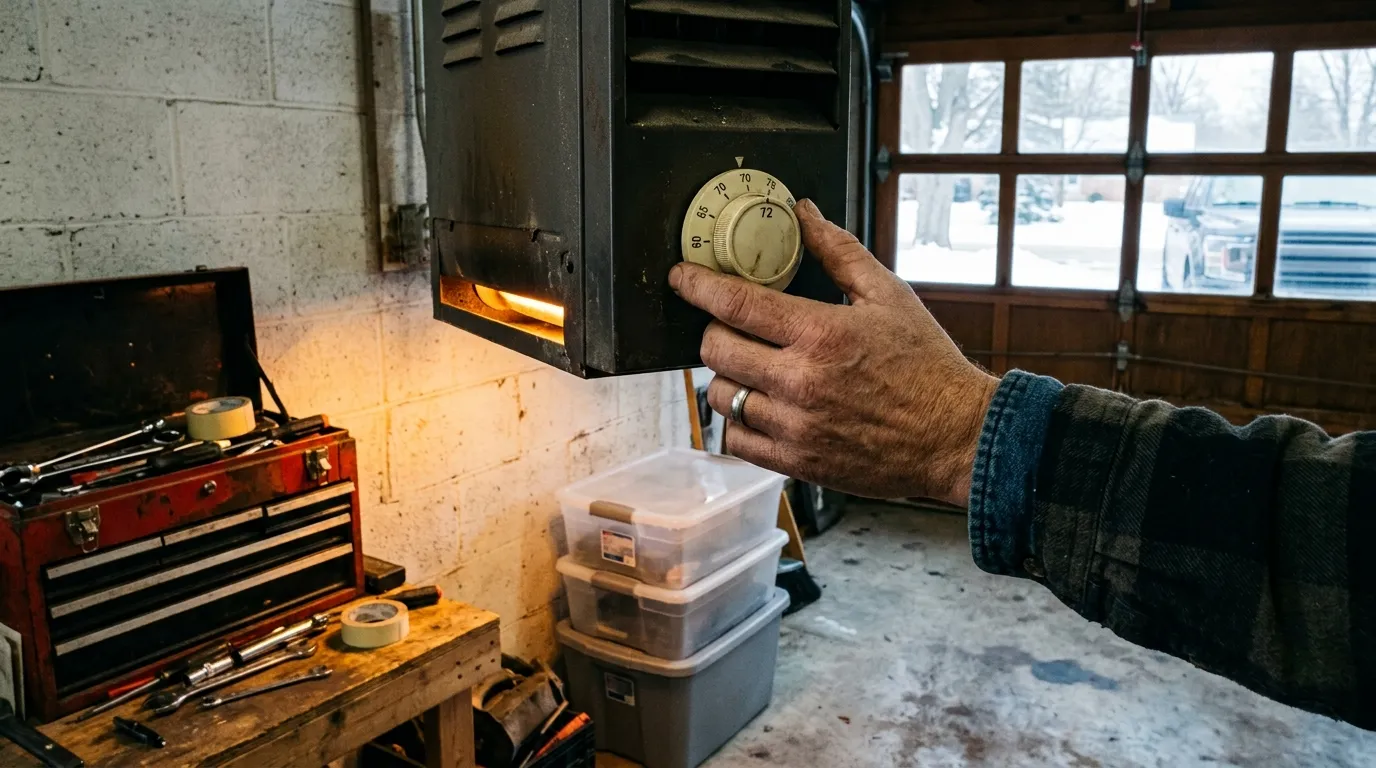
Garage heating is really a wiring-and-size decision before it is a brand decision, because a garage is the coldest, least-insulated part of most homes and its indoor climate depends entirely on how much heat you can legally get into it. If you have (or can add) a 240V circuit, a hardwired electric unit like the Comfort Zone below is the cleanest whole-garage answer. If your garage is very large or has no suitable circuit, a gas forced air unit heats more air for the money. And if you only need warmth at a bench, radiant or infrared spot heat is cheaper and simpler than heating the whole bay. Start by asking what power you have and how the garage is built — insulation, square footage and how cold your climate gets all shape the answer — then pick the category and size within it.
What types of garage heaters are there — electric, propane and infrared?
Garage heaters split into three main types: electric forced air units (240 volt, ceiling mount or portable), propane or gas forced air heaters for large unwired spaces, and infrared radiant heaters for spot warmth over a workbench. Each solves a different sizing and wiring problem.
Electric forced air heaters use a fan-forced blower to push heated air across the garage, and the better ones are built for ceiling mount installation to keep the floor and walls clear for parking and storage. Propane heaters use the same forced air principle but burn fuel instead of drawing 240 volt power, which is why they scale up to heat volumes an electric unit cannot reach. Infrared heaters skip moving air altogether — they warm a workshop bench or a single stall directly, which is efficient for zone heating but does nothing for the rest of a cold climate garage. Mr. Heater, Fahrenheat, Dr Infrared and Modine each specialize in a different one of these three approaches, which is worth knowing before you compare models by price alone. Whichever type you pick, insist on a real adjustable thermostat rather than a fixed-output switch — cycling on and off at a set temperature is what keeps a garage comfortable without running full blast the entire time you're out there.
How many watts or BTUs do I need to heat a garage?
As a rough guide, an insulated single-car garage is well served by a 5,000W (240V) electric unit, a two-car garage by 7,500W or more, and a large or poorly insulated garage by a gas unit in the 50,000 BTU range. A 120V plug-in heater warms a work zone, not the whole space.
Insulation changes these numbers more than anything else. A sealed, insulated garage holds heat and lets a smaller unit keep up; an uninsulated block garage with a leaky door will lose heat as fast as you make it, so err upward or add insulation first. The single most common regret owners report is buying a heater one size too small for a drafty garage.
How does insulation and square footage affect garage heater sizing?
Match heat output to your garage's square footage first, then adjust up if it is uninsulated or in a cold climate. An insulated, sealed one-car garage needs far less heat output than an open, drafty two-car garage of the same square footage — insulation matters as much as size.
A garage with bare studs, a single-pane window and a leaky door will lose heat as fast as a heater can produce it, so owners in a genuinely cold climate are usually better off adding insulation before or alongside buying a bigger unit. Mounting the heater near the ceiling, out of the way of a car or workbench, also helps heat output reach the floor evenly. As a rough rule, a well-insulated garage needs roughly 10 watts of electric heat output per square foot of square footage; an uninsulated one can need double that.
Do I need 240V, or will a regular outlet work?
A regular 120V outlet powers a spot or radiant heater up to 1,500 watts — enough for a bench, not a whole garage. Real whole-garage electric heat needs a 240 volt circuit, either hardwired or through a NEMA 14-50 outlet. That is the dividing line between a plug-in and an installed heater.
This is where budgets get real: the heater is often the cheap part, and the 240V circuit is the expense. If you already have a 240V outlet (from a welder or EV charger), a plug-in unit like the InoKraft skips the electrician. If not, factor wiring and mounting into the total cost before you compare sticker prices.
Is a gas or electric garage heater better?
Electric is simpler, needs no venting, and suits most insulated home garages; gas produces more heat per dollar of running cost and suits large or uninsulated spaces, but requires fuel, ventilation, and a more involved install. For a typical two-car garage with wiring, electric is the easier choice.
Gas forced air units like the Mr. Heater win on raw heat output and running cost in a big cold-climate garage, which is why they dominate commercial workshop use. Electric running cost is easy to estimate — multiply the wattage by hours run and your utility's per-kWh rate — while propane running cost depends on local fuel prices instead. For a home garage where safety and simplicity matter and the space is a reasonable size, most owners are happier with a hardwired electric unit. Our electric vs gas garage heater comparison breaks the decision down further.
Where should a garage heater be mounted?
Ceiling mount is the standard for any electric or gas forced air garage heater you plan to run regularly. It keeps the unit clear of a parked car, a workbench and anything flammable, and lets a fan-forced blower push heat down and across the whole floor.
Mounting height and angle matter for even coverage in a cold climate garage — too low and it warms a narrow band near the wall; too high or angled wrong and heat stacks at the ceiling instead of reaching where you actually stand. Follow the manufacturer's clearance specs to the letter, especially around a workshop bench or storage shelving, and never mount a fuel-burning heater in a space without the ventilation it calls for.
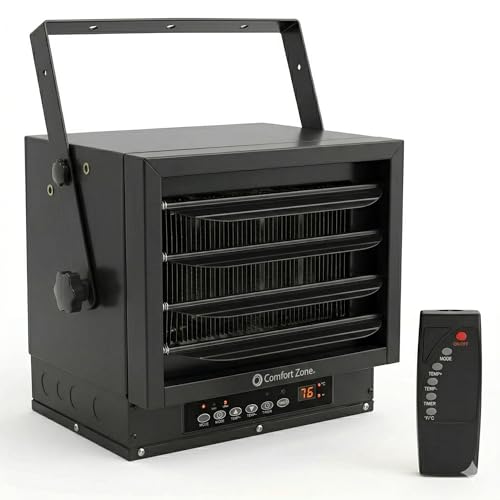
Best for a wired single- or two-car garage you want reliably warm
- Fan-forced 7,500W output on a 240V circuit
- Ceiling mount to keep the floor clear
- Digital thermostat with remote
- Overheat protection and thermal cut-out
Why buy it: Owners consistently report this is the sweet-spot Comfort Zone for a home garage — enough output to warm a two-car space, mounted overhead out of the way, and controllable by remote. A common note is that it needs a proper 240V circuit, so budget for an electrician if you do not already have one.

Best for a garage with a 240V outlet where you want no hardwiring
- 7500W output on 240V
- NEMA 14-50P plug — no hardwiring needed
- Adjustable thermostat
- Overheat safety protection
Why buy it: The plug is the whole appeal: owners with an existing 240V outlet (the kind used for a welder or EV charger) can run high-output heat without an electrician wiring it in. A common complaint is that many garages lack that outlet, so confirm you have a NEMA 14-50 receptacle first.

Best for a big or unwired garage that needs whole-space warmth
- 50,000 BTU forced-air output
- Runs on propane or natural gas
- Heats large volumes electric units cannot
- Requires venting and clearance
Why buy it: When the garage is too big for a plug-in, the consensus favors a gas forced-air unit — it warms the whole air volume rather than a work zone. Owners report strong output; the trade-offs are fuel, required ventilation, and a more involved install than an electric heater.

Best for a smaller wired garage on a tighter budget
- Fan-forced 5,000W output on 240V
- Three heat settings
- Ceiling mount, indoor rated
- Overheat protection
Why buy it: The 5,000W Comfort Zone is the value pick for a one-car garage that does not need the flagship output. Owners consistently report it warms a modest, insulated garage well; a common note is that it is underpowered for a large or drafty two-car space.

Best for a large workshop that needs maximum electric heat
- Fan-forced 10,000W output on 240V
- Full-function remote and digital control
- Ceiling mount to save floor space
- Overheat protection and thermal cut-out
Why buy it: This is the top of the Comfort Zone electric range, and owners with a large workshop report it delivers the whole-garage warmth the smaller units cannot. It demands a heavier 240V circuit, so the install cost is part of the decision.

Best for quick directed warmth over a bench without wiring a 240V line
- Radiant halogen heat, 1500W/750W settings
- Ceiling mount with 90-degree rotation
- Two units for covering two work areas
- Standard 120V operation
Why buy it: These are the pick when you want instant, directed warmth over a workbench rather than heating the whole garage. Owners like that they run on a normal outlet and aim where needed; a common complaint is that radiant heat only warms what it points at, so they suit spot use, not whole-room heating.
How we picked
We do not buy, test, or physically handle the heaters we cover. These rankings come from aggregated owner reviews, manufacturer specifications, and the recurring complaint patterns across garage-heater listings — the consensus view, not one reviewer's opinion. Each model links to its live Amazon listing so you can confirm the current price and read the reviews yourself. See How We Rank for the full methodology, the garage heaters hub for buying context, and the heating pillar for how garage heat fits your wider home climate.
One last note on running cost math: a 5,000-watt electric heater run for two hours a day burns roughly 10 kWh, so multiply that by your utility's rate to see what a season actually costs before you size up to the next wattage tier "just in case."