

Affiliate Disclosure
Some links on this page are affiliate links. As an Amazon Associate, we earn from qualifying purchases — at no extra cost to you. We do not buy, test, or physically handle the products we cover; our rankings come from aggregated owner reviews, ratings and expert consensus. Commissions never change our verdicts. How we rank & full disclosure.
Some links below are affiliate links. As an Amazon Associate we earn a commission from qualifying purchases at no extra cost to you — and it never changes which product we recommend or where it ranks.
Dr Infrared Heater and Fahrenheat sit on opposite sides of the biggest garage heater decision there is: plug-in and portable, or hard-wired and permanent. The Fahrenheat FLCH4R is a 240 volt, wall-mounted unit built for a garage that gets heavy year-round use. The Dr Infrared Heater DR-968 is a 1500W portable cabinet heater you plug into any outlet and roll wherever it's needed. The right pick has less to do with brand loyalty and more to do with whether you're willing to wire a 240 volt circuit or would rather avoid an electrician entirely.
| Product | Best for | Buy |
|---|---|---|
| Fahrenheat FLCH4R 4,800-Watt 240V Garage Heater | Best for a dedicated garage heater | Check Price (paid link) |
| Dr. Infrared Heater DR-968 Portable Cabinet Heater | Best for portable, no-install heat | Check Price (paid link) |
Which is a better fit — a 240 volt garage heater or a portable plug-in?
The Fahrenheat, by a clear margin, if your garage already has 240 volt service. At 4,800W on a dedicated circuit it puts out roughly three times the heat output of a standard 1500W portable like the Dr Infrared, so it recovers faster every time a big door opens.
Standard household outlets cap a plug-in electric heater at 1500W, which is why every portable unit — the Dr Infrared included — tops out around the same output no matter the brand. A hard-wired 240 volt unit like the FLCH4R sidesteps that ceiling entirely. Other shop-heater brands like Mr. Heater and Modine build similar 240 volt units for the same reason: a bigger circuit means bigger, faster heat.
Ceiling mount vs wall mounting
The Fahrenheat is built for ceiling mount or wall mounting, out of the way of parked cars and workbenches. Fixed mounting also keeps the unit clear of dust and away from anything flammable stored on the floor — a real safety plus in a workshop. The Dr Infrared skips mounting entirely; it sits on caster wheels and rolls wherever you need it.
Electric garage heater vs propane: which fuel makes sense here?
Both the Fahrenheat and the Dr Infrared are electric, and that's a deliberate choice for most attached garages. A propane heater burns fuel indoors and needs ventilation, which rules it out for a tightly sealed, attached garage where exhaust could reach the house.
Propane heaters do have a place — a detached, well-ventilated workshop with no electrical service nearby is a case where propane still wins on raw heat output per dollar of equipment. But for a typical attached garage, electric is simpler, safer, and avoids storing a fuel tank next to the car.
Forced air, fan-forced heat output — how much BTU do you actually need?
The Fahrenheat's forced air design pushes roughly 16,000 BTU across the garage, using a fan-forced motor to circulate warm air instead of just radiating it locally. The Dr Infrared blends infrared quartz elements with a smaller fan for a gentler, more localized 1500W of heat output, closer to 5,100 BTU.
For a one-car garage used occasionally, the portable's BTU output is often plenty. For a two-car garage that doubles as a workshop, or one with a big door letting cold air flood in, the Fahrenheat's extra forced air headroom is the difference between "warm enough" and "actually comfortable."
Sizing to square footage and insulation — how big is your garage?
Square footage and insulation both drive which unit makes sense. A small, well-insulated one-car garage holds heat from either unit; a large, uninsulated two-car space with a single-pane window and a thin garage door loses heat fast enough that only the higher-output Fahrenheat keeps up.
Insulation is the cheaper fix before buying a bigger heater. Weatherstripping the garage door and insulating an exposed ceiling can shrink the heater you actually need, sometimes enough that the portable 1500W unit becomes viable in a space that would otherwise demand a 240 volt install.
Which handles a cold climate workshop better?
In a genuinely cold climate — long winters, sustained below-freezing days — the Fahrenheat's forced air output holds a workshop at a stable working temperature far better than a portable heater cycling on and off. A 1500W unit struggles to keep pace once outdoor temperatures drop into the teens.
In a milder cold climate, or a garage used only for occasional projects, the Dr Infrared's radiant, zone heating approach — warming the bench and the person at it rather than the whole workshop — is often the more practical and cheaper choice.
Thermostat control: does either unit hold a set temperature?
Yes, both ship with a built-in thermostat. The Fahrenheat's thermostat cycles the forced air fan to hold a set workshop temperature all day. The Dr Infrared's thermostat does the same for its smaller heating zone, so neither unit runs at full output constantly once the space is warm.
Zone heating and running cost — which is cheaper over a winter?
Per hour, the Fahrenheat costs more to run simply because it draws more power. But it's also doing a bigger job across a bigger space, so the fairer comparison is running cost per degree of comfort, not cost per hour.
In a large garage, running a 1500W portable heater long enough to make a real difference can cost more in total than a shorter, higher-output run from the Fahrenheat, because the portable can't heat the space efficiently no matter how long it runs. In a small garage, the opposite is true — the Dr Infrared's zone heating keeps kWh use low by warming only where you're working, rather than the whole workshop.
What do owners complain about with each garage heater?
The recurring complaint about portable garage heaters like the DR-968 is that 1500W isn't enough for a large or poorly insulated garage — it takes the edge off rather than making the space genuinely warm. The recurring complaint about hard-wired units like the Fahrenheat is the upfront cost and hassle of running a 240 volt circuit and arranging the mounting.
Neither complaint points to a flaw in the specific product. Both are the predictable trade-off of the format. A portable heater can't outrun the 1500W outlet limit no matter how well it's engineered, and a hard-wired heater can't install itself.

Best for a garage that needs real, hard-wired output all winter
- 4,800W output on a 240V circuit
- Wall or ceiling mount, out of the way
- Built-in thermostat with remote control
- Fan-forced for fast recovery each time the door opens
Why buy it: The FLCH4R is the Fahrenheat owners point to when the garage is a real workspace, not an occasional warm-up spot. Mounted out of the way and wired to a dedicated 240V circuit, reviewers consistently say it recovers fast every time a big door opens and lets cold air in.
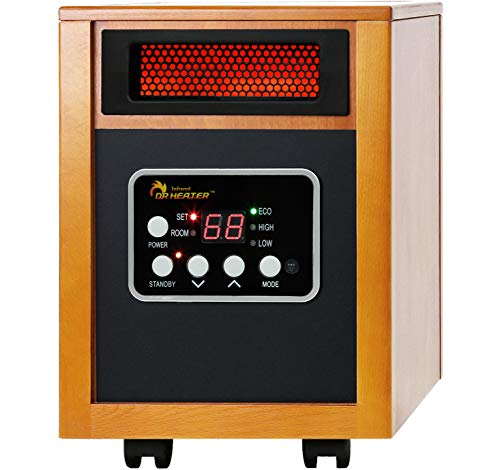
Best for a garage without a 240V circuit, or heat you want to move around
- 1500W dual heating system
- Infrared quartz plus a fan for room-wide reach
- Cabinet body on caster wheels
- Plugs into any standard 120V outlet
Why buy it: The DR-968 fills the role Dr. Infrared Heater is best known for: warmth you can roll into a garage, use for an evening, and roll back out — no electrician, no permanent mount. Owners consistently cite it as the easiest way to add real heat to a garage that was never wired for a dedicated unit.
The verdict
If your garage sees regular use through the cold months and you're willing to wire a 240 volt circuit, the Fahrenheat FLCH4R is the stronger long-term investment and the one owners with dedicated workshops recommend most. If you want real heat today with no installation — or your garage use is occasional — the Dr Infrared Heater DR-968 is the more practical buy. Both are well-regarded names in their respective formats, so neither is a gamble on quality; the decision comes down to how your garage gets used. We don't buy or physically handle these units; this comparison reflects aggregated owner reviews and published specifications. See the garage heaters hub, our best garage heaters roundup, and How We Rank for the methodology behind these calls.