



Affiliate Disclosure
Some links on this page are affiliate links. As an Amazon Associate, we earn from qualifying purchases — at no extra cost to you. We do not buy, test, or physically handle the products we cover; our rankings come from aggregated owner reviews, ratings and expert consensus. Commissions never change our verdicts. How we rank & full disclosure.
The garage is where portable heating advice falls apart. It's usually the least insulated space attached to the house, with a large uninsulated door and often no ceiling above the joists. A 1,500-watt plug-in heater carried out from a bedroom is roughly a tenth of the output the space actually needs. Getting this right starts with an honest measurement, not a product choice.
How Much Heat Does a Two-Car Garage Actually Need?
A typical two-car garage is 400 to 500 square feet. Contractor rules of thumb put an insulated garage at roughly 30 BTU per square foot, and an uninsulated one at 45 or more — landing a 450-square-foot space between 13,000 and 20,000 BTU per hour.
Compare that against what a household outlet can deliver. A 1,500-watt plug-in heater produces about 5,100 BTU per hour — a quarter to a third of the requirement for a cold two-car garage. This gap is the single most common disappointment in the category, and no amount of shopping around fixes it, because the limit is the outlet, not the heater.
BTU, heat output and square footage
Work out your required heat output from your garage's actual square footage and how many degrees of temperature rise you need on the coldest day you care about, not on an average. A garage in a mild climate needing a fifteen-degree rise is a manageable job. The same garage in a cold climate needing a forty-degree rise is a different specification entirely.
Electric, Propane or Infrared: Which Garage Heater Fits Your Power Supply?
A 120-volt plug-in tops out at 1,500 watts — enough to take the edge off a single bay. A hardwired 240 volt electric unit heater in the 4,000 to 7,500-watt range covers a real two-car garage. Propane unit heaters go further again, at the cost of venting.
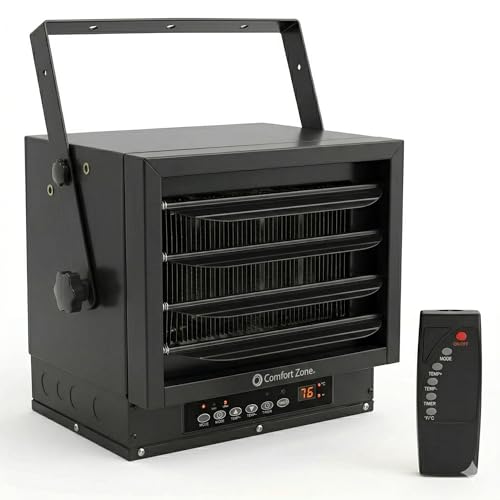
The 240-volt electric unit heater, built around forced air, is the standard answer for an attached garage in most of the country. Mr. Heater and Fahrenheat both build well-reviewed models in this class. It's clean, needs no fuel storage and produces no combustion products — but it does need a dedicated circuit sized for the load, which usually means an electrician and a panel with spare capacity.
240 volt, fan-forced and forced air heat
Where 240 volt service isn't available, propane forced-air garage heaters take over, and vented models are built to live permanently in a garage. There's also a real case for radiant: if you only need to be warm at the bench rather than heat the whole volume, a fan-forced or infrared heater from Dr Infrared aimed at the work area makes the space usable for a fraction of the output a full warm-up would need. Unvented portable propane is a temporary, supervised solution rather than an installation — covered on our propane heaters hub.
Does Insulation Matter More Than the Heater You Buy?
Often, yes. An uninsulated garage door is usually the largest single heat-loss surface in the space. Sealing the perimeter and adding insulation can cut the required heater output substantially, which changes what you need to buy, not just what you pay to run it.
Sizing a heater for a leaky garage means buying a bigger unit and a bigger circuit to feed it, then paying to push heat through the gaps for as long as you own the place. Sizing it after air-sealing means a smaller heater and lower running cost, permanently. Weatherstripping the door base, sealing the wall-to-slab gap, and insulating the door panels are the three highest-value moves in most garages.
Is It Safe to Run a Combustion Heater in a Closed Garage?
Only a heater specifically rated and installed for it. Garages hold gasoline and solvent vapours, which are heavier than air and pool at floor level — which is why fuel-burning appliances in garages have long been required to keep ignition sources well above the slab.
A floor-standing combustion heater in a space where someone has just filled a mower is a genuine ignition risk, however carefully the heater itself is built. Carbon monoxide is the other half of it: an attached garage shares air with the house more than most people assume, and a carbon monoxide alarm in both spaces is the minimum precaution.
What Do Garage Heater Owners in Cold Climates Complain About?
Undersizing, by a wide margin — the heater runs constantly and the space never gets warm. After that: 240-volt units arriving without the wiring the owner assumed, and thermostats that read the ceiling rather than the floor.
Modine and Dr Infrared unit heaters mounted near the ceiling have their built-in sensor sitting in the warmest air in the building, so they satisfy and shut down while the floor is still cold. Models that accept a remote wall thermostat solve this properly.
Thermostat placement and running cost
A remote wall thermostat placed at working height, rather than trusting the unit's built-in sensor near the ceiling, is the single fix owners describe as making the biggest difference. It cuts running cost too, because the heater stops chasing a warm reading at the ceiling and starts responding to the temperature you actually feel.
What Does a Garage Heater Cost to Run?
A 4,000-watt electric unit heater draws 4 kWh for every hour it runs at full output. Multiply that by your utility's rate per kWh, then by the hours you'll actually run it in a cold climate, to get a real monthly figure rather than a guess.
Propane and gas unit heaters are priced by BTU output rather than by the kWh, so comparing electric and propane running cost means converting both to a common unit — your fuel supplier or utility can usually do this for you. Either way, a well-insulated garage with a correctly sized heater on a working thermostat will always beat an undersized unit running flat out around the clock.
Garage Heater Mounting: Ceiling Mount and Zone Heating for the Workshop
High on a wall or from a ceiling mount, angled down toward the working area and clear of the vehicle door travel. Corner mounting at roughly 45 degrees is the usual arrangement, because it lets a single unit sweep the length of the space.
Height isn't optional for combustion units and is good practice for electric ones too — it keeps the heater out of reach of children and clear of anything stored on the floor. Zone heating the workshop area specifically, rather than trying to warm the whole garage volume evenly, is usually the more practical and cheaper goal. Aim the unit at the bench or the lift rather than down the middle of an empty bay, and leave the clearances the manual specifies before you drill.
Every guide below is ranked from aggregated real owner reviews and manufacturer documentation, never from us buying and running a heater ourselves — see How We Rank for the full methodology.


