


Affiliate Disclosure
Some links on this page are affiliate links. As an Amazon Associate, we earn from qualifying purchases — at no extra cost to you. We do not buy, test, or physically handle the products we cover; our rankings come from aggregated owner reviews, ratings and expert consensus. Commissions never change our verdicts. How we rank & full disclosure.
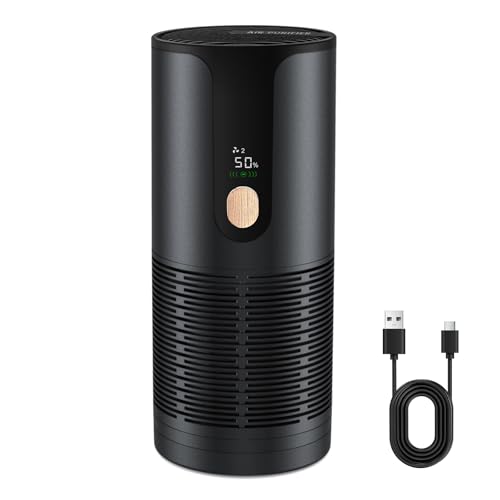
A car cabin is small, sealed and already has a ventilation system built in. That makes it an easy space to filter — and a place where a plug-in purifier is often solving a problem the car can solve more cheaply. This category has the widest gap between marketing and physical capability. The most useful thing a buyer can do is understand what a device the size of a coffee cup can actually move.
Do car air purifiers actually work — HEPA, activated carbon and airflow?
Small ones do very little. The ones that work have a real fan, a genuine HEPA filter with an activated carbon stage behind it, and enough airflow to turn over a cabin's air several times an hour. Passive plug-in devices with no meaningful fan are close to decorative, whatever the listing claims.
The physics is simple. A car cabin holds roughly 100 to 150 cubic feet of air. To clean it usefully, you need to move several times that volume every hour. That takes a fan with real capacity, not a token whisper. Devices that publish no airflow figure at all are almost always in the weak group — the missing number is itself informative.
A properly specified cabin unit earns its place on a long commute in heavy traffic, where you sit in the exhaust plume of the car ahead for an hour at a time. Continuous filtration of a small sealed volume favors filtration — the space is tiny, so even modest airflow produces high air-change rates.
Is your car's cabin filter more important than a portable car air purifier?
Usually, yes. Nearly every modern car has a replaceable cabin air filter that treats all incoming air, and many have never had it changed. A fresh high-quality cabin filter costs less than most portable purifiers and treats the air right where it enters.
This is the single most cost-effective step in the whole category, and the one most owners skip. A clogged cabin filter reduces ventilation airflow, adds musty smells, and lets more through than it should. Replacement intervals run roughly every 12,000 to 15,000 miles or once a year — sooner in dusty or high-pollen environments.
Cabin air quality and recirculate mode
Higher-grade cabin filters with an activated carbon layer address odor from traffic fumes in a way a basic particulate filter can't. Switching to recirculate mode in heavy traffic stops most outside air quality problems before they enter the cabin at all. Combining a good cabin filter with recirculate covers most of what a small plug-in purifier is being asked to do, and it costs less to maintain.
What should you avoid — ionizer, VOC claims and oversized cup holder units?
Ozone. A car cabin is the smallest enclosed space most people spend time in, and ozone-generating "ionizer" or "fresh air" devices can raise concentrations to irritant levels fast. Ozone is a lung irritant, not an air cleaner — a sealed cabin is the worst place to introduce it.
Marketing in this segment leans on words like ionizer, ozone, plasma and negative ion. Some ionizers produce ozone as a byproduct and disclose it only in fine print. If a device's main mechanism is anything other than pushing air through a physical filter, treat its claims skeptically — especially in a space this small. The broader safety picture is covered in UV and ozone air purifiers.
Cup holder devices with no filter to replace are the other pattern worth avoiding. A purifier that never needs a new filter is either not capturing much, or quietly losing effectiveness as its media loads. Filtration is consumable by nature — a device that pretends otherwise is telling you something about how much work it's actually doing.
PM2.5, allergens and vague performance claims
Listings in this segment often quantify nothing at all — no airflow figure, no filter rating, no PM2.5 reduction number, no cabin size the device is built for. A manufacturer that has built something capable usually publishes numbers, because numbers are the argument. Pollen and other large allergens are the easiest particles to capture; a device that won't state a PM2.5 result is telling you it hasn't been tested against the harder target.
What can a car air purifier do about cigarette smoke and odor?
It can reduce ambient odor if it carries a real activated carbon stage. It can't remove a smell whose source is still in the car. Spilled milk under a seat, cigarette smoke residue in the headliner, or damp carpet will keep producing odor faster than a small carbon filter can adsorb it.
Carbon works by adsorption onto a finite surface area, and the carbon quantity in a cabin-sized device is small by definition. That capacity fills quickly in a car with an active odor source. After that, the unit passes the smell straight through with no warning — filter indicators, where they exist, are usually timers rather than sensors.
Cigarette smoke deserves a specific caution. It settles into upholstery, headliner and vents, and off-gasses back into the cabin for a long time afterward. A purifier holds the airborne load down and takes the edge off, but a car that has absorbed years of smoke needs cleaning, not filtering. The same principle applies at home, which is why air purifiers for smoke puts source removal ahead of filtration.
How do you power a car air purifier — USB, 12V or dashboard mount?
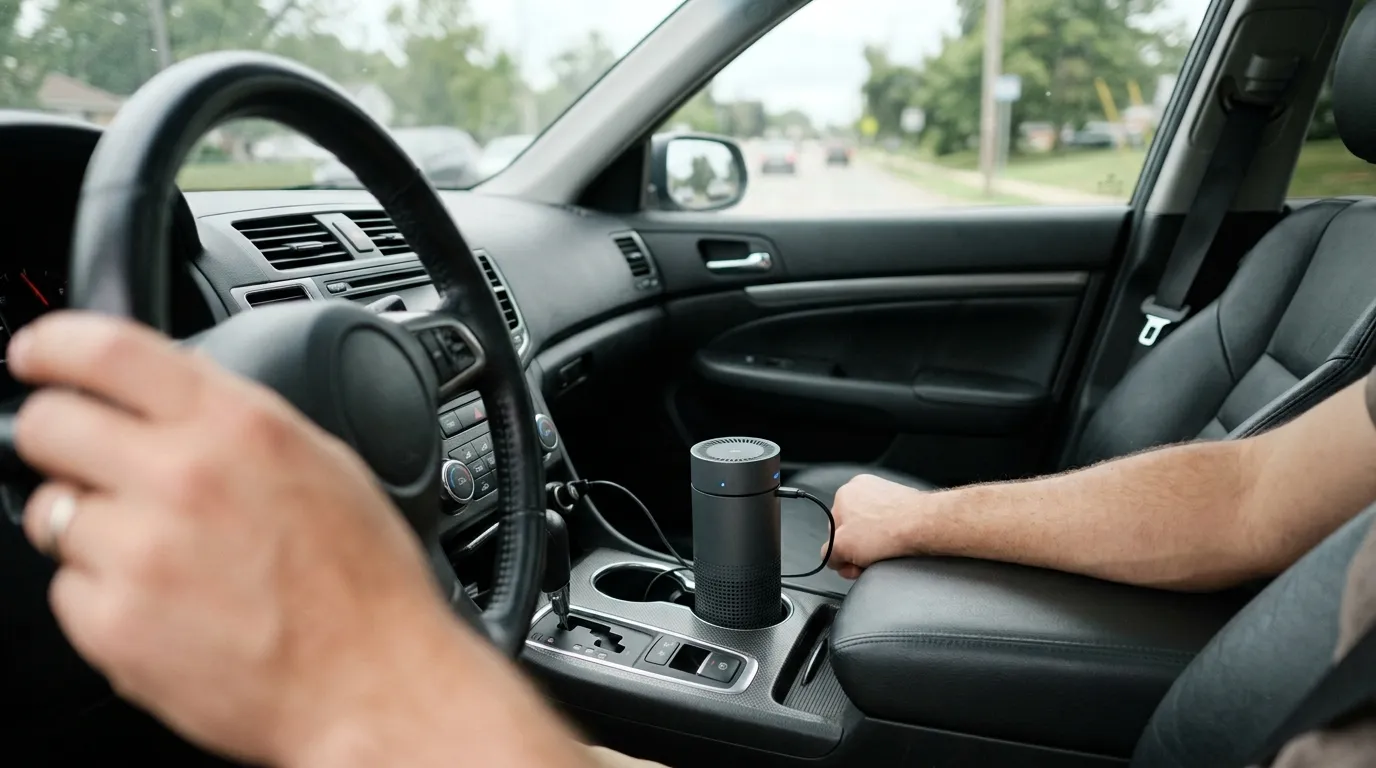
Hardwired to a 12V socket or USB port, positioned where airflow isn't blocked, and secured so it can't become a projectile. Battery-only units that need regular recharging tend to sit unused, which makes even a well-specified one worthless.
USB power is convenient because most cars already have a port near the dashboard, but check the current rating — a purifier drawing more than a basic USB port can supply will underperform or refuse to run at full fan speed. A dedicated 12V socket usually delivers more headroom for a real fan.
Compact, cup holder and headrest placement
Placement follows the same logic as a room purifier: intake and exhaust need clearance. A compact device wedged in a cup holder, boxed in between a console and a seat, is drawing from a stagnant pocket. Headrest-mounted and dashboard-mounted positions generally circulate better, because they sit in the path the car's own ventilation is already moving air along.
The safety point is worth stating plainly. Anything loose in a cabin is a hazard in a collision, so a unit with a proper mount, strap or non-slip base isn't a luxury feature. For the general principles that apply to filtration at any scale, the air purifiers hub is the wider starting point.
Does a car air purifier help with pollen, VOC and filter replacement costs?
For pollen, yes — it's a large particle and easily captured, and a sealed cabin on recirculate is already a favorable environment. For VOC and traffic pollution the picture is mixed: fine particulate is filterable, but the gaseous VOC component needs activated carbon, and most cabin units carry very little.
Pollen is the strongest case in this category. Allergy sufferers who drive with the windows down in spring are effectively sitting in an outdoor air stream. Simply closing the windows and switching to recirculate removes most of that exposure before any device is involved. Adding filtration on top keeps the small remaining load down over a long commute.
Traffic exhaust is harder. Stop-start traffic exposes a cabin to fine particulate from the vehicle ahead, plus nitrogen dioxide and VOCs, and only the particulate half is addressed by a filter. Recirculate mode is again the most effective single response, since it stops drawing the plume in rather than cleaning it afterward. A carbon-equipped cabin filter handles more of the gaseous fraction than any cup-holder-sized device, and needs filter replacement on the same 12,000 to 15,000 mile schedule as the rest of the cabin system.
Brands such as LEVOIT and Philips build the better-specified plug-in units, with real HEPA and carbon stages and published airflow figures. Pure Enrichment and FRiEQ compete mostly on price and compact size, so check the fan and filter specs closely before buying at that end of the market. EPA guidance on PM2.5 is the reference point most of these performance claims should be measured against, and it's a useful check before trusting a listing's numbers.
Every recommendation in this category comes from aggregated real owner reviews and published manufacturer specifications, never from buying and running units ourselves — see How We Rank for the full methodology.